Thigh lift surgery in Kolkata, also known as thighplasty, is a specialised body-contouring procedure designed to improve the shape and appearance of the thighs by removing excess skin and, when appropriate, reducing localised fatty tissue. Loose or sagging skin may develop after significant weight loss, ageing or changes in skin elasticity and can sometimes cause discomfort or difficulty with clothing and physical activity. A personalised thigh lift can help create a smoother, firmer and more proportionate thigh contour. Liposuction, when appropriate, addresses localised fat deposits. Some patients may benefit from one procedure, while others may require a combination of thighplasty and liposuction.
Thigh Lift Techniques for Different Patterns of Skin Laxity
Thigh lift surgery, or thighplasty, is not performed using a single incision pattern for every patient. The appropriate technique depends on the location and extent of excess skin, skin elasticity, fat distribution, previous weight loss and the overall body contour. Careful preoperative assessment helps determine how much tissue needs to be removed and where the resulting scars can be positioned.
Inner or Medial Thigh Lift
An inner thigh lift, also known as a medial thigh lift, is commonly considered when excess skin and laxity are predominantly present along the upper and inner aspect of the thighs. The incision pattern is planned according to the degree of skin excess and the desired correction.
In selected patients, liposuction may be combined with an inner thigh lift when localised fat deposits are also present. Liposuction and thighplasty address different problems: liposuction reduces selected areas of fat, whereas a thigh lift removes excess skin and improves skin laxity.
Vertical Thigh Lift
A vertical thigh lift may be appropriate when excess skin extends further down the inner thigh and cannot be adequately corrected through an incision limited to the groin region. This technique allows removal of a greater vertical segment of redundant skin.
Because the incision is more extensive, patients considering a vertical thigh lift should understand that it involves a longer scar and potentially a more extensive recovery than a limited inner thigh lift.
Extended Thigh Lift
An extended thigh lift may be considered when excess skin extends beyond the upper inner thigh toward the lateral thigh or hip region, particularly in some patients following substantial weight loss.
The incision is extended according to the distribution of redundant tissue, allowing a broader area of skin laxity to be addressed. The exact extent of an extended thigh lift is individualised rather than following a fixed pattern.
Thigh Lift After Major Weight Loss
Patients who have lost a substantial amount of weight may develop significant redundant skin around the thighs. In these situations, the distribution of loose skin can be more extensive and may require a carefully planned body-contouring procedure.
Thighplasty may be performed as an isolated procedure or, where appropriate, as part of a staged body-contouring plan. The timing and extent of surgery depend on weight stability, skin quality, overall health and the patient’s individual pattern of excess tissue.
Thigh Lift With Liposuction
Some patients have a combination of excess skin and localised thigh fat. When clinically appropriate, liposuction can be incorporated into the surgical plan to improve contour while the thigh lift addresses redundant skin.
However, liposuction is not a substitute for removing significant excess skin. Conversely, a thigh lift may not be necessary when the principal concern is localised fat with good skin elasticity. The decision between liposuction, thighplasty or a combination of both should therefore be based on individual examination.
Choosing the Appropriate Thigh Lift Technique
The choice of technique is determined during consultation after assessing the amount and location of skin laxity, skin elasticity, fat distribution, body proportions and previous weight changes. The objective is to achieve meaningful improvement in thigh contour while avoiding unnecessary removal of tissue and explaining the expected scar pattern and recovery requirements.
A personalised approach is particularly important after major weight loss, when the pattern of redundant skin can vary considerably between patients.
Who May Benefit from a Thigh Lift?
Patients with significant loose skin on the thighs, particularly following substantial weight loss, may benefit from thigh lift surgery. Some patients may also develop skin laxity due to ageing or changes in body weight. A thigh lift may be considered when excess skin remains despite maintaining a stable weight and healthy lifestyle. During consultation, the surgeon evaluates skin quality, tissue distribution, thigh contour and overall body proportions to determine the most suitable approach.
Natural-Looking Thigh Contouring
The objective of thighplasty in Kolkata is to create a smoother and more harmonious thigh contour rather than simply removing as much skin as possible. Careful planning of the incision and tissue removal is important for achieving an aesthetically balanced result while considering scar placement and healing. Patients should have realistic expectations about postoperative scars, swelling and the time required for the final contour to develop.
Thigh Lift by Prof. (Dr.) Souvik Adhikari
Prof. (Dr.) Souvik Adhikari brings 17+ years of surgical experience to cosmetic, plastic and reconstructive surgery, with additional AOCMF Fellowship training at Johns Hopkins University, USA. His approach to thigh lift surgery in Kolkata focuses on individualised assessment, meticulous surgical planning, patient safety and proportionate body contouring. You can read more about him here and about his academic achievements here.
Thigh Lift Recovery and Consultation
Recovery following thighplasty in Kolkata varies according to the extent and type of surgery and whether liposuction or another body-contouring procedure is performed at the same time. Patients receive personalised postoperative guidance regarding wound care, compression garments, mobility, physical activity and follow-up. During consultation, the expected results, incision placement, potential scarring, recovery period and possible complications are discussed carefully.
If you are considering thigh lift surgery in Kolkata, a consultation with an experienced plastic surgeon can help determine whether thighplasty is appropriate for your individual concerns. The goal is to achieve firmer, smoother and naturally proportioned thighs while developing a treatment plan based on your anatomy, expectations and overall body contour.
Personalised Planning for Thigh Lift Surgery
Thigh lift surgery is not a single standard procedure. The surgical approach depends on the amount and location of excess skin, skin elasticity, fat distribution, previous weight loss, body proportions and the patient’s expectations. Prof. (Dr.) Souvik Adhikari evaluates these factors during consultation before recommending the most appropriate form of thighplasty.
Who May Be Considered for a Thigh Lift?
A thigh lift may be considered for adults who have significant loose or sagging skin of the thighs, particularly after substantial weight loss. Some patients develop thigh skin laxity with ageing or changes in body weight.
Patients should ideally have a relatively stable weight, realistic expectations and adequate general health for elective surgery. Smoking, medical conditions, medications and factors that may affect wound healing are also considered during preoperative assessment.
What Can a Thigh Lift Improve?
The principal aim of thighplasty is to remove appropriately selected excess skin and improve the contour of the thighs. Depending on the individual anatomy, surgery may help:
Reduce significant skin laxity and sagging
Improve the contour of the inner or other affected areas of the thigh
Reduce skin-on-skin friction and chafing in selected patients
Improve the fit of clothing where excess tissue is contributing to difficulty
Create a more proportionate transition between the thighs and surrounding body contours
A thigh lift is a body-contouring procedure rather than a weight-loss operation.
Inner or Medial Thigh Lift
An inner thigh lift, also called a medial thigh lift, is designed primarily for excess skin and laxity along the inner thigh. The incision pattern varies according to the amount and location of excess tissue.
In selected patients, an inner thigh lift may be combined with liposuction when there are localised fat deposits that also require contouring. Liposuction alone, however, may not adequately address significant loose skin.
Vertical Thigh Lift
A vertical thigh lift may be considered when excess skin extends more extensively down the inner thigh and cannot be adequately addressed through a shorter incision pattern.
The location and length of the incision are determined by the distribution of excess skin. A more extensive procedure may provide greater correction in appropriately selected patients but also involves more extensive scars and recovery.
Thigh Lift After Major Weight Loss
Significant weight loss can leave redundant skin around the thighs even when a patient has reached a healthy and relatively stable weight. Exercise can improve muscle tone but cannot remove substantial excess skin.
For appropriately selected patients, thighplasty can remove this redundant tissue and improve the contour of the lower body. The timing and extent of surgery should be individualised according to weight stability, skin quality, general health and the patient’s overall body-contouring plan.
Thigh Lift With Liposuction
Some patients have both excess skin and localised fat deposits. In these situations, liposuction may be combined with thighplasty to improve contour.
The two procedures address different problems: liposuction reduces selected areas of subcutaneous fat, while thighplasty removes excess skin and addresses skin laxity. The combination is not necessary for every patient and is decided after clinical assessment.
Thigh Lift Versus Liposuction
Liposuction is primarily a fat-reduction procedure and works best when the skin has sufficient elasticity to contract around the new contour. It does not remove substantial excess skin.
A thigh lift is primarily used when skin laxity and redundant skin are significant. Some patients therefore require a thigh lift, some may benefit from liposuction alone, and others may require a combination of both.
Thigh Lift and Body Contouring After Weight Loss
Patients who have undergone major weight loss may have excess skin affecting several areas, including the abdomen, thighs, buttocks and arms. In such cases, thighplasty may form part of a broader staged body-contouring plan.
Combining multiple procedures requires careful consideration of the patient’s health, anatomy, operative extent and recovery requirements. The safest approach is determined individually rather than by using a fixed combination of procedures.
Anaesthesia
The type of anaesthesia depends on the extent of thighplasty and the patient’s overall health and surgical plan. Anaesthetic planning is undertaken after appropriate preoperative assessment and discussion with the anaesthesia team.
Duration of Thigh Lift Surgery
The duration of surgery varies according to the type and extent of thigh lift, the amount of tissue being treated and whether liposuction or another procedure is performed at the same time. An individual operative estimate is provided after assessment rather than using a fixed duration for every patient.
Recovery After Thigh Lift Surgery
Recovery varies considerably between patients and depends on the extent of surgery and the technique used. Swelling, bruising, tightness and discomfort are expected during the early postoperative period.
Postoperative instructions may include wound care, compression garments, activity modification, prescribed medication and scheduled follow-up. Activities that place excessive tension, friction or movement across the incisions may need to be restricted while the wounds heal.
Return to work, walking, exercise and other normal activities is determined individually during follow-up rather than according to a fixed timetable.
Scars After Thigh Lift Surgery
Scarring is an unavoidable part of thigh lift surgery. The position and length of the scars depend on the technique, the amount of skin removed and the distribution of excess tissue.
Incisions are planned carefully to balance the required correction with scar placement, but patients should understand that thigh lift scars may remain visible. Scars generally mature gradually over time and their final appearance varies between individuals.
Risks and Possible Complications
Like any major surgical procedure, thighplasty carries potential risks. These may include bleeding, infection, seroma or fluid collection, delayed wound healing, wound separation, changes in skin sensation, asymmetry, persistent swelling, recurrent skin laxity, unfavourable scarring and the possibility of revision surgery.
More serious complications such as venous thromboembolism and anaesthetic or cardiopulmonary complications are uncommon but important considerations. Individual risk depends on the patient’s health, the extent of surgery and whether additional procedures are performed.
These risks and the measures used to reduce them are discussed during consultation and informed consent.
Expected Results After Thighplasty
Thigh lift surgery can provide a significant improvement in the contour and appearance of appropriately selected patients. Early postoperative swelling can temporarily obscure the result, and the contour continues to settle as healing progresses.
The improvement can be long-lasting, although ageing, significant weight changes and changes in skin elasticity can affect the result over time. Maintaining a relatively stable weight and following postoperative advice can help preserve the improvement.
Why Choose Prof. (Dr.) Souvik Adhikari for Thigh Lift Surgery?
Prof. (Dr.) Souvik Adhikari is a Professor & Consultant Plastic Surgeon with 17+ years of independent surgical experience in cosmetic, plastic and reconstructive surgery. His approach to thighplasty is based on individual assessment, careful planning, appropriate technique selection and realistic discussion of scars, recovery, risks and expected outcomes.
Each thigh lift plan is developed according to the patient’s anatomy rather than applying a standard procedure to every patient.
Consultation for Thigh Lift in Kolkata
A consultation is the first step in determining whether thigh lift surgery is appropriate for you. The assessment includes the distribution of excess skin and fat, skin quality, body proportions, previous weight changes, general health and your specific concerns.
If thighplasty is appropriate, the proposed technique, incision pattern, expected improvement, recovery requirements, possible combination with liposuction and potential risks can be discussed in detail before a decision is made.

Prof. (Dr.) Souvik Adhikari
MS, MCh (Plastic Surgery)
17+ years experience
Thigh Lift vs Liposuction
Thigh lift surgery and liposuction are both used for thigh contouring, but they address different concerns. Choosing between the two depends mainly on whether the patient’s predominant problem is excess fat, loose skin, or a combination of both.
When Liposuction May Be More Appropriate
Liposuction is primarily a fat-reduction procedure. It may be suitable for patients who have localised fat deposits around the thighs but retain relatively good skin elasticity. By removing selected areas of subcutaneous fat, liposuction can improve the contour and proportion of the thighs without removing skin.
However, liposuction does not remove substantial amounts of loose or redundant skin. If the skin has limited ability to contract after fat removal, liposuction alone may not provide the desired contour.
When a Thigh Lift May Be More Appropriate
A thigh lift, or thighplasty, is primarily designed to address significant skin laxity and excess skin. It may be considered when the thighs have become loose or sagging, particularly after major weight loss, ageing or substantial changes in body weight.
The procedure involves removing appropriately selected redundant skin and reshaping the thigh contour. Because skin removal is involved, a thigh lift inevitably results in scars, and the position and extent of these scars depend on the technique required.
When Thigh Lift and Liposuction Are Combined
Some patients have both localised excess fat and significant skin laxity. In appropriately selected cases, liposuction may be combined with a thigh lift to address both components of the contour.
The procedures have complementary roles: liposuction reduces selected fat deposits, while thighplasty removes excess skin and addresses skin laxity. Combining the procedures is not necessary for every patient and depends on individual anatomy, skin quality and the extent of correction required.
Which Procedure Is Right for You?
The choice between liposuction and thigh lift surgery should be based on an individual clinical assessment rather than simply on the amount of tissue present. The condition of the skin, its elasticity, the distribution of fat and excess skin, previous weight loss and the patient’s overall body proportions all influence the surgical plan.
In general:
- Localised thigh fat + good skin elasticity: liposuction may be sufficient.
- Significant loose or sagging skin: thigh lift may be more appropriate.
- Excess skin + localised fat: a combination of thigh lift and liposuction may be considered.
- Extensive excess skin after major weight loss: thighplasty or a broader staged body-contouring procedure may be appropriate.
During consultation, the most suitable approach can be discussed along with the expected improvement, scar pattern, recovery and potential risks.
Thigh Lift After Major Weight Loss
Significant weight loss can produce a major improvement in overall health and body shape, but it may also leave loose, redundant skin around the thighs. When the skin has been stretched considerably, exercise and further weight loss may not be able to remove this excess tissue. A thigh lift, or thighplasty, may be considered for appropriately selected patients who have persistent skin laxity after achieving substantial weight loss.
Why Does Loose Skin Develop After Weight Loss?
When the body gains a significant amount of weight, the skin stretches to accommodate the increased volume. After substantial weight reduction, the skin may not completely contract because of factors such as the degree and duration of weight gain, age, skin elasticity and individual tissue characteristics.
The resulting redundant skin may be particularly noticeable along the inner thighs and can sometimes extend toward the outer thigh or hip region.
Who May Consider a Thigh Lift After Weight Loss?
Thighplasty may be considered when a patient has:
- Significant excess or sagging skin of the thighs
- Persistent skin laxity despite achieving a relatively stable weight
- Difficulty with clothing because of redundant tissue
- Skin-on-skin friction or chafing in the inner thighs
- Realistic expectations regarding improvement and scarring
- Adequate general health for elective body-contouring surgery
A relatively stable weight is generally preferable before body-contouring surgery because further substantial weight loss may alter the result.
Thigh Lift After Bariatric Surgery
Patients who have undergone bariatric surgery and subsequently experienced substantial weight loss may develop excess skin involving several areas of the body, including the abdomen, arms, thighs and buttocks.
A thigh lift can address the thigh component of this excess skin. Depending on the patient’s anatomy and overall body-contouring needs, thighplasty may be performed as an isolated procedure or incorporated into a staged body-contouring plan.
The timing and sequence of procedures should be individualised according to weight stability, nutritional and general health, the distribution of excess skin and the extent of surgery required.
Thigh Lift With Liposuction After Weight Loss
Post-weight-loss patients may have both redundant skin and localised areas of residual fat. In selected patients, liposuction may be combined with thighplasty to improve the overall contour.
These procedures have different purposes. Liposuction targets selected fat deposits, whereas a thigh lift removes excess skin and addresses significant skin laxity. Not every post-weight-loss patient requires both procedures.
What Can a Thigh Lift Achieve After Weight Loss?
The objective of post-weight-loss thighplasty is to create a smoother and more proportionate thigh contour by removing appropriately selected redundant skin and reshaping the remaining tissues.
Patients should understand that the procedure is designed to improve contour rather than produce further weight loss. It also cannot restore the skin to its pre-weight-gain condition, and the final result depends on factors such as skin quality, tissue characteristics, healing and future changes in body weight.
Scarring and Expectations
Scarring is an inherent part of thigh lift surgery. The location and extent of the scars depend on the amount and distribution of excess skin and the technique required. Patients who have undergone major weight loss should therefore consider both the potential improvement in contour and the trade-off of surgical scars.
A detailed consultation allows the proposed incision pattern, expected improvement, limitations, recovery and potential risks to be discussed before surgery.
Gallery
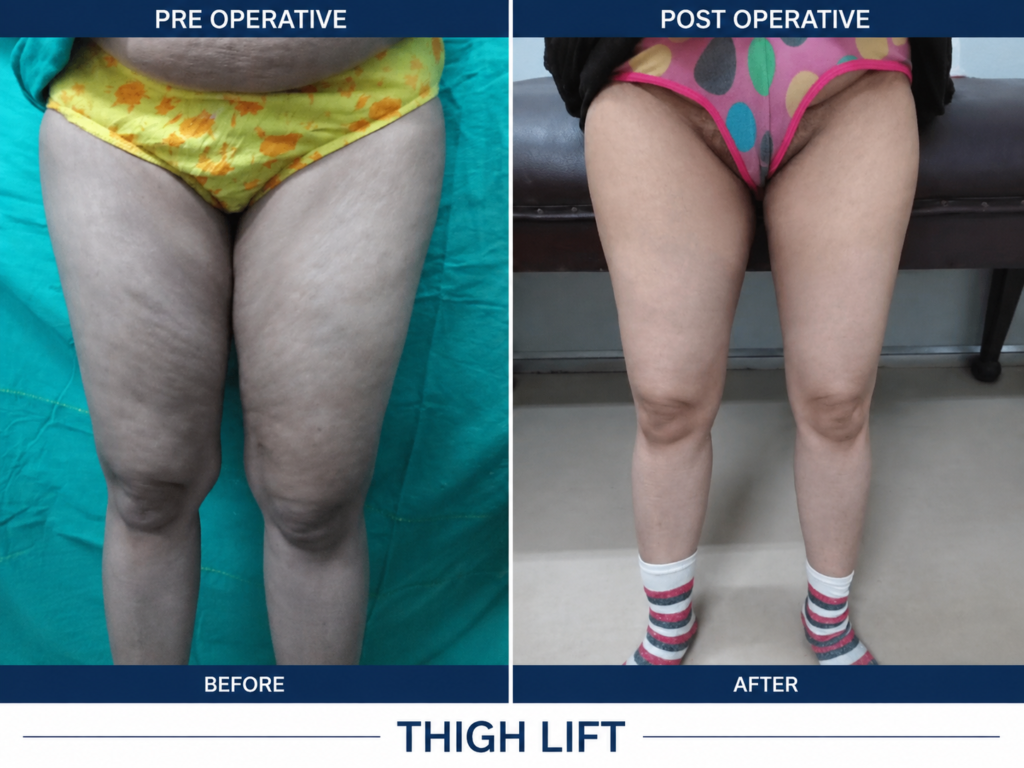
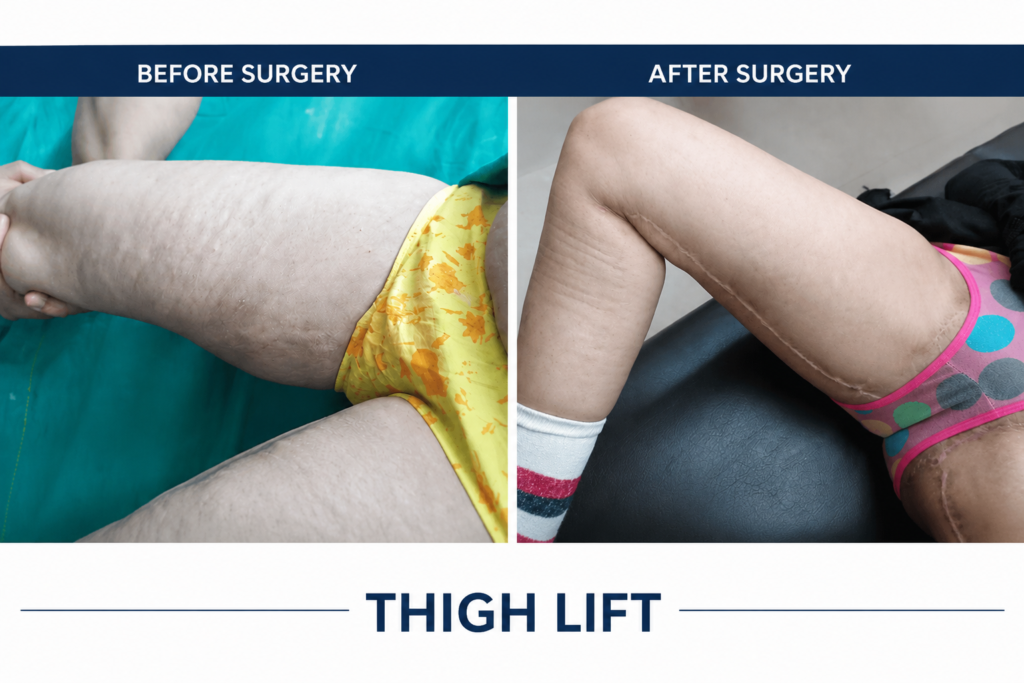
Consented before-and-after photographs for thigh lift surgery are reviewed privately during consultation, in line with medical advertising guidelines.
Frequently Asked Questions
What is thigh lift surgery?
Thigh lift surgery, also called thighplasty, is a body-contouring procedure that removes excess skin and, in selected patients, addresses excess fat to improve the shape and contour of the thighs. It is particularly useful when loose skin remains after significant weight loss or when skin laxity cannot be adequately improved through exercise and weight management alone.
Who is a good candidate for thigh lift surgery?
A thigh lift may be considered for adults with significant loose or sagging skin of the thighs, particularly after substantial weight loss. Good candidates generally have relatively stable weight, realistic expectations and sufficient overall health for elective surgery. Smoking and medical conditions that may impair healing are also considered during assessment.
Can a thigh lift remove excess skin after weight loss?
Yes. Thigh lift surgery is particularly useful for patients who have developed significant loose skin after major weight loss. When skin elasticity is poor, removing the excess skin surgically may provide a contour improvement that cannot be achieved through exercise or liposuction alone.
What types of thigh lift surgery are available?
The appropriate technique depends on where the excess skin is located and how much tissue needs to be removed. Options may include inner or medial thigh lift, vertical thigh lift, outer thigh lift and more extensive thigh-contouring procedures. The incision pattern and extent of surgery are individualised according to the patient's anatomy and goals.
What is an inner thigh lift?
An inner thigh lift, or medial thigh lift, primarily addresses excess skin and contour irregularities along the inner thigh. It may be considered when loose skin causes rubbing, irritation or dissatisfaction with the appearance of the inner thighs.
Can thigh lift surgery be combined with liposuction?
Yes. Liposuction may be combined with a thigh lift in selected patients who have both excess skin and localised fat deposits. Liposuction addresses subcutaneous fat, whereas the thigh lift removes excess skin and tightens the contour. The combination is not necessary for everyone and depends on skin elasticity and the distribution of fat and loose tissue.
Is liposuction alone enough to treat sagging thighs?
Not always. Liposuction can reduce localised fat but does not remove significant excess skin. When the skin has poor elasticity and remains loose after fat reduction, a thigh lift may be required to achieve a more satisfactory contour.
Can thigh lift surgery help with chafing between the thighs?
It can. Excess skin and tissue on the inner thighs may cause friction, chafing, irritation and difficulty with clothing. Removing appropriately selected excess tissue may reduce these problems while improving thigh contour.
Does a thigh lift remove cellulite?
A thigh lift is not primarily a cellulite treatment. It can improve the overall contour and remove excess skin, which may change the appearance of the thighs, but cellulite may persist after surgery.
Will a thigh lift make my thighs slimmer?
A thigh lift is primarily a contouring and skin-tightening procedure, rather than a weight-loss operation. It can improve the shape and proportion of the thighs by removing excess skin and, when appropriate, combining the procedure with liposuction.
Can a thigh lift be performed after major weight loss?
Yes. Patients who have undergone substantial weight loss may develop significant excess skin around the thighs. Thighplasty can remove this redundant skin and improve lower-body contour, provided the patient's weight is reasonably stable and they are medically suitable for surgery.
Is a thigh lift suitable for loose skin after bariatric surgery?
Yes. Patients who have undergone bariatric surgery or substantial weight loss may develop significant redundant skin around the thighs. A thigh lift may be considered once weight has stabilised and the patient is medically suitable for elective body-contouring surgery. The extent and timing of surgery depend on the amount of excess skin, skin quality, overall health and whether other areas of the body also require contouring.
What happens to the scars after thigh lift surgery?
Thigh lift surgery requires incisions and therefore scars are unavoidable. Their location and length depend on the technique and amount of skin removed. Incisions are planned as carefully as possible, but scars may remain visible and can take many months to mature.
How long does it take to recover from thigh lift surgery?
Recovery varies according to the type and extent of thigh lift and whether liposuction or another procedure is performed at the same time. Early recovery may involve swelling, bruising, tightness and discomfort. Strenuous exercise and activities that place tension on the incisions should be avoided until adequate healing has occurred. Your individual return-to-work and exercise schedule should be determined during follow-up.
When can I return to work after a thigh lift?
The timing depends on the extent of surgery and the nature of your work. Patients with desk-based work may return progressively after the initial recovery period, while jobs involving prolonged standing, walking, lifting or physical activity may require more time. There should not be a fixed return-to-work promise for every patient.
How long do the results of a thigh lift last?
A thigh lift can provide long-lasting improvement in thigh contour, but it does not stop the normal ageing process. Significant weight gain or loss and changes in skin elasticity over time can affect the result. Maintaining a relatively stable weight can help preserve the improvement.
Is thigh lift surgery painful?
Some discomfort, tightness, swelling and tenderness are expected after surgery. The intensity varies according to the extent of the procedure and individual healing. Pain medication and postoperative instructions are provided according to the patient's needs, and discomfort generally improves as recovery progresses.
What are the risks of thigh lift surgery?
Potential complications include bleeding, infection, seroma, delayed or poor wound healing, wound separation, changes in skin sensation, asymmetry, unfavourable scarring, persistent swelling, recurrent skin laxity, blood clots and the possibility of revision surgery. The specific risks depend on the procedure and the patient's health.
Can thigh lift surgery correct loose skin on both the inner and outer thighs?
In selected patients, more extensive thigh-contouring surgery may address multiple areas of skin laxity. However, the appropriate procedure depends on the distribution of excess skin and the patient's overall body proportions. A consultation is necessary to determine whether one procedure or a staged approach would be more appropriate.
Can a thigh lift be combined with a lower body lift?
In selected patients, thigh lift surgery may be performed as part of a broader body-contouring plan following major weight loss. However, combining procedures increases the extent of surgery and must be considered carefully based on the patient's health, anatomy and surgical requirements.
Is thigh lift surgery suitable for men?
Yes. Men with significant thigh skin laxity or excess tissue may also be candidates for thigh lift surgery. The surgical plan is adapted to male anatomy, skin distribution and individual body-contouring goals.
Can thigh lift surgery improve the appearance of stretch marks?
A thigh lift may remove some skin containing stretch marks, particularly when those marks are located within the tissue being excised. However, a thigh lift is not a dedicated treatment for stretch marks, and stretch marks remaining on the thighs will not necessarily disappear.
Is thigh lift surgery a weight-loss procedure?
No. Thigh lift surgery is a body-contouring procedure, not a treatment for obesity or a substitute for weight loss. It is designed primarily to remove excess skin and improve the contour of the thighs after weight stability has been achieved.
How is the right thigh lift technique selected?
The technique is selected after assessing the location and amount of excess skin, skin elasticity, fat distribution, previous weight loss, body proportions and the patient's desired outcome. Different patients may require different incision patterns or combinations of procedures.
Where can I have thigh lift surgery in Kolkata?
Yes. Thigh lift surgery (thighplasty) is available in Kolkata as a specialised body-contouring procedure. A consultation with Prof. (Dr.) Souvik Adhikari can help determine whether an inner thigh lift, another thigh-lift technique, liposuction-assisted contouring or a different body-contouring procedure is appropriate for your anatomy and goals.
Honest assessment, written estimate, no pressure to book.