Rhinoplasty is often talked about as if it’s one universal procedure — the same technique applied to every nose, everywhere. In reality, nothing could be further from the truth. The nose is one of the most anatomically variable features on the human face, and South Asian noses in particular have a set of structural characteristics that require a distinctly different surgical approach than the techniques developed for, and popularized on, Caucasian anatomy.
Understanding these differences matters enormously — not as an academic point, but because a surgeon who applies a “one-size-fits-all” Western technique to a South Asian nose can end up with results that look unnatural, disproportionate, or simply don’t hold up structurally over time.
What Makes South Asian Noses Anatomically Distinct
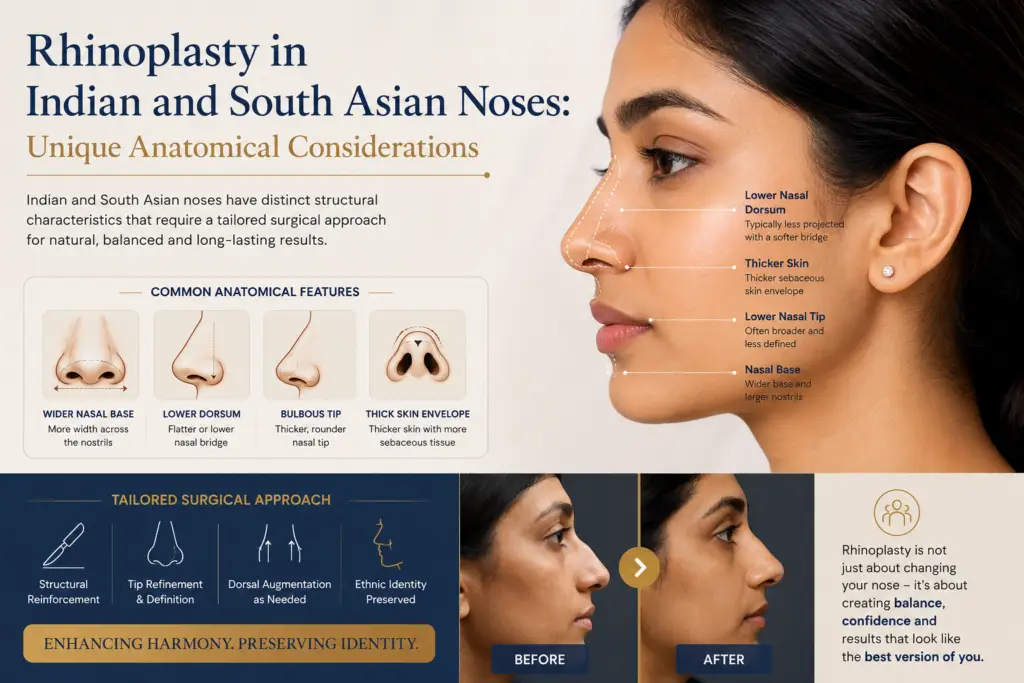
While every patient’s anatomy is individual, several features are common across many Indian and South Asian noses:
- Thicker, more sebaceous skin. The skin envelope is often thicker and has more oil glands than Caucasian skin, which affects how well underlying cartilage work shows through and how much swelling persists during recovery.
- Weaker, thinner cartilage. The structural cartilage — particularly at the tip — is frequently softer and less rigid, offering less natural support. This means it often needs to be reinforced rather than simply reduced.
- A wider, less-projected nasal tip. Many South Asian noses have a rounder, broader, and less-defined tip compared to the narrower, higher-projected tips common in Western rhinoplasty “ideals.”
- A lower nasal bridge (dorsum). Rather than needing reduction, many patients need bridge augmentation — building height and structure rather than removing it.
- Wider nasal base and nostrils (alar base). The base of the nose is often proportionally wider, which factors into how the nostrils and tip are reshaped together.
This combination means that South Asian rhinoplasty is, more often than not, a structural building and support procedure — adding cartilage grafts, strengthening the tip, and building bridge height — rather than the reductive “shaving down” approach that dominates a lot of Western rhinoplasty training and marketing.
Why This Distinction Actually Matters
A surgeon trained primarily on thin-skinned, high-cartilage Western noses may default to reduction-focused techniques. Applied to a South Asian nose, this can lead to:
- Under-corrected results, where thick skin hides the changes made to the underlying structure, leaving patients feeling like “nothing changed”
- Loss of structural support, particularly at the tip, leading to collapse or drooping over time
- A tip or bridge that looks disconnected from the rest of the face, because Western proportions were applied without adjusting for the patient’s actual facial structure
- Longer, more pronounced swelling, which is normal with thicker skin but can be misinterpreted as a poor outcome if patients aren’t counseled about it in advance
This is why rhinoplasty for South Asian patients should never be treated as a smaller version of a Western technique. It requires surgical planning built around this anatomy from the start.
Common Techniques Used for South Asian Rhinoplasty
Cartilage grafting Because the native cartilage is often thinner, grafts — frequently harvested from the septum, or occasionally the ear — are used to add structure, definition, and long-term support, particularly at the tip.
Dorsal augmentation Rather than reducing the bridge, many patients benefit from building height using cartilage grafts or, in select cases, implants, to create better facial balance and profile definition.
Tip refinement with structural support Reshaping the tip in South Asian rhinoplasty usually focuses on adding definition and slight elevation while preserving enough width and softness to look proportionate to the rest of the face — an overly narrow, pinched tip often looks out of place.
Alar base reduction When the nostrils and nasal base are proportionally wide, a alar base reduction can narrow this area, though this needs to be balanced carefully to avoid looking disproportionate to the rest of the nose.
Setting Realistic Expectations
One of the most important conversations I have with patients before rhinoplasty is about what “improvement” actually looks like for their specific anatomy. A nose that looks striking on someone with thin skin and strong cartilage won’t translate directly to a patient with thicker skin and softer cartilage — and trying to force that result often leads to disappointment or complications.
The goal of a well-planned South Asian rhinoplasty isn’t to erase ethnic characteristics, but to refine and balance the nose in proportion to the patient’s own face — often preserving natural width and softness while improving projection, symmetry, and profile.
Recovery Considerations
Because of thicker skin and more soft tissue, South Asian patients often experience:
- More prolonged swelling, particularly at the tip, which can take 12–18 months to fully resolve (though the vast majority of visible swelling resolves within the first 2–3 months)
- Slightly longer bruising, typically resolving within 2 weeks
- A visible, presentable result within 3–4 weeks, sufficient for most patients to return to work and social settings, even though final refinement continues for months afterward
Patients should be counseled on this timeline clearly before surgery, so that normal healing isn’t mistaken for a disappointing outcome.
A Note for International Patients
If you’re travelling for rhinoplasty, it’s worth choosing a surgeon with specific, demonstrated experience in South Asian or ethnic rhinoplasty — not simply a general cosmetic surgeon. Ask to see before-and-after results specifically from patients with similar skin thickness and nasal structure to your own, rather than a generic portfolio.
Final Thoughts
The best rhinoplasty results come from surgeons who design the procedure around the anatomy in front of them, not a universal template. If you’re considering a nose job and have South Asian or Indian heritage, make sure the surgeon you choose can speak specifically to how they’ll approach your skin thickness, cartilage strength, and facial proportions — not just show you a portfolio of noses that don’t reflect your own anatomy.
If you’d like to discuss what’s realistic for your specific anatomy, I offer consultations in person in Kolkata and via video call for patients planning to travel from abroad.