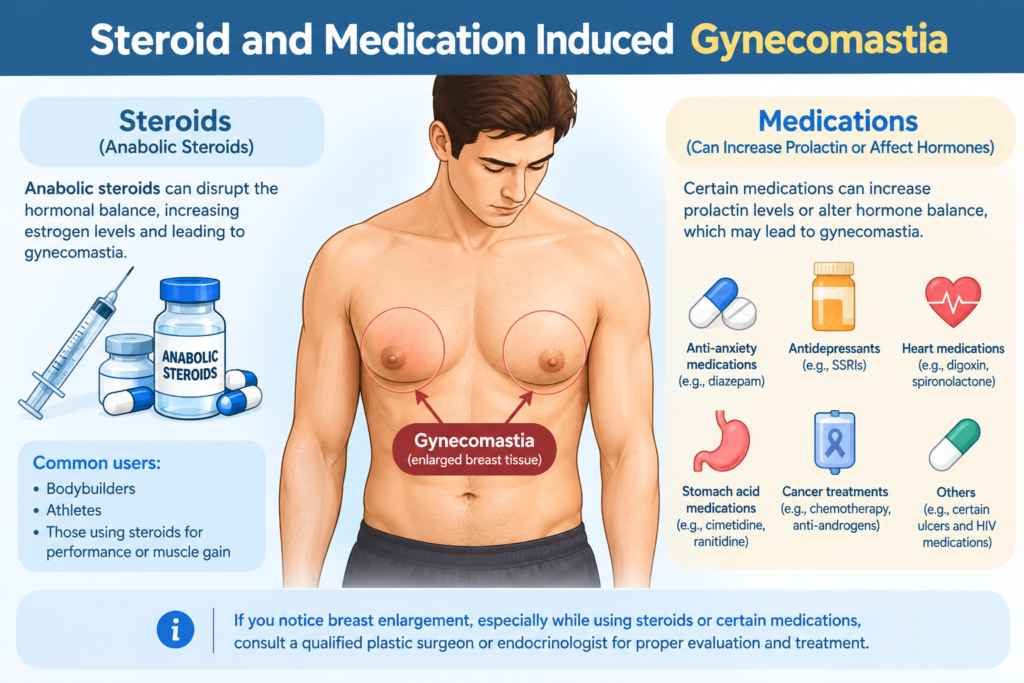
Of all the patients I see for gynecomastia, one group has grown noticeably in recent years: young men, often serious about fitness and bodybuilding, who developed breast tissue enlargement as a direct result of anabolic steroid or performance-enhancing drug use. It’s a conversation that carries its own layer of reluctance, since it usually means acknowledging steroid use to a doctor for the first time. I want to address it directly and without judgment, because steroid and medication induced gynecomastia is far more common than most people realize.
Why Steroids Cause Gynecomastia
Anabolic steroids increase testosterone levels in the body — but the body doesn’t simply let testosterone levels climb indefinitely. Through a process called aromatization, excess testosterone is converted into estrogen by an enzyme called aromatase. The more anabolic steroids used, and the higher the dose, the more estrogen is produced as a byproduct.
Breast tissue in men — like breast tissue in women — is estrogen-sensitive. When estrogen levels rise relative to testosterone, glandular tissue can begin to grow, resulting in gynecomastia. This is why bodybuilders sometimes develop breast tissue enlargement even while simultaneously building significant muscle mass elsewhere — the two effects are happening through entirely different mechanisms.
This applies most commonly to:
- Anabolic-androgenic steroids (the most common cause in this category)
- Testosterone replacement therapy at high or poorly managed doses
- Certain prohormones and SARMs (selective androgen receptor modulators), some of which also affect estrogen levels
- Human chorionic gonadotropin (hCG), sometimes used alongside steroid cycles
Other Medications That Can Cause It
Steroids aren’t the only medication-related cause. Gynecomastia has also been associated with:
- Certain prostate medications (like finasteride, sometimes used off-label for hair loss)
- Some ulcer and acid-reflux medications
- Certain heart and blood pressure medications
- Some antipsychotic and antidepressant medications
- Recreational use of substances like marijuana
If you’re on any long-term medication and notice new chest tissue development, it’s worth discussing with your prescribing doctor before assuming surgery is the only path forward — in some cases, adjusting or switching medication can help.
Why This Type Often Doesn’t Resolve on Its Own
Short-term hormonal fluctuations — like those during puberty — often resolve naturally as hormone levels stabilize. Steroid-induced gynecomastia behaves differently. Once glandular tissue has actively grown and matured in response to elevated estrogen, it frequently doesn’t shrink even after stopping steroid use and allowing hormone levels to normalize. The tissue, once formed, tends to be permanent — similar to how breast tissue develops and persists in other contexts.
This is one of the most common frustrations I hear: patients who stopped their cycle months or even years ago, gave their body time to “reset,” and still see no change. In many of these cases, surgery is the only way to remove the tissue that has already developed.
Common Concerns From Patients in This Situation
“Will this happen again if I use steroids in the future?” Yes — if you resume steroid or PED use, particularly without appropriate estrogen management, there’s a meaningful risk of recurrence, even after surgical correction. This is worth discussing honestly during your consultation so you understand the long-term risk profile of your choices.
“Do I need to stop steroids before surgery?” Generally, yes. Active steroid use can affect anesthesia safety, wound healing, and cardiovascular risk during surgery. Your surgeon will want a clear picture of your current use, including any planned cycles, to plan safely.
“Will my surgeon judge me for steroid use?” This comes up more than almost any other concern. Steroid use is common, and a good surgeon’s job is to treat you safely and effectively — not to lecture. Being upfront about your use (including dosage, duration, and any current cycle) is essential for safe surgical planning, not a moral conversation.
“Can I just wait it out longer?” If it’s been more than 12 months since stopping and there’s been no meaningful change, it’s very unlikely that further waiting will resolve established glandular tissue. At that point, a proper evaluation can confirm whether the tissue is truly fixed.
What Treatment Looks Like
Steroid-induced gynecomastia often presents as firmer, more fibrous glandular tissue than other causes, sometimes requiring a slightly more involved surgical excision compared to fat-predominant cases. Depending on your specific anatomy, treatment usually involves:
- Surgical excision of the glandular tissue, often through a small incision at the edge of the areola
- Liposuction, if there’s an additional fatty component
- In some cases, skin tightening or a modified excision pattern for patients with significant tissue that has stretched the skin envelope, which can be more common with a history of substantial muscle mass fluctuation
A Note on Honesty During Consultation
I’ll say this plainly: the single most helpful thing you can do before your consultation is be completely honest about what you’ve used, how much, for how long, and whether you’re currently on a cycle. This isn’t about judgment — it directly affects surgical planning, anesthesia safety, and how we set expectations for your results and any recurrence risk.
Final Thoughts
If you’ve developed chest tissue from steroid or medication use, you’re far from alone, and there’s no reason to keep hiding it out of embarrassment. A confidential, judgment-free conversation with a specialist is the fastest way to understand your options and get a realistic, lasting result.
I offer confidential consultations for this specific concern, in person in Kolkata and via video call for patients planning to travel from abroad.
Gynecomastia Surgery in Kolkata