Accessory breast removal in Kolkata is a specialised cosmetic and reconstructive procedure for treating accessory breast tissue, which is extra breast tissue that develops outside the normal breast area. It is most commonly noticed in the armpit (axilla) but can occur along the embryonic milk line. Accessory breast tissue may become more prominent during puberty, pregnancy, breastfeeding or weight fluctuations and can cause a visible bulge, discomfort, tenderness or cosmetic concerns.
Accessory Breast Tissue Removal Surgery in Kolkata
Accessory breast tissue removal surgery in Kolkata is individually planned according to the amount and type of tissue present. Accessory breast tissue may contain glandular breast tissue, fat or both. Depending on the patient’s anatomy, treatment may involve surgical excision, liposuction or a combination of techniques. A careful clinical assessment is important before surgery to distinguish accessory breast tissue from other causes of an axillary lump.
Who May Benefit from Accessory Breast Removal?
Women with a persistent axillary breast bulge or lump that becomes more noticeable with hormonal changes may consider accessory breast removal. Some patients experience swelling or tenderness during menstruation, pregnancy or breastfeeding, while others are mainly concerned about the appearance of the upper arm and armpit when wearing sleeveless or fitted clothing. If an axillary lump is new, rapidly changing or otherwise unusual, appropriate medical evaluation should be performed before cosmetic treatment.
Natural-Looking Axillary Contouring
The objective of accessory breast removal in Kolkata is not simply to remove tissue but to create a smooth transition between the breast, armpit and upper arm. When excess fatty tissue surrounds the glandular component, carefully planned liposuction may be combined with excision to improve the overall contour. If significant skin excess is present, additional skin removal may sometimes be considered.
Accessory Breast Removal After Pregnancy
Hormonal stimulation can cause accessory breast tissue to enlarge during pregnancy and breastfeeding. For some women, the tissue becomes smaller once hormonal activity settles, while in others the bulge remains. Surgery may be considered after appropriate assessment when the tissue has stabilised. The timing of surgery should be individualised, particularly for women who may plan future pregnancies or breastfeeding.
Accessory Breast Removal by Prof. (Dr.) Souvik Adhikari
Prof. (Dr.) Souvik Adhikari brings 17+ years of surgical experience in cosmetic, plastic and reconstructive surgery, with additional AOCMF Fellowship training at Johns Hopkins University, USA. His approach to accessory breast removal in Kolkata focuses on detailed assessment, appropriate technique selection, careful tissue handling and aesthetically considerate scar placement.
Recovery After Accessory Breast Surgery
Recovery following accessory breast removal surgery in Kolkata depends on the amount of tissue removed and whether liposuction or skin excision is also performed. Temporary swelling, bruising, tenderness and restricted arm movement may occur during the early recovery period. Patients receive personalised instructions regarding wound care, compression garments, arm movement, activity and follow-up. Scars gradually mature over time, although their final appearance varies between individuals.
If you are searching for accessory breast removal in Kolkata, a personalised consultation can help determine the nature of the tissue and whether surgical excision, liposuction or a combined approach is appropriate. The goal is to achieve a smoother, more comfortable and naturally contoured armpit and upper-chest area while maintaining realistic expectations about scars and recovery.
Individualised Assessment Before Accessory Breast Removal
Accessory breast removal is not a standardised procedure because the amount and composition of accessory breast tissue vary considerably between patients. The tissue may consist predominantly of glandular breast tissue, fatty tissue, excess skin or a combination of these components.
Before surgery, the location, extent and characteristics of the tissue are assessed to determine whether surgical excision, liposuction or a combination approach is most appropriate.
A new, rapidly enlarging or otherwise unusual axillary lump should be medically evaluated before cosmetic surgery is considered.
Who May Be Suitable for Accessory Breast Removal?
Accessory breast removal may be considered when persistent accessory breast tissue causes visible fullness, discomfort, tenderness, difficulty with clothing or personal aesthetic concerns.
Some patients notice the tissue primarily during hormonal changes such as menstruation, pregnancy or breastfeeding. Others may have a relatively stable axillary bulge that remains noticeable despite changes in body weight.
The appropriate treatment depends on the nature and extent of the tissue rather than simply its size.
Accessory Breast Tissue in the Armpit
The armpit is the most common location where accessory breast tissue becomes clinically noticeable. The tissue may respond to hormonal changes in a manner similar to normal breast tissue and can become more prominent or tender during certain periods.
Because not every axillary lump represents accessory breast tissue, appropriate clinical assessment is important before treatment.
For accessory breast tissue located specifically in the armpit, see our detailed guide to [Axillary Breast Removal in Kolkata].
Glandular Accessory Breast Tissue vs Fatty Tissue
The composition of the tissue influences the surgical approach.
Predominantly glandular accessory breast tissue generally requires surgical excision when definitive removal is indicated. When the area contains a significant fatty component, liposuction may be useful either alone in selected cases or in combination with excision.
When excess skin is also present, skin excision may be considered to achieve an appropriate contour.
Accessory Breast Removal with Liposuction
Excision and liposuction can sometimes be combined when accessory breast tissue consists of both glandular tissue and surrounding fat.
The glandular component can be removed surgically while liposuction may be used to refine the surrounding contour. This approach can be particularly useful when the fullness extends beyond the main area of glandular tissue.
The exact combination of techniques is determined according to individual anatomy.
Accessory Breast Removal After Pregnancy and Breastfeeding
Accessory breast tissue can enlarge during pregnancy and breastfeeding because it responds to hormonal stimulation. In some patients, the tissue becomes less prominent after hormonal activity settles, while in others a persistent bulge remains.
Surgery is generally considered after appropriate assessment and when the tissue has stabilised. Timing should be discussed individually, particularly in patients considering future pregnancies or breastfeeding.
Accessory Breast Removal and Axillary Contouring
The objective of surgery is not simply to remove the accessory breast tissue. The relationship between the breast, armpit and upper arm also needs to be considered.
Careful tissue removal and, when appropriate, liposuction or skin excision can help create a smoother transition between these areas while avoiding an unnecessarily hollow or irregular contour.
Accessory Breast Removal vs Liposuction
Liposuction and accessory breast excision are not interchangeable.
Liposuction primarily removes subcutaneous fat. Established glandular accessory breast tissue may require direct surgical excision. When both glandular tissue and excess fat are present, the two techniques may be combined.
A clinical assessment is therefore important before deciding which procedure is appropriate.
Accessory Breast Removal vs Axillary Breast Removal
The terms are closely related but can describe slightly different anatomical situations. Accessory breast removal may refer to treatment of ectopic breast tissue at different locations along the embryonic milk line, whereas axillary breast removal specifically refers to accessory breast tissue located in the armpit.
For patients with axillary fullness, determining the nature of the tissue is more important than the terminology used to describe it.
Accessory Breast Surgery in Men
Accessory breast tissue can occur in men as well as women. Although hormonal changes may make the condition more noticeable in women, men can also develop persistent accessory breast tissue or an axillary fullness requiring assessment.
The treatment approach is determined by the composition and anatomy of the tissue.
Anaesthesia for Accessory Breast Removal
The type of anaesthesia depends on the extent and location of the tissue being removed, whether liposuction or skin excision is required and the patient’s overall medical assessment.
The anaesthetic plan is individualised rather than being identical for every patient.
Duration of Accessory Breast Removal Surgery
The duration varies according to the amount and type of tissue being treated and whether excision, liposuction or additional skin removal is performed.
An expected operative time can be discussed after clinical assessment and surgical planning.
Recovery After Accessory Breast Removal
Recovery depends on the extent of tissue removal and the techniques used. Temporary swelling, bruising, tenderness, tightness and changes in sensation may occur during the early healing period.
Arm movement and physical activity may need to be restricted temporarily, particularly when extensive axillary tissue has been removed. The timing of return to work, exercise and normal activities is individualised according to recovery.
Scars After Accessory Breast Removal
Surgical excision requires an incision and therefore results in a scar. For axillary accessory breast removal, the incision can often be planned in or near a natural underarm crease where anatomically appropriate.
Scar appearance varies between individuals and continues to mature over time. The length and visibility of the scar depend on the amount of tissue requiring removal and the surgical approach.
Possible Risks and Complications
Potential complications include bleeding, infection, seroma or fluid collection, changes in skin sensation, asymmetry, contour irregularities, delayed wound healing and unfavourable scarring. Residual or recurrent fullness may also occur depending on the amount and type of tissue present.
Appropriate patient selection, careful assessment of the axillary anatomy and individualised surgical planning are important for reducing avoidable risks.
Expected Results After Accessory Breast Removal
The aim is to reduce unwanted accessory breast fullness and create a smoother transition between the breast, armpit and upper arm.
The contour improves progressively as postoperative swelling settles. The final appearance develops gradually, while scars continue to mature over a longer period.
The long-term appearance can also be influenced by future changes in body weight and hormonal status.
Consultation for Accessory Breast Removal in Kolkata
A consultation is important to determine whether an axillary or other area of fullness actually represents accessory breast tissue and to establish its composition.
Depending on the findings, treatment may involve surgical excision, liposuction, skin removal or a combination of techniques. The objective is not simply to remove as much tissue as possible, but to achieve appropriate tissue removal with a balanced and natural contour.
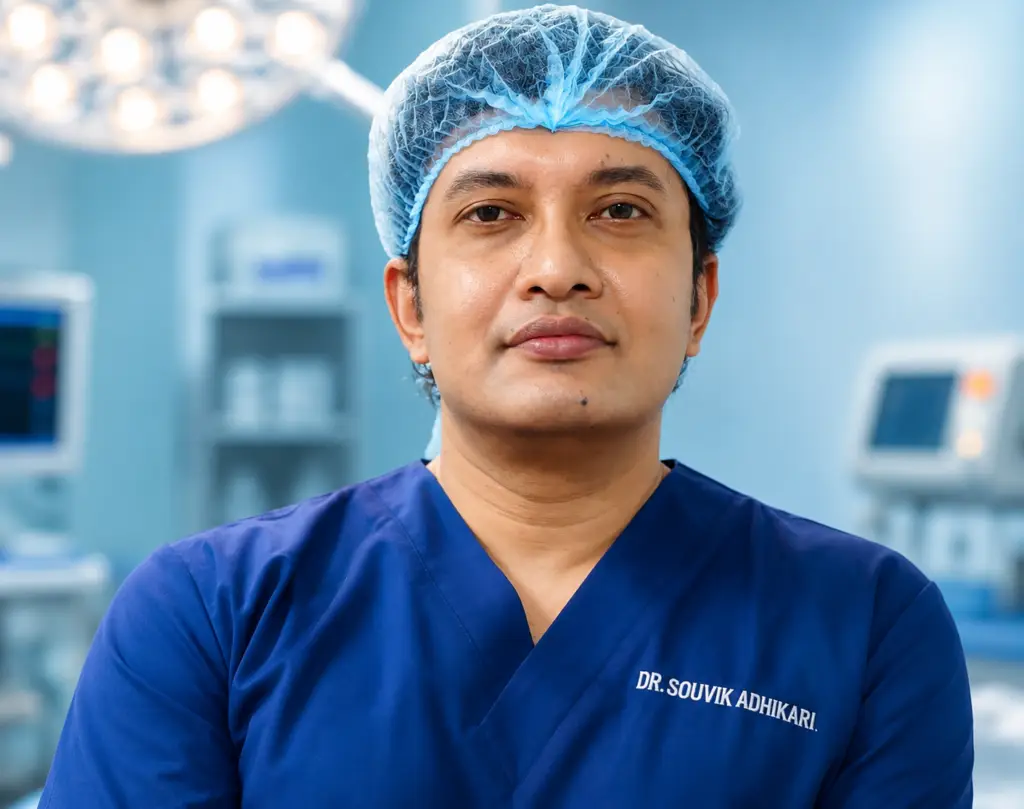
Prof. (Dr.) Souvik Adhikari
MS, MCh (Plastic Surgery)
17+ years experience
Frequently Asked Questions
Is Accessory Breast Reduction Surgery painful?
Discomfort is well controlled with a multimodal pain protocol. Most patients describe a tightness or soreness rather than sharp pain, easing significantly within the first week.
How much does Accessory Breast Reduction Surgery cost in Kolkata?
The cost varies according to the amount and type of tissue being removed, the surgical technique, anaesthesia, facility charges and whether liposuction or skin excision is performed at the same time. An individualised estimate can be provided after clinical assessment and discussion of the proposed surgical plan.
When can I return to work?
The timing depends on the extent of surgery and the type of work. Patients with desk-based work may return relatively early when comfortable, while physically demanding work and strenuous exercise generally require a longer recovery period. The timing is individualised during postoperative follow-up.
Will the scars be visible?
Yes. Surgical removal requires an incision and therefore leaves a scar. For axillary accessory breast tissue, the incision can often be planned in or near a natural underarm crease where appropriate. Scar appearance varies between individuals and gradually changes as it matures.
Do you treat patients traveling from outside Kolkata?
Yes. Patients from across West Bengal, India and abroad are treated, with video consultations and coordinated travel and stay planning.
What is accessory breast tissue?
Accessory breast tissue, also called supernumerary or ectopic breast tissue, is additional breast tissue that develops outside the normal breast area, most commonly in the armpit. It may become more noticeable during puberty, pregnancy, breastfeeding, or other hormonal changes.
What is accessory breast surgery?
Accessory breast surgery is a procedure performed to remove or reshape unwanted additional breast tissue outside the normal breast. When accessory breast tissue is located in the armpit, the procedure is often referred to as axillary breast removal surgery or accessory axillary breast tissue excision.
Why does accessory breast tissue develop in the armpit?
Accessory breast tissue develops because breast tissue can occur along the embryonic milk line during development. Some people may have accessory breast tissue from birth but only notice it later when hormonal changes cause the tissue to enlarge or become painful.
Can accessory breast tissue be removed permanently?
Yes. When the accessory breast tissue is appropriately excised, the removed glandular tissue is not expected to grow back. However, changes in body weight or hormonal fluctuations can affect the surrounding fatty or soft tissues and alter the appearance of the area.
Can accessory breast tissue be removed without surgery?
Treatment depends on the composition of the swelling. If the area contains predominantly fatty tissue, liposuction may be considered in selected patients. When there is significant glandular breast tissue or excess skin, surgical excision may be more appropriate. A clinical examination is necessary to determine the most suitable approach.
Can an axillary lump be mistaken for accessory breast tissue?
Yes. Not every lump or swelling in the armpit represents accessory breast tissue. Other causes of axillary swelling are possible, so a new, rapidly changing, painful or otherwise unusual lump should be medically assessed before cosmetic surgery is considered.
Is accessory breast surgery the same as axillary breast removal?
The terms are closely related but are not always identical. Axillary breast removal specifically refers to removal of accessory breast tissue located in the armpit, whereas accessory breast surgery can refer to treatment of ectopic breast tissue in other locations as well.
Does accessory breast tissue need to be evaluated before removal?
Accessory breast tissue should be assessed clinically before surgery, particularly when there is a new, changing or symptomatic lump. The appropriate evaluation depends on the patient's age, symptoms, examination findings and clinical history. The surgeon can advise whether further breast or axillary assessment is appropriate before proceeding with removal.
Can accessory breast tissue become painful?
Yes. Accessory breast tissue may become tender, swollen or painful, particularly during hormonal changes such as menstruation, pregnancy or breastfeeding. Persistent pain, a new lump or a change in an existing swelling should be evaluated medically before considering cosmetic surgery.
Can men have accessory breast tissue?
Yes. Accessory breast tissue can occur in both men and women, although it may be more noticeable in women because breast tissue responds to hormonal changes.
Will accessory breast surgery leave a scar?
Because surgical removal requires an incision, a scar is expected. For axillary accessory breast removal, the incision can often be positioned strategically within or close to a natural underarm crease. Scar appearance varies between individuals and generally changes and matures over time.
What is the recovery after accessory breast removal surgery?
Recovery depends on the amount of tissue removed and whether liposuction or skin excision is performed at the same time. Temporary swelling, bruising, tightness and discomfort can occur. Patients can generally return gradually to routine activities according to their individual recovery and postoperative instructions.
Is accessory breast removal surgery safe?
Like any surgical procedure, accessory breast removal surgery has potential risks, including bleeding, infection, fluid collection, changes in sensation, asymmetry, contour irregularities and visible scarring. Appropriate patient selection, detailed surgical planning and postoperative follow-up are important for achieving a safe and satisfactory result.
Can accessory breast tissue develop again after surgery?
Complete removal of the abnormal glandular tissue makes recurrence of the removed tissue unlikely. However, residual tissue, weight fluctuations or hormonal changes can affect the appearance of the treated area. The surgical technique should therefore be selected carefully according to the amount and type of tissue present.
Can accessory breast surgery be combined with liposuction?
Yes, in selected patients, accessory breast removal may be combined with liposuction. This can be useful when the underarm fullness consists of both glandular breast tissue and excess fat. The combination of excision and liposuction may allow more comprehensive contouring of the axillary region.
Where can I get accessory breast surgery in Kolkata?
Patients considering accessory breast surgery in Kolkata should undergo an individual assessment by a qualified plastic surgeon. The consultation can determine whether the swelling represents accessory breast tissue, fat, excess skin or another condition and whether excision, liposuction or a combination approach would be appropriate.
Honest assessment, written estimate, no pressure to book.