Fat Transfer Surgery in Kolkata
Fat transfer in Kolkata, also known as autologous fat grafting or fat transplantation, is a cosmetic procedure that uses a patient’s own fat to enhance or restore volume in selected areas of the body. Fat is typically collected from areas with unwanted localised deposits, processed carefully and then strategically transferred to areas where additional volume or contour improvement is desired. Because the patient’s own tissue is used, fat transfer can provide a natural approach to selected cosmetic contouring procedures.
Advanced Fat Transfer Surgery in Kolkata
Fat transfer surgery in Kolkata involves three important stages: careful fat harvesting, processing of the harvested tissue and precise placement into the recipient area. Common applications include facial fat grafting, breast fat transfer and selected buttock contouring procedures. The technique and amount of fat transferred depend on the patient’s anatomy, available donor fat, treatment area and aesthetic goals. A detailed consultation is essential to determine whether fat grafting is appropriate. Gluteal fat grafting, including Brazilian Butt Lift (BBL), has specific safety considerations and should be planned and performed using appropriate patient selection, surgical technique and recognised safety protocols.
Fat Transfer for Natural-Looking Contouring
One of the advantages of fat transfer is that it can address two aesthetic concerns in a single treatment—reducing unwanted fat from a donor area while adding volume to another area. Fat can be used to improve contour and restore selected areas of volume, including the cheeks, temples, breasts and buttocks, depending on the patient’s individual requirements. The objective is to achieve a balanced and natural-looking result rather than excessive augmentation.
Fat Transfer to the Face
Facial fat transfer in Kolkata can be considered for patients who want to restore volume in areas affected by ageing or natural volume loss. Carefully processed fat may be strategically placed in areas such as the cheeks, temples or other areas of facial volume deficiency. Because the transferred fat becomes part of the body’s tissue, the result can provide a natural form of volume restoration, although some of the transferred fat may be reabsorbed during healing. Facial fat transfer may sometimes be combined with procedures such as facelift or blepharoplasty.
Fat Transfer to the Breast and Body
Breast fat transfer in Kolkata may be considered for selected patients seeking modest breast-volume enhancement or improvement of breast contour using their own fat as an alternative to breast implants for breast augmentation. Fat grafting can also be used for selected body-contouring applications. Suitability depends on factors such as available donor fat, breast or body anatomy, desired volume enhancement and overall health. It is important to understand that fat transfer does not provide the same degree of predictable volume increase as breast implants.
Fat Transfer by Prof. (Dr.) Souvik Adhikari
Prof. (Dr.) Souvik Adhikari has more than 17 years of surgical experience in plastic, reconstructive and cosmetic surgery. His approach to fat transfer focuses on careful patient selection, assessment of donor and recipient areas, appropriate tissue handling and realistic expectations regarding fat survival and final volume.
Treatment is planned according to the anatomical requirements of each patient rather than using a standardised volume or technique.
Prof. (Dr.) Souvik Adhikari’s academic work includes research in plastic, reconstructive and aesthetic surgery. His peer-reviewed publications and academic contributions are available on the Research & Publications page.
Fat Transfer Recovery and Consultation
Recovery following fat transfer in Kolkata varies depending on both the donor and recipient areas. Swelling and bruising are common during the initial healing period, while the final result develops gradually as the transferred fat stabilises. A proportion of transferred fat may be naturally reabsorbed, so the final volume cannot always be predicted precisely. Patients receive personalised postoperative instructions and follow-up based on the specific procedure performed.
If you are considering fat transfer in Kolkata, a consultation with an experienced plastic surgeon can help determine whether autologous fat grafting is suitable for your goals. The treatment should be individually planned after assessing your anatomy, available donor fat and the amount of enhancement realistically achievable.
Who is a candidate for fat transfer surgery in Kolkata?
- You are in good general health with stable, well-controlled medical conditions.
- You have a specific, realistic concern that fat transfer surgery can address.
- You are a non-smoker, or willing to stop for the advised period before and after surgery.
- You understand the recovery timeline and can arrange support at home.
Benefits
Natural, proportionate result matched to your features
Techniques chosen to keep scars discreet and well-hidden
Personalised surgical plan, never a template procedure
Uses the patient’s own tissue — Fat transfer can restore or enhance volume without using a synthetic implant in appropriately selected patients.
Can combine contouring and volume restoration — Fat can be harvested from a suitable donor area while being used to enhance another area.
The procedure
How Is Fat Transfer Performed?
Fat transfer generally involves three stages: fat harvesting, processing and reinjection. Fat is first harvested from a suitable donor area using liposuction. The harvested tissue is then processed to separate and prepare the fat for grafting. The purified fat is subsequently transferred in small amounts to carefully selected areas to restore or enhance volume.
The amount of fat required and the injection technique depend on the treatment area, available donor fat, tissue characteristics and the desired degree of correction. Because some transferred fat is naturally reabsorbed during healing, the final result cannot always be predicted precisely.
Anaesthesia
The type of anaesthesia depends on the treatment area, volume of fat being harvested and whether fat transfer is combined with another procedure. Smaller procedures may be performed with local anaesthesia and appropriate sedation, while larger procedures may require general anaesthesia. The choice is made after individual assessment and pre-anaesthetic evaluation.
Duration
Around 2 – 3 hours, depending on the extent of correction and additional touch-ups planned.
Recovery timeline
- Day 0–2: rest, elevation, prescribed analgesia; mild swelling and bruising expected.
- Week 1: first review and dressing change; light indoor activity resumed.
- Week 2–4: return to desk work, gradual walking; garments or taping as advised.
- Week 6–12: exercise cleared in stages; swelling continues to settle.
Risks and complications
- fat resorption
- contour irregularity
- asymmetry
- fat necrosis
- infection
- bleeding
- donor-site contour irregularity
- swelling/bruising
- need for revision/additional grafting
Results
Some of the transferred fat is naturally reabsorbed during healing, while fat cells that successfully establish a blood supply may provide long-lasting volume. The final result becomes clearer over several months as swelling settles and the transferred tissue stabilises. Significant changes in body weight and the natural ageing process can affect the appearance over time.
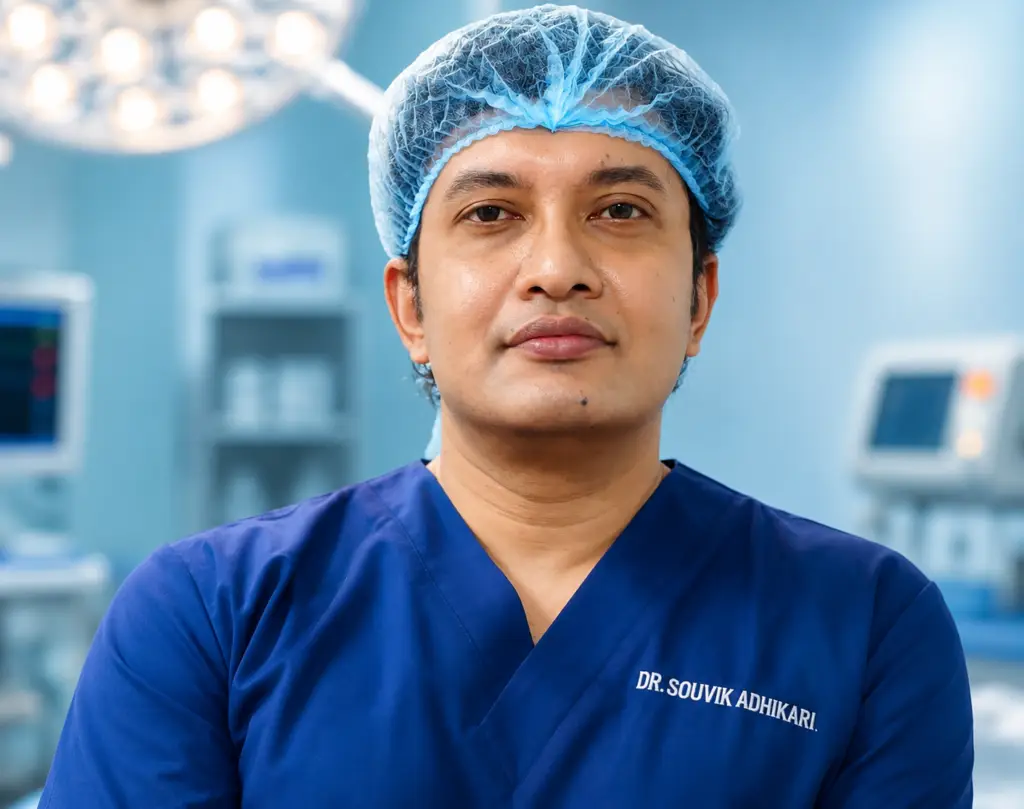
Prof. (Dr.) Souvik Adhikari
MS, MCh (Plastic Surgery)
17+ years experience
Video: Penile Fat Injection for Girth Enhancement
Penis Fat Injections to increase Penile Girth
In this video, Prof. (Dr.) Souvik Adhikari explains penile fat injection for girth enhancement, a procedure in which a patient’s own fat is harvested from a suitable donor area and carefully transferred to the penile shaft to increase penile circumference. The video discusses the principles of autologous fat transfer for penile girth augmentation, including patient selection, fat harvesting, processing and injection, expected outcomes, recovery and the limitations of the procedure. Because transferred fat does not survive uniformly, the final result can vary between patients. Possible complications include fat resorption, asymmetry, contour irregularities, nodules, fat necrosis, infection and other surgical complications. Careful patient selection and appropriate surgical technique are therefore important.
Frequently Asked Questions
What is fat transfer surgery?
Fat transfer surgery, also called fat grafting or fat injection, involves removing unwanted fat from one area of the body using liposuction, processing the harvested fat and carefully injecting it into another area to restore or enhance volume. It can be used for facial rejuvenation, breast enhancement, contour correction and selected reconstructive procedures.
What is fat transfer in Kolkata?
Fat transfer in Kolkata is a cosmetic or reconstructive procedure in which your own body fat is harvested from a suitable donor area and transferred to another part of the body. The treatment is individually planned according to your anatomy, available donor fat, the area being treated and the desired degree of correction.
Which areas can be treated with fat transfer?
Fat transfer can be used to restore or enhance volume in several areas, including the face, cheeks, temples, lips, breasts, buttocks and selected areas with contour irregularities or soft-tissue deficiency. The appropriate application depends on the patient's anatomy and treatment goals.
What is facial fat transfer?
Facial fat transfer uses a patient's own fat to restore volume and improve facial contours. It may be used for areas such as the cheeks, temples, under-eye region and other areas affected by age-related or congenital volume deficiency.
What are the benefits of facial fat transfer?
Facial fat transfer can restore lost soft-tissue volume and improve facial contours using the patient's own tissue rather than a synthetic filler. It may be considered as a standalone procedure or combined with procedures such as facelift or blepharoplasty when appropriate.
Can fat transfer be used for breast augmentation?
Yes. Fat transfer breast augmentation uses liposuction to harvest fat from another part of the body and inject it into the breasts to achieve a modest increase in volume and improve contour. It is different from breast augmentation with implants and may be suitable for selected patients.
Is fat transfer better than implants?
Fat transfer and implants are different approaches rather than one being universally better. Fat transfer uses your own tissue and can provide a natural-feeling increase in volume, but the amount of enhancement possible is limited by the available donor fat and the survival of the transferred fat. Implants may provide a more predictable increase in breast volume. The appropriate option depends on your anatomy and goals.
How is fat transfer surgery performed?
Fat transfer generally involves three stages: fat harvesting, fat processing and fat injection. Fat is usually obtained through liposuction from a suitable donor area, processed to prepare it for grafting, and then injected in small amounts into carefully selected tissue planes of the recipient area.
How much fat survives after fat transfer?
Not all transferred fat cells survive. The proportion that remains varies between patients and treatment areas, which is why the final result can be less predictable than an implant. The transferred fat requires a new blood supply to survive, and the final result becomes clearer as postoperative swelling settles and the surviving fat stabilises.
Are fat transfer results permanent?
The fat cells that successfully establish a blood supply can provide long-lasting volume. However, the amount of fat that survives varies, and changes in body weight and ageing can affect the appearance of the treated area. A final assessment is usually made only after the postoperative swelling has settled and the graft has stabilised.
Who is a good candidate for fat transfer?
A suitable candidate is generally in good health, has an adequate amount of donor fat and has realistic expectations about the degree of enhancement possible. A consultation is important because not every patient has sufficient donor fat or is anatomically suited to every type of fat transfer.
Can fat transfer be combined with liposuction?
Yes. Fat transfer commonly involves liposuction of a donor area, allowing unwanted fat to be reduced in one area while the harvested fat is used to restore volume elsewhere. This can provide both donor-site contouring and enhancement of the recipient area.
Does fat transfer help with body contouring?
Fat transfer can be incorporated into a body-contouring plan when a patient has suitable donor fat and requires additional volume or contour correction elsewhere. It is not primarily a weight-loss procedure; its purpose is to reshape and restore volume rather than produce major overall weight reduction.
How long does fat transfer surgery take?
The duration varies according to the treatment area, amount of fat being harvested and whether another procedure is performed at the same time. A smaller facial fat transfer may require considerably less operating time than a larger-volume procedure.
What is the recovery after fat transfer surgery?
Swelling, bruising, tenderness and temporary changes in contour are common after fat transfer. Recovery varies according to the donor and recipient areas and the amount of fat transferred. Many patients can gradually resume routine activities within days to weeks, according to the specific procedure and postoperative instructions.
When will I see the final results of fat transfer?
The initial appearance can change considerably as swelling settles and some of the transferred fat is naturally absorbed. The final outcome is therefore assessed after sufficient time has passed for the grafted tissue to stabilise; this may take several months depending on the treatment area.
What are the risks of fat transfer?
Potential risks include bleeding, infection, swelling, bruising, contour irregularity, fat necrosis, inadequate fat survival, asymmetry and the possibility of requiring additional treatment. Rare but serious complications such as fat embolism can occur, with the risk depending substantially on the type and location of fat grafting.
Is fat transfer safe?
Fat transfer can be performed safely when appropriate patient selection, surgical technique and postoperative care are used. However, it is still a surgical procedure with potential complications. Gluteal fat grafting in particular has important safety considerations, and recognised plastic-surgery organisations have issued specific safety guidance because of the risk of fat embolism.
Can fat transfer be used for facial scars or contour defects?
Yes. Fat grafting can sometimes be used to improve selected soft-tissue deficiencies, contour irregularities and scars by restoring volume beneath or around the affected area. Whether it is appropriate depends on the nature and depth of the defect.
Can fat transfer be repeated if more volume is required?
Yes. Depending on the treatment area and the amount of fat that survives, an additional fat-transfer procedure may sometimes be considered to achieve further volume or refinement. The need for another session cannot be determined accurately until the initial result has stabilised.
How much does fat transfer cost in Kolkata?
The cost of fat transfer in Kolkata varies according to the treatment area, amount of fat required, liposuction donor sites, surgical technique, anaesthesia, operating-room and hospital facilities, and whether another procedure is performed at the same time. An accurate estimate can be provided only after individual assessment.
Is fat transfer available for patients from outside Kolkata?
Yes. Patients travelling to Kolkata can have an initial consultation to discuss their concerns, suitability, treatment plan and expected recovery. The timing of travel and postoperative follow-up should be planned according to the procedure being considered.
Where can I get fat transfer surgery in Kolkata?
Fat transfer surgery in Kolkata should be performed after a proper assessment by a qualified plastic surgeon in an appropriate surgical facility. The consultation should include discussion of the indication, available donor fat, expected results, limitations, risks, recovery and alternatives.
Honest assessment, written estimate, no pressure to book.