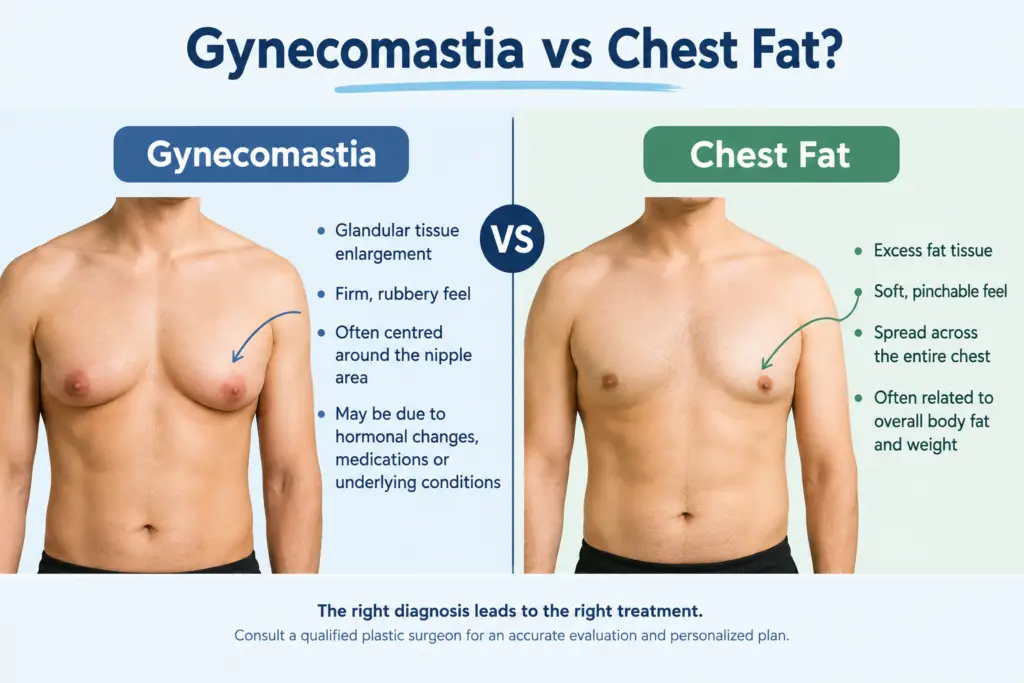
A very common question that comes to the minds of the patients is whether they have gynecomastia vs chest fat. “Is this actually gynecomastia, or am I just carrying extra weight?” It’s one of the most common questions I hear in consultations, and it’s a genuinely important one to answer correctly — because the two conditions, while they can look similar from across a room, require completely different treatment approaches.
Here’s how to think through the difference, and why getting it right matters.
The Core Difference: Tissue Type, Not Just Appearance
Gynecomastia is the enlargement of actual glandular breast tissue in men, caused by a hormonal imbalance between estrogen and testosterone. This tissue is structurally similar to female breast tissue — firm, often disc-shaped, and centered directly beneath the nipple.
Pseudogynecomastia (sometimes called “chest fat” or “man boobs”) is simply excess fatty tissue in the chest area, usually as part of broader weight gain. There’s no glandular component — it’s the same type of fat found elsewhere on the body, just distributed to the chest.
The distinction Gynecomastia vs Chest Fat matters because:
- Fat responds to weight loss, diet, and exercise over time
- Glandular tissue does not shrink with diet or exercise, no matter how disciplined the effort — it typically requires surgical removal
This is exactly why so many men spend months or years in the gym, doing chest exercises and cutting calories, and see little to no change. If the tissue is glandular, no amount of training will resolve it.
A Simple Self-Assessment (Not a Diagnosis)
While only a physical exam can properly diagnose gynecomastia, there are a few things you can check at home to get a general sense of what you’re dealing with:
1. The pinch test Sit or stand relaxed and gently pinch the tissue directly beneath your nipple between your thumb and forefinger.
- If it feels soft, evenly distributed, and similar to fat elsewhere on your body → more likely fat-based
- If you feel a firm, rubbery, disc-like lump directly under the nipple, distinct from the surrounding tissue → more likely glandular (true gynecomastia)
2. Location of the fullness
- Fat tends to be spread more broadly across the chest, often alongside fullness in the belly, back, and arms
- Glandular tissue is usually concentrated specifically behind and around the nipple-areola area, sometimes creating a distinct, puffy, or “tender button” appearance
3. Nipple sensitivity Tenderness or sensitivity around the nipple — especially if it developed suddenly or during a specific life stage like puberty — is more commonly associated with active glandular tissue than with fat.
4. Response to weight change If you’ve lost significant weight elsewhere on your body but the chest fullness hasn’t changed proportionally, that’s a meaningful clue that glandular tissue, not fat, may be involved.
Important: many men have a combination of both — some fat, some glandular tissue — which is actually the most common presentation in adult patients. A home self-check can point you in the right direction, but it isn’t a substitute for a physical exam.
Why the Distinction Changes Your Treatment Plan
| Pseudogynecomastia (fat) | True Gynecomastia (glandular) | |
|---|---|---|
| Responds to diet/exercise | Yes, over time | No |
| Feels firm or rubbery under nipple | Rarely | Often |
| Best treated with | Weight loss, or liposuction if stubborn | Surgical excision, sometimes combined with liposuction |
| Can improve without surgery | Often | Rarely, unless hormonal cause is reversible |
A patient with pure fatty tissue may only need liposuction, a comparatively simpler procedure. A patient with true glandular tissue typically needs surgical excision — liposuction alone won’t remove it. Most adult patients I see need a combination of both, tailored to their specific anatomy.
When It’s Time to See a Specialist
It’s worth getting a proper evaluation if:
- The fullness hasn’t improved despite sustained weight loss and exercise
- You feel a firm lump or band of tissue directly under one or both nipples
- There’s tenderness, especially if it’s new or has changed recently
- It’s asymmetric — noticeably larger on one side than the other
- It’s affecting your confidence, clothing choices, or social comfort
A proper clinical evaluation — sometimes supported by a hormone panel or an ultrasound in ambiguous cases — can confirm exactly what type of tissue is present, which then determines the most effective treatment path, whether that’s lifestyle changes, medical management of an underlying cause, or surgery.
Final Thoughts
There’s no need to guess indefinitely or keep pushing through workouts that aren’t producing results. A short consultation can usually tell you, definitively, which type of tissue you’re dealing with — and from there, exactly what your realistic options are.
If you’re unsure whether what you’re seeing is fat or true gynecomastia, I offer consultations in person in Kolkata and via video call for patients planning to travel from abroad.
Gynecomastia Surgery in Kolkata