Jawline Contouring Surgery in Kolkata
Jawline contouring in Kolkata is an advanced facial aesthetic procedure designed to create a more defined, balanced and proportionate lower face. An indistinct jawline may be influenced by excess facial or neck fat, loose skin, ageing, skeletal structure or the natural shape of the face. Depending on the underlying cause, jawline contouring surgery may involve procedures such as liposuction, neck lift, facelift, chin enhancement or a combination of techniques.
Jawline Contouring Surgery in Kolkata
Jawline contouring in Kolkata requires detailed assessment of the face, chin, neck and underlying skeletal proportions. Treatment is tailored to the patient’s anatomy rather than following a standardised approach. For patients with excess fat beneath the chin or along the jawline, carefully planned liposuction may improve definition. Where skin laxity is also present, a neck lift or facelift may provide a more comprehensive improvement.
Jawline Definition and Facial Harmony
The goal of jawline enhancement is not simply to make the jawline sharper. Facial proportions, chin projection, neck contour and overall facial balance must be considered together. A well-defined jawline should complement the patient’s other facial features and create a smooth transition from the chin to the neck. In selected patients, addressing the chin and jawline together can produce a more harmonious facial profile.
Jawline Contouring for a Double Chin
For patients concerned about a double chin or excess submental fat, jawline contouring may help create a cleaner transition between the chin, jaw and neck. Treatment options depend on the amount of fat, skin elasticity and underlying anatomy. Liposuction may be appropriate for selected patients with good skin elasticity, while patients with significant loose skin may benefit from a lifting procedure.
Natural-Looking Facial Contouring
Successful jawline contouring surgery should produce definition without making the face appear excessively sharp or artificial. The amount of tissue removed or repositioned is carefully planned according to individual facial proportions. A personalised approach helps maintain natural facial movement and expression while improving the overall contour of the lower face.
Jawline Contouring Techniques for Different Facial Structures
Jawline contouring is not a single standardised procedure. The most appropriate approach depends on the underlying facial anatomy and whether the lack of jawline definition is related to the chin, mandible, submental fat, skin laxity or a combination of these factors. A detailed assessment of the face from the front, profile and oblique views helps determine which procedure, or combination of procedures, is appropriate.
Chin Augmentation for a Recessed or Underprojected Chin
A small or recessed chin can make the lower face appear less defined and may reduce the visual distinction between the chin, jawline and neck. In appropriately selected patients, chin augmentation can increase forward projection and improve lower-face proportions.
Chin augmentation may be performed using a customised chin implant or, in selected patients, by repositioning the patient’s own chin bone through sliding genioplasty. The choice depends on the degree and direction of chin deficiency, facial proportions and the desired structural change.
Sliding Genioplasty for Chin Position, Projection and Asymmetry
Sliding genioplasty is a bone-based procedure in which a portion of the chin is surgically divided and repositioned. It can be used to modify chin projection and, in selected cases, chin height or asymmetry.
Because the patient’s own bone is repositioned rather than augmented with a prosthetic chin implant, sliding genioplasty can provide considerable flexibility when the desired correction involves the position or three-dimensional shape of the chin.
Jaw or Mandibular Implants for Increased Jawline Definition
When the principal concern is inadequate definition or width along the mandibular body or angle, jawline or mandibular implants may be considered in selected patients.
Unlike a chin implant, which primarily increases anterior chin projection, jaw implants can augment a longer segment of the lower jaw. Implant dimensions and position should be selected according to the individual’s mandibular anatomy and overall facial proportions rather than simply aiming for maximum jaw width.
Chin Reduction and Bone Contouring for a Prominent Lower Face
Not every patient seeking jawline contouring requires augmentation. Some patients have a chin or mandibular contour that is excessively prominent, broad or disproportionate to the remainder of the face.
In carefully selected cases, chin reduction or bone contouring may be considered to modify the shape or prominence of the lower face. The extent of bone reshaping depends on the underlying anatomy and the specific structural concern.
Submental Liposuction for Excess Fat Beneath the Chin
A poorly defined jawline may sometimes be caused primarily by excess submental fat, commonly described as a double chin. When the skin has adequate elasticity and excess fat is the principal concern, submental liposuction may improve the transition between the chin, jawline and neck.
Liposuction does not reposition the jawbone or increase chin projection. Therefore, patients with a recessed chin or significant skeletal deficiency may require a structural procedure rather than liposuction alone.
Neck Contouring for Skin Laxity and Submental Fullness
Loss of jawline definition can also occur because of loose skin or changes in the tissues beneath the chin and along the n
Jawline Contouring by Prof. (Dr.) Souvik Adhikari
Prof. (Dr.) Souvik Adhikari brings 17+ years of surgical experience in cosmetic, plastic and reconstructive surgery, with additional AOCMF Fellowship training at Johns Hopkins University, USA. His approach to jawline contouring in Kolkata focuses on detailed facial analysis, three-dimensional treatment planning, precise surgical technique and natural-looking facial definition.
Recovery After Jawline Contouring
Recovery following jawline contouring in Kolkata varies depending on the procedure performed. Temporary swelling, bruising, tightness or tenderness may occur during the initial healing period. Patients receive personalised postoperative instructions regarding compression, wound care, activity and follow-up. The final facial contour becomes increasingly apparent as swelling settles and the tissues heal.
If you are considering jawline contouring in Kolkata, a personalised consultation can help determine whether excess fat, skin laxity, facial structure or a combination of factors is responsible for reduced jawline definition. The objective is to achieve a cleaner, more defined and naturally proportionate jawline while maintaining facial harmony.
Individualised Planning for Jawline Contouring Surgery
Jawline contouring is not a single standard procedure. The appropriate surgical approach depends on whether reduced jawline definition is caused by the underlying facial skeleton, a recessed or small chin, excess submental fat, loose skin, the shape of the mandibular angle, or a combination of these factors.
During consultation, the chin, jawline, neck and overall facial proportions are assessed together. The treatment plan is then designed around the patient’s anatomy, facial balance and specific goals rather than applying the same procedure to every patient.
Jawline Contouring Techniques
Depending on the underlying anatomy, jawline enhancement may involve one or more of the following approaches:
Chin Augmentation
A chin implant can increase chin projection and definition in patients with a small or recessed chin. Improving chin projection can also enhance the appearance of the lower face and the transition between the chin and neck.
Sliding Genioplasty
Sliding genioplasty uses the patient’s own chin bone. A segment of the chin is surgically repositioned to improve projection, length, position or selected forms of asymmetry. Unlike chin implant surgery, it does not require a prosthetic implant.
Jaw or Mandibular Implants
Jaw implants can increase the width and definition of the lower third of the face and may be considered when the mandibular body or angle lacks definition. The size and shape of an implant need to be selected according to the patient’s facial proportions rather than simply maximising jaw width.
Chin Reduction or Bone Contouring
Some patients have a chin or mandibular contour that is excessively prominent or disproportionate. In carefully selected cases, bone reshaping or reduction may be considered to improve facial proportions.
Submental Liposuction and Neck Contouring
When excess fat beneath the chin is the principal cause of an indistinct jawline, submental liposuction may improve the transition between the chin, jaw and neck. The suitability of liposuction depends partly on the amount of fat and the quality and elasticity of the overlying skin.
Neck Lift or Facelift
When skin laxity contributes significantly to loss of jawline definition, removing or repositioning excess soft tissue may be more appropriate than treating fat or bone alone. A neck lift or facelift may therefore be considered in selected patients.
Choosing Between Chin, Jaw and Soft-Tissue Contouring
A weak jawline does not necessarily mean that a jaw implant is required. A patient may have a recessed chin, excess submental fat, loose skin or a combination of these findings.
For example:
Recessed chin: chin implant or genioplasty may be considered.
Poor mandibular definition: jaw augmentation may be appropriate in selected patients.
Excess submental fat: liposuction may improve definition.
Significant skin laxity: a neck lift or facelift may be more appropriate.
Combined structural and soft-tissue concerns: more than one procedure may be considered.
A detailed facial assessment is therefore more important than selecting a procedure based only on photographs or a desired jawline shape.
Jawline Contouring for Men and Women
Jawline contouring can be performed in both men and women. However, the desired degree of chin projection, mandibular width and lower-face definition may differ between individuals.
The objective is not simply to create a sharper or more angular jaw. Treatment should maintain harmony between the chin, jaw, lips, nose, cheeks and neck while respecting the patient’s natural facial proportions.
Jawline Contouring and Facial Asymmetry
Mild facial asymmetry is common, but asymmetry may sometimes involve the chin, mandible, soft tissues or a combination of structures. Depending on the cause, jawline contouring may improve selected forms of asymmetry, although complete facial symmetry cannot always be achieved.
Where asymmetry appears to be related to the underlying skeletal relationship or bite, additional assessment may be necessary before cosmetic jawline surgery.
Jawline Contouring and a Double Chin
A double chin may result from submental fat, skin laxity, skeletal anatomy or a combination of these factors. Jawline contouring should therefore address the underlying cause rather than treating every double chin with liposuction alone.
In selected patients, submental liposuction can improve the contour beneath the chin. When significant skin laxity is present, a lifting procedure may provide a more appropriate approach.
Anaesthesia
The type of anaesthesia depends on the procedure being performed and its extent. Chin or jaw implants, genioplasty and procedures combined with neck or facial surgery may require different anaesthetic approaches. This is determined during preoperative assessment according to the planned operation and the patient’s individual circumstances.
Duration of Surgery
There is no single operating time for jawline contouring because the procedure may range from a focused chin procedure to more extensive combined facial surgery. The expected duration is discussed after the surgical plan has been established.
Recovery After Jawline Contouring
Recovery varies according to whether treatment involves an implant, bone surgery, liposuction, skin tightening or a combination of procedures.
Swelling, bruising, tightness and temporary tenderness are common during the early healing period. Patients undergoing procedures involving the chin or jaw may also receive specific instructions regarding oral hygiene, diet and physical activity.
The visible contour gradually improves as postoperative swelling settles. More extensive structural procedures may require a longer period for the final result to become apparent.
Risks and Possible Complications
The risks depend on the specific jawline procedure performed. Potential complications may include bleeding, infection, swelling, bruising, asymmetry, altered sensation, nerve-related symptoms, wound-healing problems, scarring and the need for revision surgery.
Implant-based procedures may additionally involve implant displacement, infection or other implant-related problems. Procedures involving the chin or lower jaw can affect sensation around the lower lip or chin because important nerves are present in this region.
Expected Results
The objective of jawline contouring is to create a more defined and proportionate lower face while maintaining harmony with the patient’s existing facial features.
The final appearance depends on the procedure performed, the underlying anatomy, soft-tissue characteristics and the individual’s healing response. Structural changes may be long-lasting, although natural ageing and changes in soft tissue can alter facial appearance over time.
Consultation for Jawline Contouring in Kolkata
A personalised consultation is the first step in determining whether jawline contouring is appropriate. The face is assessed from the front, side and oblique views, with particular attention to chin projection, mandibular definition, neck contour, soft-tissue fullness and overall facial proportions.
The treatment plan is then selected according to the underlying cause of the patient’s concern. Where a different procedure would provide a more appropriate solution, this can be discussed as part of the consultation.

Prof. (Dr.) Souvik Adhikari
MS, MCh (Plastic Surgery)
17+ years experience
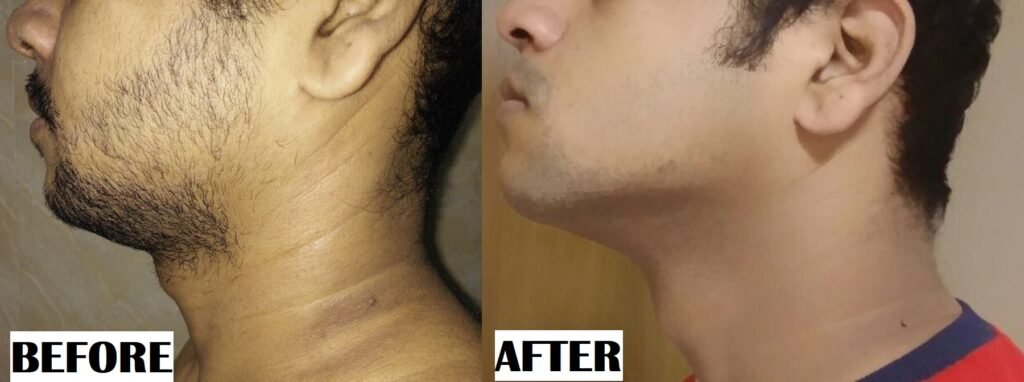
Gallery
Frequently Asked Questions About Jawline Contouring Surgery in Kolkata
1. What is jawline contouring surgery?
Jawline contouring surgery is a group of procedures designed to improve the shape, definition, symmetry and proportions of the lower face. Depending on the individual’s anatomy and goals, treatment may involve the chin, mandibular angle, jawline, excess soft tissue or a combination of these areas. Surgical options can include chin augmentation, genioplasty, jaw implants and selected bone-contouring procedures.
2. Who may benefit from jawline contouring surgery?
Jawline contouring may be considered by adults who feel that their lower face lacks definition, appears disproportionate or has asymmetry involving the chin or jawline. The appropriate procedure depends on whether the concern is related primarily to the bone, chin position, soft tissue or a combination of factors.
3. Can jawline contouring make the jawline more defined?
Yes. Depending on the underlying anatomy, surgical contouring can increase definition by augmenting the chin or jaw, repositioning the chin, reducing selected areas of prominent bone, or addressing excess soft tissue. A detailed facial assessment is necessary to determine which approach is appropriate.
4. What surgical procedures can be used for jawline contouring?
Depending on the patient’s anatomy, jawline contouring may involve:
Chin implant augmentation
Sliding genioplasty
Jaw or mandibular implants
Chin reduction or reshaping
Selected mandibular bone-contouring procedures
Submental fat reduction or neck contouring when excess soft tissue contributes to poor jawline definition
These procedures are not interchangeable, and the choice is based on facial proportions and the specific structural problem.
5. What is the difference between a chin implant and jaw implant?
A chin implant primarily increases the projection and definition of the front of the lower face. A jaw implant can provide greater width and definition along the mandibular body and jaw angle. A chin implant therefore addresses the anterior chin, whereas a jaw implant can extend along a larger portion of the jawline.
6. What is sliding genioplasty?
Sliding genioplasty is a surgical procedure in which a segment of the patient’s own chin bone is cut and repositioned. The chin can be moved forward, backward or sideways to improve projection, proportions or asymmetry. Unlike a chin implant, it does not require an implanted chin prosthesis.
7. Is jawline contouring the same as genioplasty?
No. Genioplasty specifically refers to surgery that reshapes or repositions the chin. Jawline contouring is a broader term that may include genioplasty as well as chin implants, jaw implants, bone contouring and soft-tissue procedures.
8. Can jawline contouring correct a weak or recessed chin?
Yes. A recessed chin may sometimes be improved with a chin implant or sliding genioplasty. The appropriate option depends on the degree of chin deficiency, facial proportions, skeletal anatomy and the relationship between the chin, lips and nose.
9. Can jawline contouring correct facial asymmetry?
It can improve certain forms of asymmetry, particularly when the asymmetry is related to the chin or mandibular contour. However, facial asymmetry may have several causes, and complete symmetry cannot always be achieved. Treatment is planned according to the individual’s underlying anatomy.
10. Can jawline contouring make a round face look more defined?
In selected patients, improving chin projection or mandibular definition can make the lower face appear more structured. However, a round or poorly defined jawline may also be influenced by facial fat, submental fullness, skin laxity and the underlying facial skeleton. These factors need to be assessed separately rather than assuming that a jaw implant alone is appropriate.
11. Can jawline contouring be combined with double-chin treatment?
Yes, when appropriate. Submental fat or loose skin can sometimes obscure an otherwise well-defined jawline. Depending on the problem, treatment may include submental fat reduction, neck contouring or another soft-tissue procedure together with structural chin or jawline surgery.
12. Is jawline contouring suitable for both men and women?
Yes. Jawline contouring can be performed in both men and women, but the desired proportions and treatment plan are individualised. The aim is not simply to create a more angular jaw, but to achieve harmony between the chin, jawline and the rest of the face.
13. Will jawline contouring change my facial profile?
It can. Changes to the chin and jawline can alter the appearance of the lower face in both frontal and side-profile views. Chin augmentation and genioplasty, in particular, can influence facial balance and the relationship between the chin, lips and nose.
14. Will I need a jaw implant or a chin implant?
Not necessarily. Some patients require only chin augmentation, while others may benefit from jawline augmentation or genioplasty. In some cases, the problem is caused predominantly by soft tissue rather than insufficient bone projection. A physical examination and, when indicated, imaging help determine the appropriate approach.
15. Are jaw implants permanent?
Jaw implants are designed as long-term implants, but they are not completely free from potential complications. Infection, displacement, nerve-related symptoms and other implant-related problems can occasionally occur, and revision surgery may sometimes be required.
16. Will jawline contouring leave visible scars?
The location of scars depends on the procedure. Some procedures, such as genioplasty, can be performed through an incision inside the mouth, while certain implant procedures may use an intraoral or small external incision depending on the technique. Your surgeon can explain the expected incision and scar for the specific procedure being considered.
17. Is jawline contouring painful?
The procedure itself is performed under appropriate anaesthesia. After surgery, some swelling, bruising, tightness and discomfort are expected. The intensity and duration of discomfort vary according to the procedure performed and the individual’s healing response.
18. How long does recovery take after jawline contouring surgery?
Recovery depends considerably on the procedure. Soft-tissue procedures and implants may have a different recovery pattern from bone surgery such as sliding genioplasty. Swelling can persist for several weeks, while refinement of the final facial contour may take longer. Your surgeon will provide procedure-specific instructions regarding diet, activity and follow-up.
19. When can I return to work after jawline contouring?
This depends on the extent of surgery, the amount of swelling and the nature of your work. Many patients require several days away from routine activities, while more extensive procedures may require a longer recovery period. The expected downtime should be discussed during the preoperative consultation rather than based on a fixed timeline.
20. What are the risks of jawline contouring surgery?
Potential risks vary according to the procedure but may include bleeding, infection, swelling, bruising, asymmetry, changes in sensation, nerve injury, wound-healing problems, scarring, implant displacement or other implant-related complications. Bone procedures such as genioplasty have their own specific risks, including temporary or persistent numbness around the lower lip or chin.
21. Can jawline contouring affect sensation in the lower lip or chin?
Yes. Procedures involving the chin or lower jaw can temporarily affect sensation because important nerves travel through this region. Numbness, tingling or altered sensation may occur after surgery and usually improves as healing progresses, although persistent nerve-related symptoms are a recognised potential complication.
22. Can jawline contouring be combined with rhinoplasty or facelift surgery?
In selected patients, jawline or chin surgery may be combined with other facial procedures when this is appropriate and safe. Chin surgery, for example, is sometimes performed together with rhinoplasty to improve overall facial balance.
23. Is jawline contouring the same as orthognathic jaw surgery?
No. Jawline contouring is generally concerned with facial shape, contour and proportions. Orthognathic surgery is a different category of surgery used to correct significant skeletal jaw relationships and bite or functional problems. Patients with major bite abnormalities or jaw discrepancies may require assessment by an appropriate maxillofacial or orthodontic team.
24. Do I need a CT scan before jawline contouring surgery?
Not every patient requires the same investigations. Clinical examination and facial photographs are important for planning, while imaging may be recommended when detailed assessment of the chin or mandibular bone is necessary. For some custom jaw implants, three-dimensional CT imaging may be used for planning.
25. Can jawline contouring correct a very wide jaw?
In selected cases, surgical reduction of prominent mandibular bone can alter the width or angle of the lower face. However, the cause of facial width must first be established because muscle bulk, fat distribution and skeletal anatomy can all contribute to the appearance of a broad jaw.
26. How is jawline contouring planned for Indian or South Asian facial features?
Jawline surgery should be planned according to the individual’s facial proportions rather than applying a single definition of an ideal jawline. Chin projection, mandibular width, facial height, soft-tissue thickness and the relationship between the nose, lips and chin all influence the final appearance. The objective is a balanced result that suits the patient’s own facial anatomy.
27. How long do the results of jawline contouring last?
The durability depends on the procedure performed. Changes involving repositioned bone or properly placed implants are intended to provide long-term structural change, although natural ageing, changes in soft tissue and other factors can alter facial appearance over time.
28. How much does jawline contouring surgery cost in Kolkata?
The cost varies according to the procedure required, whether treatment involves the chin, jawline or both, the complexity of surgery, anaesthesia, investigations and other factors. A personalised estimate can be provided after examination and discussion of the treatment plan.
29. Is jawline contouring surgery suitable for everyone?
No. The procedure is not appropriate for every facial concern. A detailed assessment is important to determine whether the problem is primarily skeletal, soft-tissue related, dental or due to another underlying condition. The safest and most appropriate treatment may sometimes be a non-surgical or different surgical approach.
30. How do I know which jawline contouring procedure is right for me?
The appropriate procedure depends on your facial anatomy, chin projection, mandibular width and angle, soft-tissue characteristics, facial asymmetry and your specific aesthetic goals. During consultation, these factors can be assessed to determine whether chin augmentation, genioplasty, jaw augmentation, bone contouring, soft-tissue treatment or a combination would be appropriate.
Honest assessment, written estimate, no pressure to book.