Mole removal in Kolkata is a common dermatologic and minor surgical procedure performed to remove unwanted moles or other pigmented skin lesions for cosmetic, functional or medical reasons. Moles can occur on the face, neck, chest, back and other areas of the body. While many moles are harmless, a mole that changes in size, shape, colour or appearance should be medically assessed before removal.
Mole Removal in Kolkata
Mole removal surgery in Kolkata is planned according to the mole’s size, location, depth and appearance. Depending on the individual lesion, treatment may involve surgical excision or another appropriate removal technique. Facial moles require particular attention to incision placement and wound closure because the aim is to remove the lesion safely while achieving the most favourable possible cosmetic result.
Cosmetic Mole Removal
For patients who are bothered by a prominent facial or body mole, cosmetic mole removal in Kolkata can improve the appearance of the affected area. Moles may catch on clothing, become irritated during shaving or cause self-consciousness. The appropriate technique depends on the individual lesion, and patients should be aware that removing a mole may leave a scar, although careful surgical planning can help optimise its appearance.
Facial Mole Removal in Kolkata
Facial mole removal requires particular precision because even a small scar can be noticeable. The location of the mole, natural skin creases, facial contours and skin characteristics are considered when planning the procedure. Where surgical excision is appropriate, careful tissue handling and meticulous closure can help achieve a discreet scar that becomes less conspicuous as it matures.
When Should a Mole Be Evaluated?
Although most moles are benign, professional assessment is particularly important when a lesion shows rapid growth, irregular borders, multiple colours, bleeding, ulceration, persistent itching or other significant changes. A suspicious lesion should be evaluated before cosmetic removal. When clinically indicated, the excised tissue can be sent for histopathological examination to establish the diagnosis.
Indications for evaluation include:
- recent or rapid increase in size
- change in shape or border
- change in colour or multiple colours
- bleeding or ulceration
- persistent itching or irritation
- a new unusual lesion
- a mole that looks significantly different from the patient’s other moles
A suspicious mole should be assessed before cosmetic removal. Cosmetic treatment should not delay appropriate medical evaluation.
Mole Removal by Prof. (Dr.) Souvik Adhikari
Prof. (Dr.) Souvik Adhikari brings 17+ years of surgical experience in cosmetic, plastic and reconstructive surgery, with additional AOCMF Fellowship training at Johns Hopkins University, USA. His approach to mole removal in Kolkata focuses on careful clinical assessment, appropriate technique selection, precise tissue removal and aesthetically considerate wound closure. You can read more about him here and about his academic achievements here.
Mole Removal Recovery and Aftercare
Recovery following mole removal surgery in Kolkata depends on the size and location of the lesion and the technique used. Mild tenderness, swelling or redness may occur initially. Patients receive personalised instructions regarding wound care, activity and scar management. The scar will continue to mature over time, and its final appearance depends on individual healing and the characteristics of the original lesion.
If you are searching for mole removal in Kolkata, a consultation can help determine whether the mole is suitable for cosmetic removal or requires further medical evaluation. The objective is safe and appropriate removal with careful attention to diagnosis, healing and the appearance of the resulting scar.
Personalised Planning for Mole Removal
Mole removal at Cosmetic Surgery Kolkata begins with careful assessment of the lesion, including its size, location, colour, surface characteristics, depth and any recent changes. Prof. (Dr.) Souvik Adhikari evaluates whether the mole appears suitable for cosmetic removal or whether further medical assessment is advisable before treatment.
When removal is appropriate, the technique is selected according to the individual lesion and the desired clinical and cosmetic outcome. Particular attention is given to facial moles, where the position of the lesion, surrounding skin, natural facial contours and wound closure can influence the final appearance of the scar.
Where clinically indicated, removed tissue may be sent for histopathological examination to help establish the diagnosis.
Who May Benefit From Mole Removal?
Mole removal may be considered when a mole is cosmetically bothersome, repeatedly irritated, catches on clothing or jewellery, becomes uncomfortable during shaving, or is otherwise difficult for the patient to accept or monitor.
Removal may also be recommended when a mole requires medical assessment because of concerning clinical features. A changing, bleeding, ulcerated, rapidly growing or otherwise unusual lesion should be evaluated before treating it as a purely cosmetic concern.
Suitability for removal depends on the type, size, depth, location and appearance of the mole, as well as the patient’s general health and expectations.
Potential Benefits of Mole Removal
Depending on the individual mole and the reason for treatment, mole removal may help to:
remove an unwanted or prominent mole
improve the appearance of a visible facial or body mole
reduce repeated irritation from clothing, shaving or friction
address a lesion that is difficult to monitor
improve confidence about the appearance of the skin
allow tissue to be examined histopathologically when clinically indicated
The cosmetic result depends on the characteristics of the mole, the removal technique and individual healing. Complete scar-free removal cannot be guaranteed.
How Is Mole Removal Performed?
There is no single technique that is appropriate for every mole. The method is selected after examining the lesion and considering its size, depth, location, appearance and whether complete tissue examination is required.
Surgical Excision
Surgical excision involves removing the mole together with an appropriate margin of surrounding tissue when clinically indicated, followed by careful closure of the wound.
This approach may be particularly useful for deeper lesions or when the removed tissue needs to be submitted for histopathological examination.
Shave Excision
Selected raised or superficial lesions may be suitable for shave removal, in which the prominent portion of the lesion is removed at an appropriate level.
The suitability of shave removal depends on the clinical characteristics of the mole and whether complete excision and histopathological assessment are required.
Technique Selection
The decision between excision, shave removal or another approach should be based on the individual lesion rather than on the desire for a particular technique.
For facial moles, the position and direction of the incision and the method of wound closure are especially important because the resulting scar is visible.
Facial Mole Removal
Facial mole removal requires particular attention to both safe removal and the cosmetic appearance of the healed area.
The location of the mole, facial contours, natural skin creases, skin characteristics and the expected direction of the scar are considered during treatment planning.
The aim is to remove the lesion appropriately while creating the most discreet and well-planned scar that the individual’s anatomy allows.
Will Mole Removal Leave a Scar?
Any procedure that removes a mole can result in a scar. The appearance of the scar depends on the size and depth of the lesion, the removal technique, its anatomical location and individual healing characteristics.
Facial scars may initially appear more noticeable and can gradually flatten and fade as they mature. Scar maturation may continue for many months, and a completely invisible scar cannot be guaranteed.
Anaesthesia for Mole Removal
Most small mole removal procedures can be performed under local anaesthesia. The anaesthetic numbs the treatment area so that the procedure can be performed comfortably.
The appropriate anaesthetic approach depends on the size, number and location of lesions and the extent of the procedure.
How Long Does Mole Removal Take?
The duration of mole removal depends on the number, size, depth and location of the lesions and the technique required.
A small, straightforward mole may be removed relatively quickly, whereas a larger or deeper lesion may require more extensive excision and wound closure.
Rather than applying one fixed operating time to every patient, the expected duration is discussed after assessment.
Recovery After Mole Removal
Recovery varies according to the size and location of the mole and the removal technique.
Mild tenderness, swelling or redness may occur during the early healing period. Patients receive instructions regarding wound care, keeping the area clean, activity restrictions and, where appropriate, suture care.
Activities that create friction, stretching or pressure over the treated area may need to be restricted temporarily.
The wound generally heals before the scar reaches its final appearance. Scar maturation continues gradually over the following months.
Histopathological Examination After Mole Removal
When clinically appropriate, the removed mole may be sent to a pathology laboratory for histopathological examination.
Histopathology allows the tissue to be examined under a microscope and can help confirm the nature of the lesion.
Whether histopathological examination is recommended depends on the clinical assessment and characteristics of the individual lesion.
Risks and Possible Complications
Mole removal is generally a straightforward procedure, but complications can occur.
Potential risks include:
bleeding or haematoma
infection
delayed wound healing
wound separation
altered sensation
pigmentation changes
contour irregularity
recurrence or regrowth of a lesion
unfavourable or prominent scarring
incomplete removal in selected cases
need for further treatment or revision
The risks relevant to a particular mole are discussed during consultation and informed consent.
Can a Mole Come Back After Removal?
A mole may recur if some of the lesion remains after treatment, depending on the type of mole and the removal technique used.
A recurrent lesion should be clinically assessed rather than automatically assumed to be harmless. Further evaluation or treatment may occasionally be necessary.
Results of Mole Removal
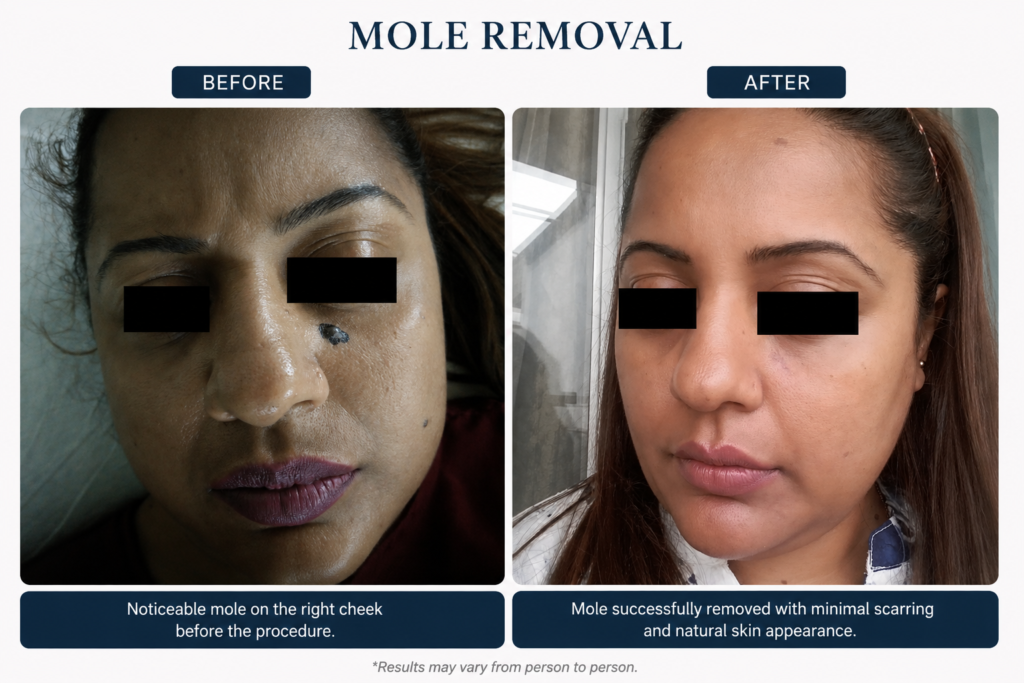
The visible mole is removed during the procedure, but the appearance of the treated area continues to evolve during healing.
Redness, swelling or temporary pigmentation changes may be present initially. The scar gradually matures and usually becomes flatter and less noticeable over time.
The final cosmetic result depends on the original lesion, its location, the technique used and the individual’s healing response. A completely scar-free result cannot be promised.
Mole Removal by Prof. (Dr.) Souvik Adhikari
Prof. (Dr.) Souvik Adhikari is a Professor and Consultant Plastic Surgeon with more than 17 years of independent surgical experience in cosmetic, plastic and reconstructive surgery.
His approach to mole removal combines appropriate clinical assessment, careful selection of the removal technique and attention to wound closure and scar appearance, particularly for visible facial lesions.
His additional AOCMF Fellowship training at Johns Hopkins University, USA, forms part of his broader academic and reconstructive surgical background.
Consultation for Mole Removal in Kolkata
During consultation, the mole is assessed carefully and the appropriate treatment options are discussed.
The consultation may include consideration of:
the size and location of the mole
its colour, shape and surface characteristics
whether it has changed recently
whether it is symptomatic or repeatedly irritated
whether cosmetic removal is appropriate
the most suitable removal technique
the expected scar
whether histopathological examination is advisable
recovery and wound care
potential risks and limitations
The objective is to ensure that mole removal is appropriate for the individual lesion and that the patient understands both the expected cosmetic result and the limitations of treatment.

Prof. (Dr.) Souvik Adhikari
MS, MCh (Plastic Surgery)
17+ years experience
Gallery
Consented before-and-after photographs for mole removal surgery are reviewed privately during consultation, in line with medical advertising guidelines.
Frequently Asked Questions
What is mole removal surgery?
Mole removal is a procedure used to remove an unwanted or medically concerning mole from the skin. Depending on the type, size, depth and location of the mole, removal may involve surgical excision, shave excision or another appropriate technique. The method is selected after examining the mole and considering both medical and cosmetic factors.
When should a mole be removed?
A mole may be considered for removal if it is changing in size, shape or colour, repeatedly irritated or bleeding, cosmetically bothersome, or difficult to monitor. A mole that appears unusual or has concerning changes should be medically assessed before cosmetic removal.
Can facial moles be removed without leaving a scar?
Any procedure that removes a mole can leave some degree of scarring. However, when appropriate, the incision and closure can be planned carefully according to the size, depth and location of the mole, with the aim of achieving the least conspicuous possible scar. Scar appearance varies between individuals and cannot be completely guaranteed.
What is the best method for removing a mole?
There is no single best technique for every mole. Surgical excision, shave removal and other techniques may be appropriate depending on the mole's appearance, depth, size, location and whether laboratory examination is required. The safest and most appropriate method is determined after clinical assessment.
Is surgical mole removal better than laser mole removal?
Laser treatment is not appropriate for every mole, particularly when the lesion needs to be removed and examined histologically. Surgical techniques can allow the removed tissue to be sent for histopathological examination when indicated. The choice between surgical and other methods should therefore be based on the diagnosis and characteristics of the individual mole rather than on the technique alone.
Can a mole be removed from the face?
Yes. Facial moles can often be removed using an appropriately selected technique. Because facial skin is highly visible, the location, size and depth of the mole and the direction of the resulting scar are important considerations when planning treatment.
Will the removed mole be sent for histopathology?
When clinically appropriate, the removed tissue can be sent for histopathological examination. Histopathology allows a pathologist to examine the tissue under a microscope and can help confirm the diagnosis. Whether laboratory examination is recommended depends on the characteristics of the lesion and the clinical assessment.
Can a mole come back after removal?
A mole may recur if some of the lesion remains after removal. The likelihood depends on the type of mole and the removal technique used. A recurrent lesion should be assessed rather than assuming that it is simply another harmless mole.
Is mole removal painful?
The procedure itself is generally performed with local anaesthesia, which numbs the treatment area. Patients may feel pressure or movement during the procedure but should not experience significant pain. Mild soreness or tenderness can occur after the anaesthetic wears off.
How long does mole removal surgery take?
The duration depends on the size, number and location of the moles and the technique required. A small, straightforward mole may be removed relatively quickly, whereas larger or deeper lesions may require more extensive excision and closure.
Can a mole be removed if it has recently changed?
A mole that has recently changed in size, shape, colour or surface characteristics should be medically assessed before cosmetic removal. Changes such as bleeding, ulceration, rapid growth or significant irregularity may require further evaluation. If removal is appropriate, the treatment plan can be decided after the lesion has been assessed.
What is the recovery after mole removal?
Recovery depends on the size and location of the treated area and whether sutures are required. Mild swelling, redness or tenderness may occur initially. Patients are generally advised to keep the area clean, follow wound-care instructions and avoid activities that could disrupt healing until the wound has adequately recovered.
When can I return to work after mole removal?
For a small uncomplicated mole removal, many patients can return to normal daily activities relatively quickly. The timing depends on the location and extent of the procedure and the type of work. Activities involving friction, stretching or pressure over the treated area may require additional precautions.
How long does a mole removal scar take to heal?
The wound usually heals progressively over the weeks following removal, but scar maturation takes considerably longer. A scar may initially appear pink, raised or darker than the surrounding skin before gradually becoming flatter and less noticeable. The final appearance can take several months or longer to develop.
Can mole removal improve the appearance of my face?
Yes. When a prominent or unwanted facial mole is successfully removed, the overall appearance of the skin and facial contour may become more balanced. The cosmetic result depends on the mole's characteristics, its location and the way the wound heals.
Can multiple moles be removed at the same time?
Multiple moles can sometimes be removed during the same treatment session. Whether this is appropriate depends on the number, size, location and clinical characteristics of the lesions. Each mole should be assessed individually before deciding on treatment.
Can a suspicious-looking mole be removed purely for cosmetic reasons?
A mole that appears suspicious should first undergo appropriate medical assessment. Cosmetic removal should not replace evaluation of a lesion that has concerning features such as significant change, irregularity, bleeding or other unusual characteristics. The priority is to establish whether further investigation or histopathological examination is necessary.
Is mole removal safe?
Mole removal is a commonly performed procedure, but like any surgical treatment it has potential risks. These may include bleeding, infection, wound-healing problems, changes in sensation, pigmentation changes, scarring and recurrence. The risks vary according to the lesion and the technique used.
How much does mole removal cost in Kolkata?
The cost of mole removal in Kolkata varies according to the size and number of moles, their location, the technique required, whether laboratory examination is needed and the complexity of wound closure. An exact cost can be provided after clinical assessment and discussion of the appropriate treatment plan.
Can I remove a mole at home?
Home removal of a mole is not recommended. Cutting, burning, tying or applying unproven chemicals to a mole can cause bleeding, infection, scarring and incomplete removal. More importantly, self-treatment can delay appropriate assessment of a lesion that may require medical evaluation.
How do I choose a surgeon for mole removal in Kolkata?
The choice of surgeon should take into account appropriate surgical training, experience with skin and soft-tissue procedures, the ability to assess whether a lesion requires further investigation, and attention to wound closure and scarring. For facial moles in particular, experience in plastic and reconstructive surgery can be valuable because both safe removal and the cosmetic outcome need to be considered.
Honest assessment, written estimate, no pressure to book.