Facial fat transfer, also known as facial fat grafting or autologous fat grafting,is a facial rejuvenation procedure that uses a patient’s own fat to restore selected areas of lost facial volume and improve facial contour. The procedure involves harvesting fat from a suitable donor area, carefully processing it and strategically transferring it to areas of the face requiring volume enhancement. It can be used to address age-related volume loss while maintaining a natural facial appearance.
Areas Treated with Facial Fat Transfer
Facial fat transfer in Kolkata may be used to enhance areas such as the cheeks, temples, tear trough region, lips and other areas of volume deficiency, depending on the patient’s anatomy and treatment goals. Unlike dermal fillers, which use an injectable synthetic or naturally occurring gel, facial fat grafting uses the patient’s own tissue. The amount and location of fat transferred are carefully planned to create balanced facial proportions rather than excessive fullness.
Facial Fat Transfer for Facial Rejuvenation
Ageing can result in gradual loss of facial fat, contributing to hollow temples, reduced cheek volume, deeper facial folds and a tired appearance. Facial fat grafting surgery in Kolkata can help restore selected areas of lost volume and improve facial contours. In addition to adding volume, fat contains a population of cells and growth factors that may influence the quality and appearance of the overlying skin, although the extent of these effects varies between individuals.
Facial Fat Transfer for Midface and Cheek Volume targets –
- hollow cheeks
- midface volume loss
- cheek projection
- facial asymmetry
Natural-Looking Facial Contouring
The goal of facial fat grafting is not simply to add volume. Precise placement in different facial layers and areas allows the surgeon to address specific contours while maintaining natural facial movement and expression. Conservative, three-dimensional planning is particularly important because excessive fat transfer can produce an unnatural or overly full appearance. Some of the transferred fat may also be naturally reabsorbed during healing, so final volume cannot be predicted with complete precision.
Who May Benefit from Facial Fat Grafting?
Patients with facial volume loss, hollow cheeks, sunken temples or selected areas of facial asymmetry may consider facial fat transfer. It may also be used as an adjunct to procedures such as facelift surgery or other facial rejuvenation treatments. Adequate donor fat and realistic expectations are important considerations. A detailed consultation is necessary to determine whether fat grafting is suitable for the patient’s facial anatomy and desired outcome.
Facial Fat Grafting by Prof. (Dr.) Souvik Adhikari
Prof. (Dr.) Souvik Adhikari brings 17+ years of surgical experience in cosmetic, plastic and reconstructive surgery, with additional AOCMF Fellowship training at Johns Hopkins University, USA. His approach to facial fat grafting in Kolkata focuses on detailed facial analysis, three-dimensional contour planning, careful fat handling and precise placement to achieve harmonious and natural-looking facial rejuvenation.
Recovery After Facial Fat Transfer
Recovery following facial fat transfer surgery in Kolkata varies depending on the areas treated and the amount of fat transferred. Swelling, bruising and temporary asymmetry are common during the early healing period and gradually improve. Patients receive personalised instructions regarding facial care, activity and follow-up. The final result becomes clearer as swelling settles and the transferred fat stabilises.
If you are considering facial fat grafting in Kolkata, a personalised consultation can help determine whether autologous fat transfer is appropriate for your facial structure and aesthetic goals. The objective is to achieve restored facial volume, improved contour and natural-looking rejuvenation using your own tissue, while maintaining realistic expectations regarding healing and long-term volume retention.
Personalised Planning for Facial Fat Transfer
Facial fat transfer at Cosmetic Surgery Kolkata is planned after detailed assessment of facial proportions, areas of volume loss, skin quality, facial asymmetry, available donor fat and the patient’s aesthetic goals. The aim is not simply to add volume, but to restore selected facial contours while maintaining natural proportions and facial expression.
The amount of fat required and the areas treated vary considerably between patients. Depending on the pattern of facial ageing or volume deficiency, treatment may focus on the cheeks, temples, under-eye region, lips, midface or other carefully selected areas.
Who May Be Considered for Facial Fat Transfer?
Facial fat transfer may be considered for adults who have:
Hollow or sunken cheeks
Loss of volume in the temples
Selected under-eye or tear-trough volume deficiency
Midface volume loss associated with ageing or weight changes
Facial asymmetry caused partly by soft-tissue volume differences
Areas of facial contour deficiency that may benefit from autologous fat
Realistic expectations regarding fat retention and the healing process
Adequate donor fat is necessary because facial fat transfer uses the patient’s own tissue. Overall health, smoking status, facial anatomy and any previous facial procedures are also considered before treatment.
Potential Benefits of Facial Fat Transfer
Depending on the areas treated, facial fat transfer may provide:
Restoration of selected areas of lost facial volume
Improved cheek and midface contour
Reduction in the appearance of hollow temples
Improvement of selected under-eye volume deficiencies
Better facial balance and proportions
A natural-tissue alternative to repeated dermal filler treatment
Potential improvement in facial contour following significant weight loss
A more refreshed appearance while preserving individual facial characteristics
The degree of improvement and the amount of retained fat vary between individuals.
How Is Facial Fat Transfer Performed?
Facial fat transfer generally involves three stages: harvesting, processing and grafting.
Fat is harvested from a suitable donor area using small liposuction access points. The harvested tissue is then processed according to the surgical technique before being transferred in small amounts to carefully selected facial areas.
Fat is placed in appropriate tissue planes using precise injection techniques. Three-dimensional planning and conservative placement are important because excessive volume can produce an unnatural appearance.
The donor area and facial treatment areas are selected according to the patient’s anatomy and the overall contouring plan.
Facial Fat Transfer for the Cheeks
Cheek fat grafting can be used to restore volume in hollow or flattened cheeks and improve midface proportions. The objective is generally to create appropriate projection and smooth transitions rather than excessive fullness.
The amount and placement of fat depend on existing cheek structure, facial proportions, skin quality and the degree of volume loss.
Facial Fat Transfer for Hollow Temples
Ageing and significant weight loss can result in loss of temporal volume. Carefully performed fat transfer may restore selected areas of temporal hollowing and improve the transition between the forehead, temples and upper face.
Because the temple is an anatomically sensitive region, treatment requires careful assessment and precise technique.
Facial Fat Transfer for Under-Eye Hollows
Selected patients with volume deficiency around the lower eyelid or tear-trough region may benefit from fat grafting. However, under-eye appearance can result from several factors, including skin quality, fat position, pigmentation, bone structure and eyelid anatomy.
Fat transfer is therefore not appropriate for every patient with dark circles or under-eye hollows. Individual assessment is important to determine whether volume restoration is likely to help.
Facial Fat Transfer After Weight Loss
Significant weight loss can reduce facial fat and lead to hollow cheeks, temples or other areas of volume deficiency. In appropriately selected patients with reasonably stable weight, facial fat transfer may restore some of this lost volume.
Further major weight changes after treatment can alter facial volume and affect the long-term appearance.
Facial Fat Transfer vs Dermal Fillers
Facial fat transfer and dermal fillers are different approaches to facial volume restoration.
Fat transfer uses the patient’s own fat and requires harvesting from a donor area, whereas dermal fillers are injected directly without a surgical donor-site procedure. Fat transfer may provide longer-lasting volume when transferred fat successfully establishes a blood supply, although some of the grafted fat is naturally reabsorbed.
The choice between fat transfer and fillers depends on the treatment area, degree of volume deficiency, desired result, available donor fat, medical considerations and patient preference.
Facial Fat Transfer with Facelift or Blepharoplasty
Facial fat transfer can be combined with other facial procedures in selected patients.
A facelift primarily addresses facial skin and soft-tissue laxity and descent, while fat transfer can restore selected areas of volume deficiency. Similarly, fat grafting may complement blepharoplasty when volume loss contributes to the appearance of the lower eyelid or surrounding facial areas.
The combination of procedures is considered only when it is appropriate for the patient’s anatomy and overall treatment goals.
Anaesthesia
The anaesthetic approach depends on the extent of facial fat transfer, the donor area being treated and whether another procedure is performed at the same time.
Smaller procedures may be performed using local anaesthesia with appropriate sedation, while more extensive treatment or combined procedures may require general anaesthesia. The final plan is determined after individual assessment and pre-anaesthetic evaluation.
Duration of Facial Fat Transfer
The duration varies according to the number of facial areas treated, the amount of fat required, the donor area and whether another procedure is performed at the same time.
The expected operating time is discussed during individual surgical planning rather than assuming a fixed duration for every patient.
Recovery After Facial Fat Transfer
Swelling, bruising, tenderness and temporary asymmetry are common during the early recovery period. These effects gradually improve as the tissues heal and the transferred fat stabilises.
The facial treatment areas and the donor area may both require postoperative care. Patients receive individual instructions regarding facial care, activity, medications and follow-up.
Routine activities can generally be resumed progressively according to the extent of treatment and individual recovery, while strenuous activity may need to be restricted during the early healing period.
Risks and Possible Complications
Facial fat transfer is a surgical procedure and carries potential risks. These may include:
Swelling and bruising
Temporary or persistent asymmetry
Variable fat survival
Fat necrosis or small areas of firmness
Contour irregularity or over- or under-correction
Infection
Bleeding or haematoma
Changes in sensation
Donor-site irregularities
Unfavourable scarring
Need for revision or additional fat grafting
Rare but serious complications can occur with facial fat injection, particularly in anatomically sensitive areas. Appropriate patient selection, careful injection technique and appropriate surgical precautions are therefore important.
Results and Long-Term Expectations
Some of the transferred fat is naturally reabsorbed during the healing period. The fat that successfully establishes a blood supply may provide longer-lasting volume.
The final appearance becomes clearer gradually as swelling resolves and the transferred tissue stabilises. Individual fat retention varies, so the final amount of volume cannot be predicted with complete precision.
Ageing, significant changes in body weight and other changes in facial tissues can influence the appearance over time. Some patients may require a second fat-transfer session if additional volume restoration is desired after the initial result has stabilised.
Why Choose Prof. (Dr.) Souvik Adhikari?
Prof. (Dr.) Souvik Adhikari is a Professor and Consultant Plastic Surgeon with 17+ years of independent surgical experience in cosmetic, plastic and reconstructive surgery.
His approach to facial fat transfer focuses on detailed facial analysis, three-dimensional contour planning, careful handling of harvested fat and precise placement according to individual facial anatomy.
The objective is to restore appropriate facial volume while maintaining natural proportions rather than creating excessive fullness or altering the patient’s characteristic facial appearance.
Consultation for Facial Fat Transfer
A personalised consultation is the first step in determining whether facial fat transfer is appropriate. Facial proportions, areas of volume loss, skin quality, facial asymmetry, available donor fat, previous procedures and individual expectations are assessed before a treatment plan is recommended.
Depending on the findings, facial fat transfer may be recommended alone or as part of a broader facial rejuvenation plan.
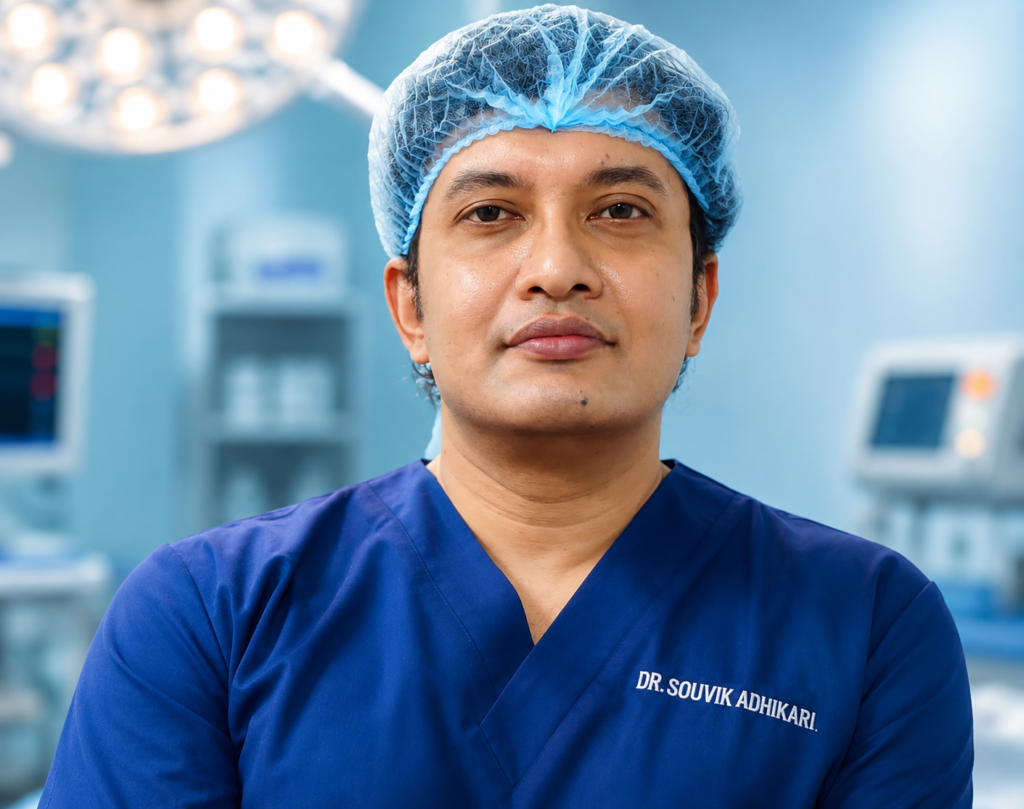
Prof. (Dr.) Souvik Adhikari
MS, MCh (Plastic Surgery)
17+ years experience
Frequently Asked Questions
What is facial fat grafting?
Facial fat grafting is a cosmetic procedure in which fat is harvested from another area of your own body, processed and carefully injected into selected areas of the face to restore volume, improve facial contours and create a more youthful, natural-looking appearance.
What is facial fat grafting in Kolkata?
Facial fat grafting in Kolkata is a personalised facial rejuvenation procedure in which a patient's own fat is transferred to areas such as the cheeks, temples, lips or under-eye region. The treatment is planned according to facial anatomy, existing volume loss and the patient's aesthetic goals.
Which areas of the face can be treated with fat grafting?
Facial fat grafting can be used to restore volume in the cheeks, temples, under-eye hollows, lips, nasolabial region and other areas of facial volume deficiency. The areas treated depend on the individual's facial anatomy and aesthetic requirements.
Can fat grafting be used to treat hollow cheeks?
Yes. Facial fat grafting can restore volume to hollow or sunken cheeks in appropriately selected patients. Carefully placed fat can improve cheek contour while maintaining natural facial proportions.
Can facial fat grafting treat under-eye hollows?
In selected patients, fat grafting or fat repositioning can improve under-eye hollows and restore volume around the lower eyelid. The appropriate technique depends on the degree of hollowing, skin laxity and the anatomy of the lower eyelid.
Can facial fat grafting improve the appearance of the temples?
Yes. Fat grafting can be used to restore volume in hollow temples in selected patients. The amount and placement of fat are carefully planned because the temples are an anatomically sensitive area.
Can facial fat grafting make the face look younger?
Facial fat grafting can restore volume that has been lost with ageing or weight changes and may improve facial contours and proportions. The aim is generally to create a refreshed and natural appearance rather than simply adding maximum volume.
Is facial fat grafting better than dermal fillers?
Facial fat grafting and dermal fillers are different treatments. Fat grafting uses the patient's own fat and requires fat harvesting through liposuction, whereas fillers are injected directly without a donor-site procedure. The choice depends on the area being treated, the desired degree and duration of volume restoration, and the patient's preferences and anatomy.
How is facial fat grafting performed?
Facial fat grafting involves three main stages: harvesting fat from a suitable donor area, processing the harvested fat and carefully injecting small amounts into the selected facial areas. Precise placement is important to achieve appropriate contour and natural-looking volume.
How long does facial fat grafting take?
The duration of facial fat grafting depends on the number of areas being treated, the amount of fat required and whether it is combined with another procedure. The expected operating time is discussed during the consultation.
How much of the transferred fat survives after facial fat grafting?
Not all transferred fat survives permanently. A variable proportion of the grafted fat is naturally absorbed during the healing period, while the surviving fat can provide longer-lasting volume. The final amount of retained volume varies between individuals and depends on several biological and technical factors.
Can facial fat grafting be used after significant weight loss?
Yes. Facial fat grafting may be considered in selected patients who develop hollowing or loss of facial volume after significant weight loss. However, the patient's weight should ideally be reasonably stable before treatment because further major weight changes can affect the result.
Is facial fat grafting permanent?
The surviving fat cells can provide long-lasting volume, but facial fat grafting should not be considered a guarantee of permanent or completely unchanged results. Ageing, weight fluctuations and individual tissue changes can affect facial appearance over time.
Can facial fat transfer improve facial asymmetry?
Facial fat transfer may improve selected facial asymmetries when differences in soft-tissue volume contribute to the imbalance. The amount and placement of fat are planned according to the individual's facial anatomy. Complete symmetry cannot be guaranteed, and the appropriate treatment depends on the underlying cause of the asymmetry.
Will I need more than one facial fat grafting session?
Some patients achieve satisfactory correction with a single procedure, while others may benefit from a second session if additional volume is required or if the initial fat retention is insufficient. The need for further treatment can only be assessed after the initial result has stabilised.
Does facial fat grafting leave scars?
Fat harvesting requires small access incisions, which generally heal as small scars. The facial injection sites are usually very small. The location and visibility of scars depend on the donor area, surgical technique and individual healing.
What is the recovery like after facial fat grafting?
Swelling, bruising and tenderness can occur both in the facial treatment areas and at the fat-harvesting site. These effects gradually improve during recovery, while the transferred fat settles and the final facial contour becomes clearer over time. Recovery varies according to the extent of treatment and whether other procedures are performed at the same time.
Is facial fat grafting safe?
Facial fat grafting is a surgical procedure and, like other procedures, carries potential risks. These may include bleeding, infection, swelling, bruising, irregularities, asymmetry, fat necrosis and variable fat survival. Rare but serious complications can occur, so appropriate patient selection, surgical technique and follow-up are important.
Who is a good candidate for facial fat grafting?
A suitable candidate is generally someone with areas of facial volume deficiency who is in reasonable overall health, has sufficient donor fat and has realistic expectations about the outcome. Suitability is determined after an individual assessment of facial anatomy, skin quality, volume loss and the patient's goals.
Can facial fat grafting be combined with blepharoplasty?
Yes. In selected patients, facial fat grafting may be combined with blepharoplasty to address volume deficiency around the eyes and other areas of the face. The combination is considered when both excess eyelid tissue and volume loss contribute to the appearance of the eyes or midface.
Can facial fat grafting be combined with a facelift?
Yes. Facial fat grafting may be performed alongside a facelift in selected patients when restoring facial volume is an important part of the overall rejuvenation plan. A facelift primarily addresses tissue laxity and descent, while fat grafting can address selected areas of volume deficiency.
How much does facial fat grafting cost in Kolkata?
The cost of facial fat grafting in Kolkata varies according to the number of facial areas treated, the amount of fat required, the donor area, the surgical technique, anaesthesia and whether another procedure is performed at the same time. An exact estimate can be provided after personal assessment and treatment planning.
Where can I get facial fat grafting in Kolkata?
Facial fat grafting should be performed by a suitably qualified plastic surgeon in an appropriately equipped surgical facility. During consultation, the surgeon should assess facial anatomy, volume deficiency, donor fat availability, treatment options, expected results and potential risks before recommending the procedure.
Honest assessment, written estimate, no pressure to book.