Facial scar revision in Kolkata is a specialised plastic surgery treatment designed to improve the appearance of scars on the face caused by accidents, burns, previous surgery, acne, infections or other injuries. Facial scars can affect skin texture, symmetry and overall appearance, and some may also cause tightness or restriction of movement. The objective of facial scar revision surgery is not to erase a scar completely, but to make it less noticeable and, where necessary, improve associated functional problems.
Facial Scar Revision: Surgical and Non-Surgical Treatment
Facial scar revision surgery in Kolkata is individually planned according to the scar’s size, location, depth, direction, texture and relationship with surrounding facial structures. Depending on the type of scar, treatment may involve surgical scar revision, scar excision, Z-plasty, W-plasty, laser treatment, microneedling, steroid therapy or a combination of techniques. The most appropriate approach is determined after examining the scar and understanding how it developed.
Types of Facial Scars and Their Treatment
Different facial scars require different treatment strategies. Traumatic scars, surgical scars, burn scars, hypertrophic scars, keloids and depressed or irregular scars may all require different approaches. Some scars are primarily a cosmetic concern, while others can cause tightness, distortion or restricted movement. A detailed assessment helps identify the type of scar and determine whether surgical or non-surgical treatment is most appropriate.
Facial Scar Revision for Acne Scars
Acne scars are not all the same. Depressed scars such as rolling, boxcar and selected tethered scars may require different approaches from raised or hypertrophic scars. Depending on the scar pattern, treatment may involve subcision, resurfacing, microneedling, fat or other volume restoration techniques, or surgical revision in selected cases. A detailed assessment is necessary to determine the most appropriate approach.
Surgical Scar Revision and Natural-Looking Results
The aim of facial scar revision in Kolkata is to improve the scar’s visibility and integrate it more naturally with the surrounding skin. Surgical techniques such as Z-plasty or W-plasty may be useful in selected scars to alter scar direction or release contracture. Precise tissue handling and careful wound closure are important because facial scars can be particularly visible. Patients should understand that revision improves a scar rather than completely removing it. Facial scar treatment may involve surgical scar revision, laser treatment, injections or other scar-management techniques depending on the type of scar.
Facial Scar Treatment After Injury or Surgery
A facial scar can continue to change in appearance for many months as collagen remodels and the scar matures. Some scars may improve with conservative treatment, while others remain wide, raised, depressed or irregular and may benefit from scar revision surgery. The timing of revision depends on the type and maturity of the scar, its location and whether any functional problem is present.
Facial Scar Revision by Prof. (Dr.) Souvik Adhikari
Prof. (Dr.) Souvik Adhikari brings 17+ years of surgical experience in cosmetic, plastic and reconstructive surgery, with additional AOCMF Fellowship training at Johns Hopkins University, USA. His approach to facial scar revision in Kolkata focuses on detailed scar assessment, appropriate technique selection, meticulous tissue handling and careful consideration of facial aesthetics and function.
Recovery After Facial Scar Revision
Recovery following facial scar revision surgery in Kolkata depends on the size and location of the scar and the technique used. Temporary swelling, bruising and sensitivity may occur after surgery. Patients receive personalised postoperative instructions regarding wound care, sun protection, scar management and follow-up. The revised scar will continue to mature over time, and its final appearance depends on individual healing as well as the original characteristics of the scar.
If you are looking for facial scar revision in Kolkata, a specialist consultation can help determine the type of scar you have and whether surgical revision, non-surgical treatment or a combination approach is appropriate. The goal is to achieve a smoother, less conspicuous scar while preserving natural facial movement, contour and expression.
Individualised Planning for Facial Scar Revision
Every facial scar has different characteristics. During consultation, the scar is assessed for its cause, age, location, direction, width, depth, texture, colour, relationship with facial structures and any associated tightness or distortion. Previous treatment and the condition of the surrounding skin are also considered.
The treatment plan is selected according to the type of scar and the improvement that can realistically be achieved. Some scars are better treated with non-surgical methods, while others may benefit from surgical revision or a combination of approaches.
Which Facial Scars May Benefit From Revision?
Facial scar revision may be considered for scars that are:
Wide, irregular or poorly aligned
Raised or hypertrophic
Depressed or indented
Tethered to deeper tissues
Associated with local distortion or tightness
Prominent because of their direction or position
Caused by previous surgery, trauma, burns or other injuries
The decision to revise a scar depends on its characteristics rather than simply how old it is.
Surgical Scar Revision
For selected scars, the existing scar may be carefully excised and the wound precisely re-closed to create a finer and more favourably positioned scar.
Layered closure may be used when appropriate to reduce tension on the skin and optimise the wound-healing environment. Careful tissue handling and precise closure are particularly important on the face because even relatively small scars can be noticeable.
Z-Plasty and W-Plasty for Facial Scars
Z-plasty and W-plasty are specialised scar-revision techniques used in selected situations.
Z-plasty can change the direction of a scar, redistribute tension and improve flexibility where a scar is restrictive. W-plasty can create a more irregular scar line that may blend more naturally with surrounding facial contours in appropriately selected scars.
The choice of technique depends on the location, orientation and characteristics of the individual scar. These are established scar-revision techniques described by the American Society of Plastic Surgeons.
Facial Scar Revision for Contracture and Tightness
Some facial scars are not only visible but also restrict movement or distort nearby structures. This can occur after burns, trauma or significant tissue loss.
When a scar causes tightness or contracture, treatment may require scar release and tissue rearrangement rather than simple scar excision. Depending on the defect, skin grafting or flap reconstruction may occasionally be required.
Treatment of Depressed Facial Scars
Depressed or indented scars may result from loss of tissue beneath the skin or tethering of the scar to deeper structures.
Depending on the cause and depth of the depression, treatment may involve scar release, subcision, volume restoration, resurfacing or surgical revision. In selected patients, fat transfer or another volume-restoration technique may be considered as part of the treatment plan.
Raised Facial Scars and Hypertrophic Scars
Raised scars require a different treatment strategy from depressed or widened scars.
Depending on the scar’s behaviour, treatment may include silicone-based scar management, steroid injections, other non-surgical approaches or surgical revision in selected cases. A history of abnormal scar formation is important when planning treatment because some patients are more prone to recurrent hypertrophic scarring or keloids.
Facial Scar Revision After Accidents or Trauma
Traumatic facial scars may result from cuts, lacerations, road-traffic accidents, falls, animal bites or other injuries.
The scar may sometimes be associated with underlying tissue distortion, loss of volume or altered facial contour. Treatment therefore focuses not only on the visible scar but also on the surrounding tissues and the relationship of the scar to normal facial anatomy.
Facial Scar Revision After Burns
Post-burn facial scars may be associated with contracture, altered skin texture, abnormal pigmentation or distortion of nearby structures.
Depending on the severity of the deformity, treatment may involve scar release, Z-plasty, skin grafting, local tissue rearrangement or flap reconstruction. Complex post-burn deformities may require staged reconstruction and rehabilitation.
Facial Scar Revision After Previous Surgery
Some facial surgical scars may remain wide, irregular, depressed, raised or poorly aligned despite otherwise satisfactory healing.
Revision may be considered when the scar itself is the primary concern. The underlying cause, previous surgical procedure and available surrounding tissue are assessed before selecting the appropriate technique.
Facial Scar Revision vs Laser or Resurfacing
Not every facial scar requires surgery.
Laser resurfacing, microneedling, dermabrasion, chemical peels or other surface treatments may be appropriate for selected scars where the main concern is surface texture, pigmentation or mild irregularity.
Surgical scar revision is more useful when the scar’s width, direction, depth, contour, tethering or tissue alignment needs to be changed.
In some patients, a combination of surgical and non-surgical treatments provides the most appropriate approach.
Anaesthesia
The choice of anaesthesia depends on the size and location of the scar, the technique required and whether additional procedures are being performed. Smaller and straightforward facial scar revisions may be performed under local anaesthesia, while more extensive procedures may require sedation or another anaesthetic approach.
Recovery After Facial Scar Revision
Initial healing depends on the extent of the procedure and the location of the scar. Temporary swelling, bruising, redness or sensitivity may occur.
The wound generally undergoes its initial healing over the first few weeks, but the revised scar continues to change afterwards. Redness, firmness, pigmentation and texture gradually improve as the scar matures.
Sun protection and appropriate scar-management measures are important during healing. The final appearance may continue to improve for several months and, in some cases, longer.
Risks and Possible Complications
Potential complications depend on the technique used and may include:
Bleeding or infection
Delayed wound healing
Wound separation
Altered skin sensation
Abnormal pigmentation
Recurrent or unfavourable scarring
Hypertrophic scar or keloid formation
Contour irregularity
Asymmetry
Unsatisfactory cosmetic improvement
Need for additional scar treatment or revision
Individual risks are discussed during consultation and informed consent.
Can Facial Scar Revision Completely Remove a Scar?
No surgical or non-surgical treatment can guarantee complete removal of a facial scar.
The objective is to make the scar less conspicuous and more compatible with the surrounding skin, facial contours and natural lines, while addressing any associated functional problem where possible.
The final result depends on the original scar, treatment technique, skin characteristics and individual healing response.
Expected Results
The appearance of a revised facial scar evolves gradually.
A scar may initially appear red, firm or more noticeable after treatment before progressively becoming softer and less conspicuous. Scar maturation can continue for many months and, in some cases, up to a year or longer.
Facial scar revision is therefore best viewed as a process of improvement rather than complete scar elimination.
Consultation for Facial Scar Revision in Kolkata
A detailed examination is the first step in deciding whether a facial scar would benefit from surgical revision, non-surgical treatment or a combination approach.
The treatment plan is tailored to the scar’s characteristics, the surrounding facial anatomy and the patient’s expectations, with emphasis on realistic improvement rather than promising complete scar removal.
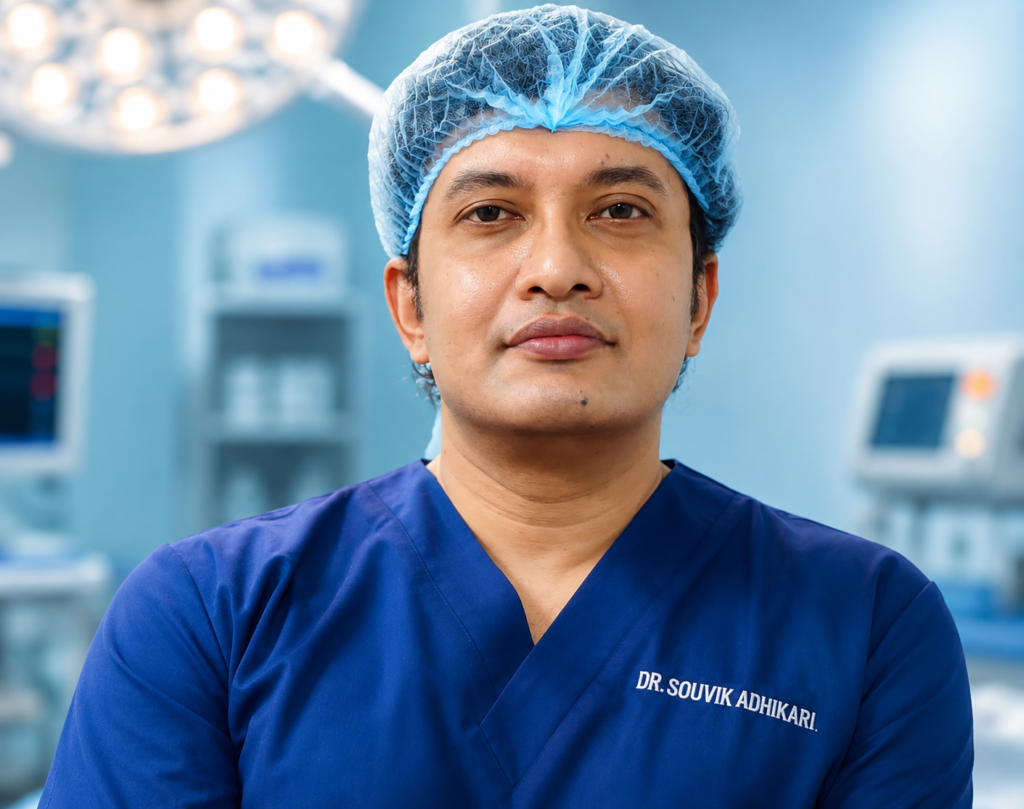
Prof. (Dr.) Souvik Adhikari
MS, MCh (Plastic Surgery)
17+ years experience
Scar type → likely treatment direction
| Scar problem | Treatment emphasis |
|---|---|
| Wide/irregular scar | Surgical scar revision |
| Depressed scar | Subcision / volume restoration / resurfacing |
| Raised hypertrophic scar | Scar management / injections / selected revision |
| Keloid | Combination treatment and careful planning |
| Contracture | Scar release / Z-plasty / tissue reconstruction |
| Surface irregularity | Laser / resurfacing / microneedling |
| Post-burn deformity | Scar release / graft / flap / staged reconstruction |
Facial Scar Revision vs Facial Reconstruction
Facial scar revision primarily focuses on improving an established scar by addressing its width, direction, texture, contour, pigmentation or tethering.
Facial reconstruction is broader and may be required when an injury, burn, tumour surgery or congenital condition has resulted in loss of skin, soft tissue or other facial structures.
Some patients require both approaches. For example, a complex traumatic facial defect may first require reconstruction of missing tissue and subsequently undergo scar revision as healing progresses.
Read more: Facial Reconstruction in Kolkata
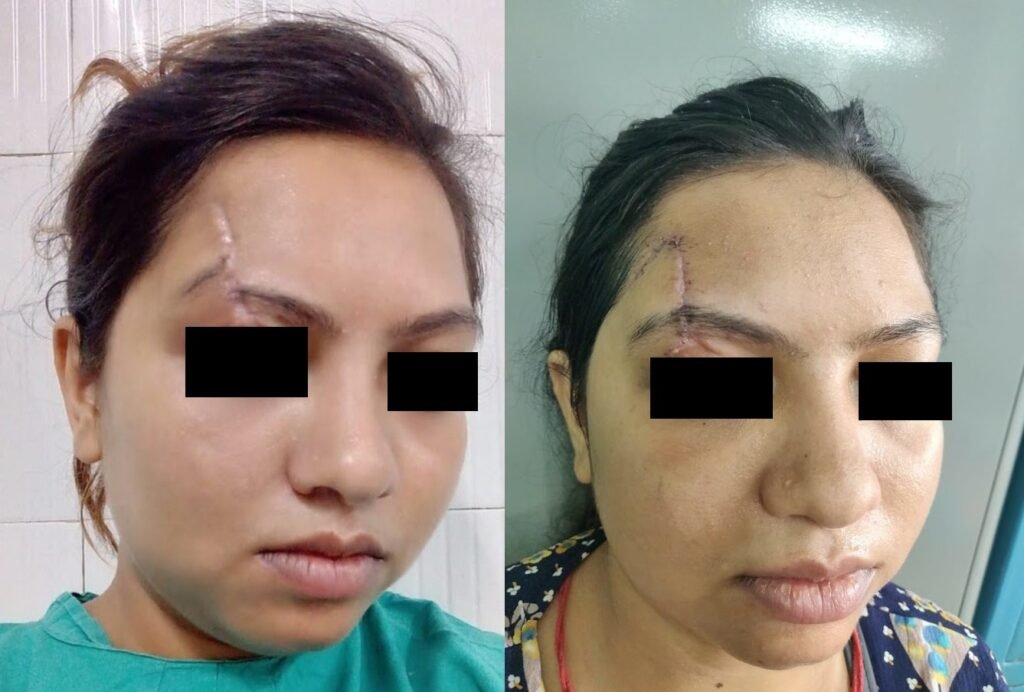
Gallery
Consented before-and-after photographs for facial scar revision are reviewed privately during consultation, in line with medical advertising guidelines.
Frequently Asked Questions
What is facial scar revision?
Facial scar revision is a procedure used to improve the appearance, texture, contour or orientation of an unwanted facial scar. Depending on the type and location of the scar, treatment may involve surgical scar revision, scar resurfacing, injections, or a combination of techniques.
Who is a good candidate for facial scar revision?
Facial scar revision may be considered for patients with noticeable traumatic, surgical, burn or other facial scars that cause cosmetic or functional concerns. Suitability depends on the scar's age, location, size, depth, skin characteristics and the patient's expectations.
Can facial scars be completely removed?
A scar cannot usually be completely erased because scar formation is part of the body's natural healing process. The aim of facial scar revision is to make the scar less noticeable by improving its alignment, width, contour, texture or colour, depending on the individual scar.
What types of facial scars can be treated?
Depending on their characteristics, facial scar revision may be considered for traumatic scars, surgical scars, acne-related scars, depressed scars, raised scars, hypertrophic scars, burn scars and scars caused by previous procedures. Different scar types require different treatment approaches.
Can old facial scars be improved with scar revision?
Yes. Old facial scars can sometimes be improved, although the appropriate treatment depends on the scar's characteristics and the condition of the surrounding skin. A scar does not necessarily have to be recent for revision to be considered.
Can facial scar revision treat scars from accidents or injuries?
Yes. Traumatic facial scars following accidents, cuts, lacerations or other injuries may sometimes be improved with scar revision. Treatment may involve revising the scar and carefully repositioning or reshaping the tissues to create a less conspicuous final scar.
Can surgical scars on the face be revised?
Yes. Facial surgical scar revision may be considered when a previous surgical scar is wide, irregular, depressed, raised, poorly positioned or otherwise noticeable. The appropriate technique depends on the location and characteristics of the scar.
What is the difference between scar revision and scar removal?
Scar revision aims to improve the appearance of a scar rather than completely remove it. Depending on the scar, revision may involve removing the existing scar tissue and creating a more favourable scar, resurfacing the skin, improving contour or combining several treatment methods.
Is facial scar revision performed with surgery or laser?
Facial scar treatment may involve surgery, laser or other non-surgical methods depending on the type of scar. Surgical scar revision is particularly useful for selected scars where the width, direction, contour or tissue alignment needs to be changed, whereas resurfacing techniques may be more appropriate for certain surface-texture problems.
Can acne scars be treated with facial scar revision?
Some acne scars can be improved with procedures designed to address depressed areas, tethering or irregular skin texture. However, acne scarring encompasses several different scar types, so treatment needs to be selected according to the specific pattern and severity of scarring.
Can facial scar revision improve a depressed or indented scar?
Yes. Selected depressed or indented facial scars may be improved using techniques that release tethered tissue, restore volume or revise the scar itself. The most appropriate approach depends on the depth, location and cause of the depression. In selected depressed scars, restoration of lost soft-tissue volume may be considered as part of the treatment plan.
Can a raised facial scar or hypertrophic scar be treated?
Yes. Raised scars, including hypertrophic scars, may sometimes be treated with injections, pressure or other non-surgical treatments, while selected scars may require surgical revision or a combination approach. Treatment is planned according to the behaviour and characteristics of the individual scar.
What is the difference between a keloid and a hypertrophic scar?
A hypertrophic scar remains within the boundaries of the original injury and may gradually become flatter, whereas a keloid can extend beyond the original wound margins. Because keloids have a tendency to recur, their treatment requires careful planning and may involve combination therapy rather than simple excision alone.
How long does facial scar revision take to heal?
Initial wound healing varies according to the size, location and technique used. The treated area may settle over the first few weeks, while the scar continues to soften, flatten and change in colour over several months.
Will there be another scar after facial scar revision?
Yes. Surgical scar revision necessarily creates a new surgical scar. The objective is to place, reshape or close the new scar in a more favourable way so that it becomes less noticeable as healing progresses. The final appearance cannot be guaranteed.
How long does it take to see the final result after facial scar revision?
The early appearance of a revised scar can change substantially during healing. Redness, firmness and swelling gradually settle, while scar maturation continues for several months and sometimes longer. The final appearance should therefore not be judged immediately after surgery.
What are the risks of facial scar revision?
Potential risks include infection, bleeding, delayed healing, recurrence or worsening of the scar, abnormal pigmentation, wound separation, contour irregularity and an unsatisfactory cosmetic result. Some patients may also develop hypertrophic scarring or keloids depending on their individual tendency to abnormal scar formation.
How much does facial scar revision cost in Kolkata?
The cost of facial scar revision in Kolkata varies according to the size, location and type of scar, the technique required, whether surgery or another treatment is appropriate, anaesthesia and the extent of postoperative care. An individual assessment is necessary to provide an accurate treatment plan and estimate.
Where can I get facial scar revision in Kolkata?
Facial scar revision should be planned after an examination of the scar and surrounding tissues by a qualified plastic surgeon. The consultation should establish the type of scar, available treatment options, expected improvement, limitations, risks and likely recovery.
Can patients from outside Kolkata undergo facial scar revision?
Yes. Patients travelling to Kolkata can arrange an initial consultation to discuss the scar and treatment options. For patients who live outside Kolkata or overseas, the timing of surgery and postoperative visits can be planned according to the procedure required.
Honest assessment, written estimate, no pressure to book.