Dimple Creation in Kolkata
Dimple creation surgery in Kolkata, also known as dimpleplasty, is a minimally invasive cosmetic procedure designed to create natural-looking dimples on the cheeks. Dimples are small depressions that appear when certain facial muscles and tissues move during smiling. For individuals who naturally do not have dimples but desire this facial feature, dimpleplasty can create a subtle indentation that becomes more visible with facial expression.
Dimpleplasty Procedure and Surgical Planning
Dimple creation surgery in Kolkata is usually performed through a small incision inside the mouth, avoiding a visible external facial scar. A carefully planned connection is created between the inner cheek tissues and the overlying skin to produce the desired dimple. The position, depth and appearance of the dimple are important considerations, as the aim is to create a result that complements the patient’s existing facial features rather than appearing artificial.
Natural-Looking Cheek Dimple Creation
The success of dimple creation surgery depends heavily on accurate positioning and individual facial anatomy. Dimples that are placed too high, too low or too deeply may appear unnatural. During consultation, facial proportions, cheek anatomy and the patient’s preferred dimple position are assessed. The goal is to create subtle, symmetrical and natural-looking dimples that enhance facial expression.
Who May Consider Dimple Creation?
Adults who desire a permanent or long-lasting facial dimple may consider dimpleplasty in Kolkata. Patients should have realistic expectations and understand that the appearance of a newly created dimple can change during the healing process. Initially, the dimple may appear deeper or more prominent than the eventual result as the tissues heal and settle.
Dimple Creation vs Cheek Augmentation
Dimple creation and cheek augmentation have opposite aesthetic objectives. Dimpleplasty creates a localized indentation in the cheek, whereas cheek augmentation increases cheek projection or volume. Dimple creation is therefore appropriate for patients seeking a defined cheek dimple rather than increased facial fullness.
Dimple Creation Surgery by Prof. (Dr.) Souvik Adhikari
Prof. (Dr.) Souvik Adhikari brings 17+ years of surgical experience in cosmetic, plastic and reconstructive surgery, with additional AOCMF Fellowship training at Johns Hopkins University, USA. His approach to dimple creation in Kolkata focuses on careful facial assessment, precise placement and natural-looking facial enhancement.
Dimpleplasty Recovery in Kolkata
Recovery after dimple creation surgery is generally shorter than many major facial procedures. Temporary swelling, tenderness or changes in dimple depth may occur during the initial healing period. Because the procedure involves the inner cheek, appropriate oral hygiene and postoperative care are important. Patients receive individualised instructions regarding diet, oral care, activity and follow-up.
If you are considering dimple creation surgery in Kolkata, a personalised consultation can help determine the appropriate dimple position and surgical approach for your facial anatomy. The objective is to create a subtle, attractive and naturally expressive facial feature that complements your individual appearance.
Dimpleplasty Procedure and Surgical Planning
Dimple creation surgery, or dimpleplasty, is a relatively small facial cosmetic procedure, but achieving a natural-looking result depends on careful assessment of facial anatomy and accurate positioning. The aim is not simply to create a depression in the cheek, but to create a dimple that integrates with the patient’s facial proportions and becomes appropriately noticeable with smiling.
The position, depth, shape and symmetry of the desired dimple are discussed during consultation. The surgical plan may differ between patients because cheek thickness, soft-tissue anatomy and facial muscle movement vary from one person to another.
How Dimple Creation Surgery Is Performed
Dimpleplasty is commonly performed through a small incision inside the cheek. Through this intraoral approach, the surgeon creates a controlled connection between the deeper cheek tissues and the overlying skin at the selected point. This creates the inward pull responsible for the visible dimple.
Different surgical techniques have been described for creating cheek dimples. Some involve removal of a small amount of tissue, while others rely primarily on carefully placed sutures to establish the desired tissue attachment. The technique is selected according to the patient’s anatomy, the desired dimple and the surgeon’s assessment. (plasticsurgery.org)
Choosing the Position of a Cheek Dimple
Dimple position is one of the most important aspects of dimpleplasty. A dimple positioned too high, too low or too close to the mouth may appear inconsistent with the patient’s natural facial proportions.
The approximate location can be planned by assessing the face at rest and during smiling. Bilateral dimples also require attention to facial symmetry, although perfectly identical dimples cannot always be guaranteed because the two sides of the face may differ naturally.
Creating Natural-Looking Dimples
A surgically created dimple should complement the patient’s existing facial features rather than look like a fixed artificial indentation. The desired appearance may vary from a subtle dimple that is primarily visible during smiling to a more noticeable indentation that remains partly visible when the face is relaxed.
The final appearance is influenced by the surgical technique, tissue characteristics, healing and the degree of scar formation. Early after surgery, the dimple may appear deeper or more prominent than the eventual result and can change as the tissues settle.
Unilateral and Bilateral Dimple Creation
Dimpleplasty can be performed on one cheek or both cheeks. Some patients prefer a single dimple, while others request bilateral dimples.
When both sides are treated, each cheek should be assessed individually rather than assuming that exactly the same placement or depth will produce identical results. Natural facial asymmetry, differences in tissue thickness and differences in muscle movement can influence the final appearance.
Dimple Creation and Facial Anatomy
Natural cheek dimples are associated with variations in the anatomy and attachment of the facial tissues, including the zygomaticus major muscle and its relationship with the overlying skin. Surgical dimple creation attempts to reproduce a controlled version of this tissue relationship.
Because important structures such as branches of the facial nerve and the parotid duct are present within the cheek, knowledge of facial anatomy is important when performing an intraoral dimple procedure. Published reports describe these structures as relevant considerations even though clinically significant injury is uncommon. (pmc.ncbi.nlm.nih.gov)
Dimple Creation for Different Cheek Shapes
Cheek thickness and soft-tissue characteristics can influence both the technique and the eventual appearance of a surgically created dimple. Patients with fuller cheeks, relatively thin facial tissues or differences in facial volume may require individualized planning.
The same surgical approach should therefore not be assumed to produce the same dimple in every face. The desired position and depth should be selected in relation to the patient’s overall facial proportions.
Anaesthesia and Duration
Dimple creation is commonly performed under local anaesthesia, particularly when a limited intraoral procedure is planned. The exact anaesthetic approach depends on the surgical technique, whether one or both cheeks are treated and individual patient factors.
Dimpleplasty is generally a relatively short procedure, but operating time varies according to the number of dimples being created and the technique used. A fixed duration should therefore not be assumed for every patient.
Recovery After Dimple Creation
Temporary swelling, tenderness, tightness or changes in dimple depth may occur during the early healing period. Because the procedure is performed through the inside of the cheek, good oral hygiene and adherence to postoperative instructions are particularly important.
The visible dimple may initially appear stronger than the intended final result. As swelling decreases and the tissues heal, the depth and appearance may change. The final appearance should therefore be assessed after adequate healing rather than during the immediate postoperative period.
Risks and Possible Complications
Dimple creation is generally a limited procedure, but it is still surgery and carries potential risks. These may include bleeding, infection, excessive or inadequate dimple formation, asymmetry, changes in the appearance of the dimple during healing and an unsatisfactory aesthetic result.
Rare complications described in the literature include injury to a branch of the facial nerve. Infection within the cheek has also been reported, particularly when postoperative oral care is inadequate. Anatomical awareness of the facial nerve branches and parotid duct is therefore important during surgery. (pmc.ncbi.nlm.nih.gov)
Is Dimple Creation Permanent?
Dimpleplasty is intended to create a long-lasting structural change, but the final result cannot be guaranteed to remain unchanged throughout life. Some surgically created dimples may become less prominent or disappear during healing, while others may remain more prominent than desired.
Published clinical studies have documented changes in dimple depth and appearance over time, emphasizing the importance of realistic expectations when considering the procedure. (pmc.ncbi.nlm.nih.gov)
Dimple Revision and Correction
Occasionally, a created dimple may be too deep, too shallow, asymmetric or otherwise different from the intended result. In selected cases, revision surgery may be considered after the tissues have adequately healed.
Revision is not always straightforward because the original procedure produces scar tissue and changes the local anatomy. The possibility of revision should therefore be discussed before the initial procedure rather than assuming that any result can easily be reversed.
Expected Results of Dimple Creation
The objective of dimpleplasty is to create a subtle, proportionate and naturally expressive cheek dimple that complements the patient’s facial features.
The final appearance depends on facial anatomy, surgical technique and individual healing. The result may be more visible during smiling and less noticeable when the face is relaxed, although the exact behaviour of the dimple varies between individuals.
Dimple Creation Surgery by Prof. (Dr.) Souvik Adhikari
Prof. (Dr.) Souvik Adhikari is a Professor & Consultant Plastic Surgeon with more than 17 years of independent surgical experience in cosmetic, plastic and reconstructive surgery. His qualifications include MBBS, MS in General Surgery and MCh in Plastic & Reconstructive Surgery, along with AOCMF Fellowship training at Johns Hopkins University, USA.
Dimple creation is planned after assessment of facial proportions, cheek anatomy, desired dimple position and the patient’s expectations. The emphasis is on individualized placement and a result that integrates with the patient’s natural facial expression.
Consultation for Dimple Creation in Kolkata
A consultation allows the desired dimple position, depth and symmetry to be discussed before surgery. The face can be assessed at rest and during smiling, and the possible limitations of dimpleplasty can be explained.
The consultation is also an opportunity to discuss unilateral versus bilateral dimple creation, the expected healing process, possible changes in dimple depth, potential complications and the possibility of revision surgery.
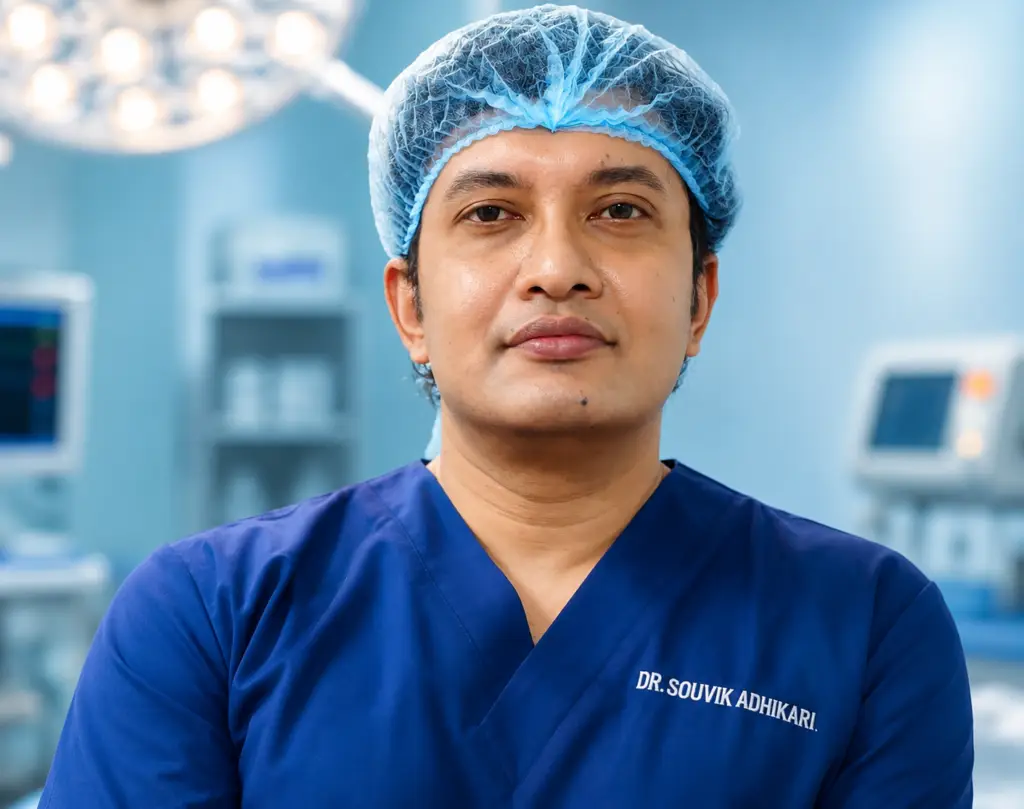
Prof. (Dr.) Souvik Adhikari
MS, MCh (Plastic Surgery)
17+ years experience
Frequently Asked Questions About Dimple Creation in Kolkata
1. What is dimple creation surgery?
Dimple creation surgery, also known as dimpleplasty, is a cosmetic procedure that creates a long-lasting or potentially permanent indentation in the cheek to resemble a natural facial dimple. The procedure is designed to create a controlled attachment between the deeper cheek tissues and the skin so that an indentation becomes visible, particularly with smiling.
2. Who is a suitable candidate for dimple creation?
Dimple creation may be considered by healthy adults who would like to create a cheek dimple and have realistic expectations about the result. The position, depth and appearance of the desired dimple should be discussed carefully during consultation because facial anatomy varies considerably between individuals.
3. Can I choose where my cheek dimple will be placed?
The approximate position can be planned according to facial proportions and the patient’s desired appearance. However, the exact final position and appearance are influenced by the underlying anatomy of the cheek, muscle movement and tissue characteristics. A dimple should therefore be planned to look appropriate when the patient is both relaxed and smiling.
4. Can I have one dimple or two dimples?
Yes. Dimple creation can be performed on one cheek or both cheeks. Some patients prefer a single unilateral dimple, while others request bilateral dimples. The two sides should be assessed individually because facial anatomy and muscle movement may not be perfectly symmetrical.
5. Will the dimples look natural when I smile?
The aim of dimpleplasty is to create an indentation that integrates with the patient’s facial movement rather than producing an artificial-looking fixed depression. The final appearance depends on the surgical technique, dimple position, depth, tissue characteristics and healing.
6. Will the dimple be visible when my face is relaxed?
The appearance of a surgically created dimple varies between individuals. Some dimples remain visible to some degree when the face is relaxed, while others become more prominent primarily during smiling. The final behaviour of the dimple depends on the technique and individual healing response.
7. How is dimple creation surgery performed?
Dimpleplasty is generally performed through a small incision inside the cheek. The surgeon creates a controlled connection between the inner cheek tissues and the overlying skin so that the skin is drawn inward at the selected point. Different surgical techniques have been described, and the exact method may vary according to the surgeon and the patient’s anatomy.
8. Is there a visible scar after dimple creation?
One advantage of an intraoral approach is that the main surgical work can be performed through the inside of the cheek, so there may be little or no obvious external incision scar. Some techniques may temporarily produce a small mark or indentation on the skin during healing. Published studies have reported that such external marks can fade substantially over time.
9. Is dimple creation performed under local anaesthesia?
Dimple creation can commonly be performed under local anaesthesia, particularly when a limited intraoral procedure is planned. The anaesthetic approach depends on the surgical technique, extent of treatment and individual patient factors.
10. Is dimple creation surgery painful?
The cheek is numbed with local anaesthesia during the procedure, so significant pain is generally not expected during surgery. Mild discomfort, tightness or tenderness may occur after the anaesthetic wears off and usually improves as healing progresses.
11. How long does dimple creation surgery take?
Dimple creation is generally a relatively short cosmetic procedure, but the duration varies according to whether one or both cheeks are treated and the technique used. An exact operating time is therefore best discussed during consultation.
12. What is the recovery like after dimpleplasty?
Mild swelling, tenderness or tightness of the cheek can occur during the early healing period. Because the procedure involves the inside of the cheek, attention to oral hygiene and the postoperative instructions provided by the surgeon is important. Recovery varies between individuals and depends on the technique used.
13. When can I return to work after dimple creation?
Many patients can return to routine activities relatively quickly after dimpleplasty. The appropriate timing depends on the extent of the procedure, swelling and the nature of the patient’s work. Activities that place unnecessary strain or pressure on the cheeks should be avoided during early healing.
14. How long does it take for the final dimple to develop?
The appearance of a newly created dimple can change during healing. Early postoperative indentation may be more pronounced than the eventual result, while swelling and tissue healing can alter the depth and appearance over time. The dimple gradually settles as the tissues mature. Published clinical research has reported that more natural-looking dimples may become apparent over several months.
15. Is dimple creation permanent?
Dimpleplasty is intended to produce a long-lasting or permanent structural change, but the final result cannot be guaranteed to remain identical throughout life. The dimple may become less prominent, disappear or change in appearance as the tissues heal and mature. Published studies have reported both satisfactory long-term persistence and cases of disappearance or undercorrection.
16. Can a dimple disappear after surgery?
Yes. A surgically created dimple can become less prominent or disappear during healing. Undercorrection, changes in scar formation or the individual healing response may contribute to loss of the intended indentation. Revision surgery may occasionally be considered if the result is inadequate.
17. Can the dimple be too deep or too prominent?
Yes. Overcorrection can result in a dimple that appears excessively deep or remains too visible when the face is relaxed. The objective is to create an indentation that is proportionate to the patient’s facial features rather than simply making the deepest possible dimple. Overcorrection and asymmetry are recognized possible complications of dimple surgery.
18. Can dimple creation produce unequal dimples on the two sides?
Yes. Some degree of asymmetry can occur because the two sides of the face are not naturally identical. Differences in muscle movement, tissue thickness and healing can also affect the final appearance. Careful planning and assessment of facial symmetry are important when creating bilateral dimples.
19. What are the risks of dimple creation surgery?
Potential complications include swelling, bleeding, infection, asymmetry, overcorrection, undercorrection, disappearance of the dimple and an unsatisfactory aesthetic result. Rare complications described in the literature include injury to a branch of the facial nerve or the parotid (Stensen) duct.
20. Can dimple creation cause facial nerve damage?
Injury to the buccal branches of the facial nerve is considered uncommon, but it is a recognised potential complication because important facial nerve structures are present in the cheek. Careful knowledge of facial anatomy and appropriate surgical technique are important for minimizing this risk.
21. Can dimple creation affect the salivary glands or ducts?
The parotid (Stensen) duct passes through the cheek and therefore needs to be considered during dimple surgery. Injury to the duct is rare, but it is a recognised potential complication. Appropriate anatomical planning is important when selecting the site and surgical approach.
22. Can dimple creation affect smiling or facial movement?
The goal of dimpleplasty is to create a localized indentation without impairing normal facial movement. However, because the procedure involves tissues associated with cheek movement, patients should be informed about the rare possibility of nerve or muscle-related complications. Persistent weakness or abnormal facial movement after surgery requires medical assessment.
23. Can dimple creation be reversed?
A surgically created dimple may sometimes be revised if it is excessively deep, asymmetric or otherwise unsatisfactory. However, reversal is not necessarily straightforward because healing and scar formation alter the tissues. Patients should therefore approach dimple creation as a procedure requiring careful planning rather than assuming that the result can always be completely reversed.
24. Can dimple creation be combined with other facial cosmetic procedures?
In selected patients, dimple creation can potentially be performed alongside other facial procedures. However, combining procedures should be considered only after evaluating the patient’s facial anatomy, treatment goals and overall surgical plan. Procedures involving the cheeks or nearby structures require particular attention to anatomy.
25. Is dimple creation suitable for men and women?
Yes. Dimple creation can be performed in both men and women. Suitability depends on facial anatomy, the desired location and appearance of the dimple, overall health and realistic expectations rather than gender.
26. Can dimple creation be performed on people with fuller cheeks?
Possibly. The thickness and structure of the cheek tissues can influence the surgical technique and the eventual appearance of the dimple. Patients with fuller cheeks may require individualized planning rather than assuming that the same technique will produce the same result in every face.
27. Is dimple creation the same as cheek augmentation?
No. Dimple creation is intended to create a localized indentation in the cheek, whereas cheek augmentation aims to increase cheek volume or projection. Cheek augmentation may involve implants or injectable fillers, while dimpleplasty uses a different surgical concept.
28. Is dimple creation the same as a facelift or cheek lift?
No. Dimple creation is a small, localized cosmetic procedure designed to create cheek dimples. A facelift addresses sagging facial tissues, particularly of the lower face, while a cheek or midface lift addresses age-related changes in the cheek and lower eyelid region.
29. How much does dimple creation cost in Kolkata?
The cost depends on factors such as whether one or both dimples are being created, the technique required, the surgical setting and individual treatment considerations. An exact estimate can be provided after consultation and assessment of the desired dimple position and facial anatomy.
30. How can I know whether dimple creation is right for me?
A consultation allows the face to be assessed at rest and during smiling, and allows the desired position, depth and symmetry of the dimple to be discussed. The surgeon can also explain the available technique, potential limitations, risks, recovery and the possibility that the final dimple may change during healing.
Honest assessment, written estimate, no pressure to book.