Pressure sore surgery in Kolkata is specialised reconstructive surgery for patients with persistent or advanced pressure ulcers, also known as bedsores. These wounds commonly develop over pressure-bearing areas such as the sacrum, buttocks, hips, heels and other bony prominences, particularly in people with prolonged immobility. When a pressure sore becomes deep, recurrent or fails to heal with appropriate conservative treatment, surgical reconstruction may be considered.
Pressure Ulcer Treatment in Kolkata
Pressure ulcer treatment in Kolkata begins with a comprehensive assessment of the wound, surrounding tissues, nutrition, mobility and underlying medical factors. Early-stage pressure sores may be managed with pressure relief, specialised wound care, nutritional optimisation and appropriate dressings. More advanced wounds, particularly those with extensive tissue loss, exposed structures, infection or persistent non-healing, may require surgical debridement and reconstructive surgery.
Pressure Sore Reconstruction Surgery
Pressure sore reconstruction in Kolkata may involve removal of unhealthy or infected tissue followed by coverage of the resulting defect using appropriate reconstructive techniques. Depending on the location and size of the wound, local tissue flaps, muscle or musculocutaneous flaps and other reconstructive procedures may be considered. The objective is to provide durable tissue coverage while restoring protection over vulnerable pressure points.
Stage 3 and Stage 4 Pressure Sore Surgery
Patients with Stage 3 or Stage 4 pressure ulcers may have significant tissue loss extending into deeper structures. In selected cases, surgery may be necessary to remove dead tissue, control infection and reconstruct the defect. The precise treatment depends on the wound’s depth, location, infection status and the patient’s ability to maintain pressure relief after surgery. A multidisciplinary approach may be required for complex wounds.
Recurrent Pressure Sore Treatment
One of the major challenges in treating pressure sores is recurrence. Surgery can close a wound, but long-term success also depends on preventing renewed pressure on the reconstructed area. Appropriate positioning, pressure-relieving mattresses or cushions, nutritional support, skin care and regular monitoring are important components of postoperative care. Patients and caregivers are counselled extensively regarding pressure-relief strategies.
Pressure Sore Surgery by Prof. (Dr.) Souvik Adhikari
Prof. (Dr.) Souvik Adhikari brings 17+ years of surgical experience in cosmetic, plastic and reconstructive surgery, with additional AOCMF Fellowship training at Johns Hopkins University, USA. His approach to pressure sore surgery in Kolkata focuses on careful wound assessment, removal of non-viable tissue, appropriate flap selection and reconstruction designed to provide durable soft-tissue coverage. Prof. (Dr.) Souvik Adhikari’s academic work includes research and publications in plastic and reconstructive surgery, reflecting his broader clinical and academic involvement in complex tissue reconstruction. See [Research & Publications] for selected academic work.
Recovery After Pressure Ulcer Surgery
Recovery following pressure sore surgery in Kolkata depends on the size and location of the ulcer, the reconstructive technique used and the patient’s overall health. Strict pressure avoidance is particularly important during healing. Patients may require specialised positioning, wound care, nutritional support and gradual mobilisation under medical guidance. Regular follow-up is essential to monitor healing and identify any early signs of complications or recurrence.
If you are looking for pressure sore surgery in Kolkata, a specialist reconstructive assessment can help determine whether your wound requires conservative management, debridement or flap-based reconstruction. The goal is to achieve durable wound closure, protection of exposed tissues and improved quality of life while addressing the underlying factors responsible for pressure ulcer formation.
Pressure Sore Reconstruction by Location
The location of a pressure sore is an important factor in planning reconstructive surgery. Different anatomical regions are exposed to different patterns of pressure, shear and mechanical stress, and the available tissue for reconstruction varies from one site to another.
The size and depth of the wound, condition of the surrounding tissues, previous operations, presence of infection or osteomyelitis, mobility and ability to maintain postoperative pressure relief are also considered when selecting the appropriate reconstructive technique. There is therefore no single flap that is suitable for every pressure sore.
Sacral Pressure Sore Reconstruction
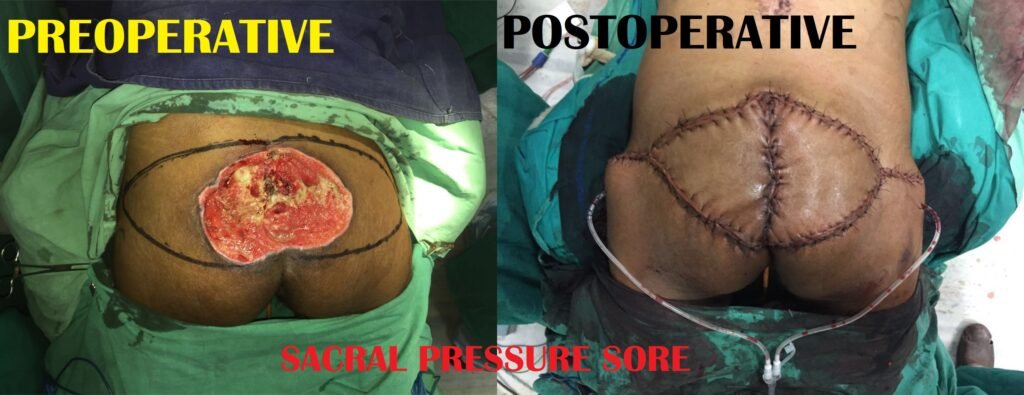
Sacral pressure sores occur over the lower back and sacral region and can range from relatively superficial wounds to deep defects extending towards bone.
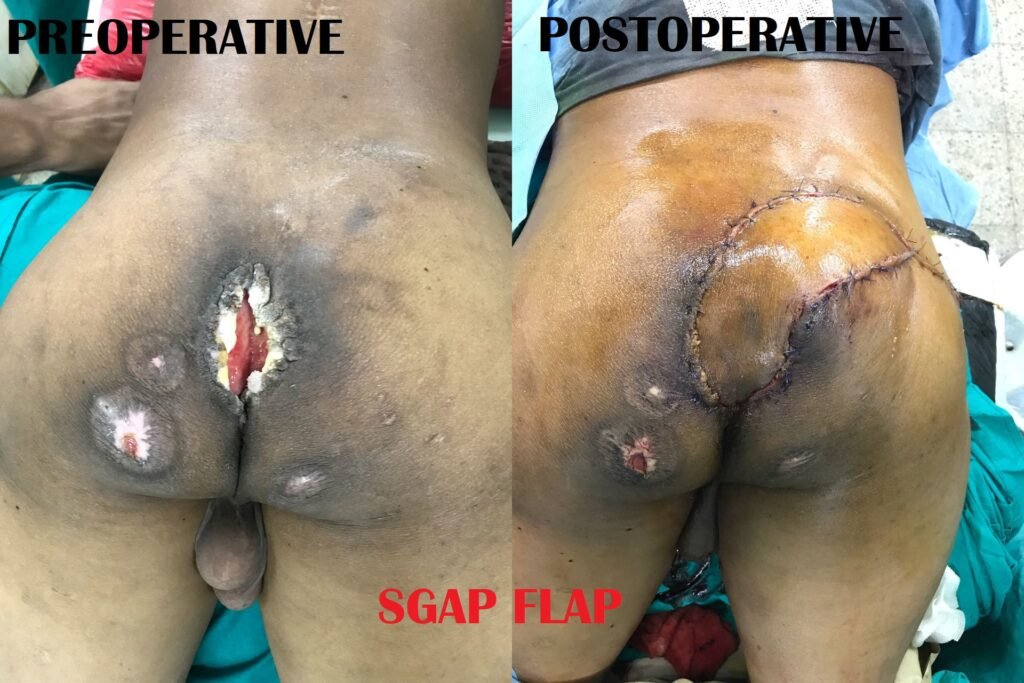
After appropriate wound preparation and debridement, selected sacral defects may be reconstructed using local fasciocutaneous or gluteal flaps, V-Y advancement flaps, rotational flaps or perforator-based flaps such as superior gluteal artery perforator (SGAP) flaps. The choice depends on the size and depth of the defect, available tissue and previous reconstructive procedures.
For recurrent sacral pressure sores, preservation of suitable surrounding tissue is particularly important because future reconstruction may be required. Flap design may therefore take into account not only the present defect but also the possibility of recurrence.
SGAP Flap Reconstruction for Sacral Pressure Sores
In selected sacral pressure sore defects, a superior gluteal artery perforator (SGAP) flap may provide well-vascularised tissue for reconstruction while allowing the surgeon to tailor the flap to the defect and preserve underlying muscle where appropriate. The choice of flap depends on the wound characteristics, previous surgery and available tissue.
Ischial Pressure Sore Reconstruction
Ischial pressure sores develop over the sitting bones and are particularly relevant in patients who spend prolonged periods sitting or have impaired mobility.
Reconstruction of an ischial pressure sore needs to provide adequate soft-tissue coverage and, where necessary, fill the deeper cavity around the ischial region. Depending on the defect and available tissue, posterior or medial thigh flaps, gluteal-based flaps, perforator flaps and selected muscle or musculocutaneous flaps may be considered.
Because the ischial region is subjected to repeated pressure during sitting, postoperative pressure redistribution and a carefully planned return to sitting are particularly important. Without effective pressure management, recurrence can occur even after successful flap reconstruction.
Trochanteric or Hip Pressure Sore Reconstruction
Trochanteric pressure sores occur over the greater trochanter on the outer aspect of the hip. Deep defects may extend towards the underlying bone and can create substantial dead space following debridement.
Reconstruction may involve local or regional flaps, including tensor fascia lata, vastus lateralis, rectus femoris or other appropriately selected tissue flaps. The choice depends on the depth and dimensions of the defect, the condition of the surrounding tissue and whether deeper structures are involved.
When significant dead space remains after debridement, reconstruction may need to provide sufficient tissue bulk to fill the defect rather than simply covering the skin surface.
Buttock Pressure Sore Reconstruction
Pressure sores involving the buttock may occur in the sacral, ischial or adjacent gluteal regions. Because these areas contain substantial soft tissue, different local and perforator-based flap options may be available depending on the exact location of the defect.
Perforator-based flaps can provide well-vascularised tissue while, in selected cases, preserving the underlying muscle. Superior and inferior gluteal artery perforator-based techniques have been described for selected sacral and ischial defects.
The reconstructive plan is individualised according to the defect and the need to preserve potential donor tissue for future reconstruction.
Heel and Ankle Pressure Sore Reconstruction
Pressure injuries can also develop around the heel and ankle, particularly in patients with prolonged immobility.
The reconstructive approach depends on the size and depth of the wound, exposure of tendon or bone, local blood supply and the amount of available surrounding tissue. Smaller defects may sometimes be managed with local tissue techniques, while deeper or more complex wounds may require more advanced soft-tissue coverage.
Because the heel is a weight-bearing area, restoration of durable coverage and protection from recurrent pressure are particularly important considerations.
Other Pressure-Related Wounds
Pressure injuries can also occur over other bony prominences, including the back, elbow and lower extremities. The reconstructive technique is selected according to the anatomical site, wound characteristics and the availability of suitable local tissue.
For complex wounds, reconstruction may involve local, regional, perforator-based or, in selected circumstances, more extensive flap techniques. The objective is to achieve stable tissue coverage while preserving future reconstructive options whenever possible.
Choosing the Appropriate Reconstruction
Pressure sore reconstruction is therefore based on more than the location of the wound alone. The depth and size of the defect, infection, osteomyelitis, previous surgery, quality of surrounding tissue, nutritional and medical status, mobility and ability to maintain postoperative pressure relief all influence the treatment plan.
The goal is to provide durable soft-tissue coverage, eliminate problematic dead space where necessary and protect the reconstructed area from the mechanical forces that caused the pressure injury. Long-term pressure redistribution and recurrence prevention remain essential after reconstruction.
Individualised Planning for Pressure Sore Reconstruction
Pressure sore reconstruction is fundamentally different from routine wound closure. The objective is not simply to cover the skin defect, but to remove non-viable tissue, address infection or other underlying problems, provide durable soft-tissue coverage and reduce the risk of recurrent breakdown.
The surgical plan depends on the location, size and depth of the pressure sore, the condition of the surrounding tissues, previous operations, nutritional status, mobility, pressure distribution and the patient’s ability to follow postoperative pressure-relief measures.
Not every pressure sore requires reconstructive surgery. Selected wounds may improve with appropriate wound care, pressure redistribution, nutritional optimisation and other non-operative measures, while deeper or persistent wounds may require debridement and definitive reconstruction.
Pressure Sore Reconstruction Techniques
Surgical Debridement
Debridement involves removal of dead, infected or otherwise non-viable tissue from the wound. This may be necessary to establish a healthy wound bed before definitive closure.
For larger or deeper pressure sores, surgical debridement may be performed in the operating theatre. The extent of debridement depends on the depth of tissue involvement and whether deeper structures such as bone are affected.
Local and Regional Flap Reconstruction
After adequate wound preparation, a pressure sore may be reconstructed using tissue from an adjacent or nearby area.
Depending on the location and characteristics of the defect, fasciocutaneous, perforator-based or musculocutaneous flaps may be considered. The choice is individualized according to the wound, available tissue, previous surgery and the need to preserve reconstructive options for the future.
Sacral Pressure Sore Reconstruction
Sacral pressure sores can produce substantial soft-tissue defects over the lower back and sacral region. Reconstruction aims to provide durable tissue coverage and, where appropriate, fill the defect and protect the underlying bony prominence.
The SGAP flap and other local or regional flap options may be considered in selected patients depending on the defect and available tissue.
Ischial Pressure Sore Reconstruction
Ischial pressure sores commonly occur in patients who spend prolonged periods sitting, particularly those with impaired mobility or spinal cord injury.
Reconstruction requires consideration of the depth of the defect, surrounding tissue availability, sitting position and long-term pressure redistribution. The postoperative plan is particularly important because recurrent pressure over the ischial region can compromise the reconstruction.
Trochanteric and Hip Pressure Sore Reconstruction
Pressure injuries over the greater trochanter or hip region may involve substantial soft-tissue loss and can occasionally extend to deeper structures.
The reconstructive approach depends on the size and depth of the defect, the condition of surrounding tissue and whether bone or other deep structures are involved.
Pressure Sore Surgery When Bone Is Exposed
Deep pressure sores can extend to bone and may be associated with osteomyelitis. When bone infection is suspected or confirmed, assessment and treatment of the underlying bone become an important part of the reconstructive plan.
Depending on the individual situation, treatment may involve debridement of infected or non-viable bone, appropriate antimicrobial therapy and subsequent reconstruction with well-vascularised tissue in selected patients.
Wound-Bed Preparation Before Pressure Sore Reconstruction
Definitive reconstruction is usually planned only after the wound has been adequately prepared.
This may involve removal of necrotic tissue, management of infection, control of excessive wound contamination, treatment of osteomyelitis when present and optimisation of the patient’s general medical condition.
A healthy wound bed provides a more appropriate environment for definitive closure. Current pressure-ulcer guidelines specifically emphasise adequate wound preparation and bacterial control before surgical closure.
Nutrition and Medical Optimisation Before Surgery
Nutritional status is an important consideration in patients undergoing pressure sore reconstruction. Malnutrition, anaemia, poorly controlled diabetes and other systemic medical problems can adversely affect wound healing and postoperative recovery.
Preoperative assessment may therefore include nutritional evaluation, optimisation of medical conditions and assessment of factors that could affect tissue perfusion and healing.
Pressure Relief Before and After Surgery
Pressure redistribution is an essential component of successful pressure sore treatment.
Surgery can provide durable tissue coverage, but continued pressure over the reconstructed area can lead to wound breakdown or recurrence. Depending on the location of the ulcer, patients may require specialised mattresses, cushions, positioning strategies and a carefully supervised programme of mobilisation and weight shifting.
Pressure-relief measures therefore form an integral part of the treatment rather than being an optional addition after surgery.
Recurrent Pressure Sore Reconstruction
Recurrent pressure sores can be more challenging to reconstruct because previous surgery may have altered the local anatomy, scarred the tissues or reduced the availability of suitable flap options.
In these situations, the reconstructive plan needs to consider previous incisions and flaps, the reason for recurrence, current pressure distribution and the possibility of preserving tissue for future reconstruction.
The underlying cause of recurrence must also be addressed. Without effective pressure redistribution and appropriate long-term care, a successfully reconstructed pressure sore can break down again.
Pressure Sore Reconstruction in Patients With Spinal Cord Injury
Patients with spinal cord injury are at particular risk of developing severe and recurrent pressure injuries because of impaired sensation, prolonged sitting or lying, mobility limitations and, in some patients, spasticity.
Reconstruction therefore needs to be integrated with pressure management, positioning, rehabilitation, nutritional optimisation and management of factors such as muscle spasm or contracture.
Can Pressure Sore Surgery Be Staged?
Not every complex pressure sore can or should be treated in a single operation.
Some patients may require staged treatment involving wound preparation and debridement before definitive flap reconstruction. The need for staged surgery depends on the extent of infection, tissue loss, nutritional and medical status and the complexity of the reconstruction.
The sequence of treatment is determined individually after assessment of the wound and the patient’s overall condition.
Anaesthesia and Surgical Planning
The anaesthetic technique depends on the location and extent of the pressure sore, the reconstructive procedure required and the patient’s medical condition.
Large or complex reconstructions may require a more extensive perioperative plan, including preoperative medical assessment and postoperative monitoring. The duration of surgery also varies according to the extent of debridement and the reconstructive technique and should not be reduced to a fixed operating time.
Recovery After Pressure Sore Reconstruction
Recovery after pressure sore surgery is different from recovery after routine cosmetic surgery.
The reconstructed area must be protected from excessive pressure while the flap or wound closure heals. Positioning, dressings, wound monitoring, nutrition and gradual mobilisation are coordinated according to the site and extent of reconstruction.
The timing of sitting, weight bearing or return to normal positioning varies according to the location of the pressure sore and the reconstruction performed. A fixed recovery timetable is therefore not appropriate for every patient.
Risks and Possible Complications
Pressure sore reconstruction is complex surgery and complications can occur despite appropriate planning.
Potential complications include bleeding, haematoma, seroma, wound infection, wound separation or dehiscence, delayed healing, flap congestion or loss, tissue necrosis, recurrent pressure injury and the need for further surgery.
Patients with significant malnutrition, anaemia, uncontrolled medical conditions, ongoing pressure or previous failed reconstruction may have additional risks. These factors are assessed and discussed before surgery.
Expected Results of Pressure Sore Reconstruction
The objective of reconstruction is durable wound closure with adequate soft-tissue coverage and protection of vulnerable underlying structures.
The appearance of the reconstructed area is secondary to achieving a safe and durable reconstruction, although careful flap design can also aim for an acceptable contour and scar.
Long-term success depends not only on the operation but also on pressure redistribution, wound care, nutrition, mobility management and prevention of the factors that caused the pressure injury.
Pressure Sore Surgery by Prof. (Dr.) Souvik Adhikari
Prof. (Dr.) Souvik Adhikari is a Professor & Consultant Plastic Surgeon with more than 17 years of independent surgical experience in cosmetic, plastic and reconstructive surgery.
His qualifications include MBBS, MS in General Surgery and MCh in Plastic & Reconstructive Surgery, along with AOCMF Fellowship training at Johns Hopkins University, USA.
Pressure sore reconstruction is approached as a reconstructive problem requiring assessment of wound depth, tissue quality, infection, pressure distribution, patient factors and available reconstructive options. The treatment plan may involve wound preparation, debridement, flap reconstruction or staged treatment depending on the individual case.
Consultation for Pressure Sore Surgery in Kolkata
A consultation allows the pressure sore to be assessed in relation to its location, size, depth, previous treatment and surrounding tissue condition.
The assessment may also consider nutritional status, mobility, pressure-relief arrangements, previous reconstructive procedures, possible bone involvement and the patient’s ability to follow postoperative positioning and rehabilitation requirements.
The appropriate treatment may range from continued wound management to surgical debridement, flap reconstruction or a staged reconstructi

Prof. (Dr.) Souvik Adhikari
MS, MCh (Plastic Surgery)
17+ years experience
Gallery
Consented before-and-after photographs for pressure sore reconstruction are reviewed privately during consultation, in line with medical advertising guidelines.
Frequently Asked Questions About Pressure Sore Surgery in Kolkata
1. What is pressure sore surgery?
Pressure sore surgery is reconstructive surgery used to remove unhealthy or non-healing tissue and provide durable soft-tissue coverage over a pressure ulcer. Depending on the wound, treatment may involve surgical debridement, removal of underlying infected or damaged tissue, and closure using local or regional tissue flaps.
2. What is a pressure sore or pressure ulcer?
A pressure sore, also called a pressure ulcer or pressure injury, is an area of tissue damage caused by prolonged pressure, often over bony prominences such as the sacrum, ischium, hip or heel. They are particularly common in people with limited mobility, spinal cord injury, neurological conditions or prolonged bed confinement.
3. When is surgery required for a pressure sore?
Surgery may be considered when a pressure sore does not heal with appropriate wound care, when there is extensive tissue loss, recurrent breakdown, exposed deeper structures, or infection involving deeper tissues or bone. Surgical treatment is considered only after assessing whether the patient and wound are suitable for reconstruction.
4. Can all pressure sores be treated with surgery?
No. Not every pressure sore requires reconstructive surgery. Smaller or more superficial wounds may respond to appropriate wound care, pressure redistribution, nutritional support and treatment of contributing factors. Surgery is generally considered for selected complex or persistent wounds.
5. Which stages of pressure sores may require reconstructive surgery?
Deep stage 3 and stage 4 pressure injuries are more likely to require surgical reconstruction because they can involve substantial tissue loss and exposure of deeper structures. However, the decision is based on the actual wound, patient’s medical condition and response to non-operative treatment rather than the stage alone. Surgical reconstruction of advanced pressure injuries requires careful patient selection because complication rates can be significant.
6. What areas can be treated with pressure sore surgery?
Pressure sore reconstruction can be performed for wounds in several anatomical locations, including the sacral region, buttocks, ischial area, greater trochanter or hip region and selected other areas affected by chronic pressure.
7. What is debridement in pressure sore surgery?
Debridement is the surgical removal of dead, infected or unsuitable tissue from the wound. It may be necessary to establish a healthy wound bed before definitive closure. In some patients, more than one stage of wound preparation may be required.
8. What are flap surgeries for pressure sores?
A flap is tissue transferred from a nearby area while maintaining its blood supply, or occasionally transferred using microsurgical techniques. Local and regional fasciocutaneous, perforator-based or musculocutaneous flaps may be selected depending on the location and characteristics of the pressure sore.
Flap selection is individualised according to the size and depth of the defect, available surrounding tissue, previous operations and the need to preserve options for future reconstruction.
9. Why are flaps often used instead of simply closing a pressure sore?
A pressure sore may have a deep cavity or significant tissue loss that cannot be adequately treated with simple skin closure. A well-designed flap can provide vascularised tissue and additional padding over vulnerable bony areas, helping to fill the defect and create a more durable reconstruction.
10. Can a pressure sore be closed directly without a flap?
In selected wounds, direct closure may be possible after adequate debridement and wound preparation. However, deeper pressure sores often require more substantial tissue coverage. The method of closure depends on wound depth, tissue quality, location and the amount of available healthy tissue.
11. Can pressure sores cause infection of the underlying bone?
Yes. A deep pressure ulcer can be associated with osteomyelitis, or infection of the underlying bone. When osteomyelitis is confirmed, management may require appropriate debridement and culture-directed antibiotic treatment, with flap reconstruction considered in appropriately selected patients.
12. Does osteomyelitis prevent pressure sore surgery?
Not necessarily. When bone infection is present, the treatment plan may include removal of infected or non-viable bone, appropriate antimicrobial treatment and reconstruction with well-vascularised tissue when indicated. The infection and overall condition of the patient need to be addressed before definitive reconstruction.
13. Does a patient need to be nutritionally fit before pressure sore reconstruction?
Nutritional status is an important consideration because malnutrition can impair wound healing. Patients may require assessment and optimisation of nutritional intake, anaemia, glucose control and other medical conditions before elective reconstructive surgery.
14. Can a pressure sore be operated on if it is actively infected?
Definitive flap closure generally requires appropriate wound preparation and control of significant infection. The wound may first require debridement, drainage, infection management and other measures before definitive reconstruction is undertaken. Current pressure-ulcer guidelines recommend achieving appropriate bacterial control before surgical closure.
15. What happens if the pressure sore keeps recurring after surgery?
Recurrence can occur after pressure sore reconstruction, particularly when the underlying causes of pressure are not adequately controlled. Prevention therefore remains an important part of treatment and may include pressure redistribution, appropriate positioning, specialised mattresses or cushions, nutritional optimisation and management of mobility or spasticity.
16. Can pressure sore surgery permanently prevent recurrence?
No surgical procedure can guarantee that a pressure sore will never recur. The reconstructed area remains vulnerable if prolonged pressure, immobility or other contributing factors continue. Long-term pressure relief and preventive care are essential after reconstruction.
17. Is pressure relief important after pressure sore surgery?
Yes. Pressure off-loading is a critical component of postoperative care. The reconstructed tissue needs adequate protection during healing, and the patient may require a carefully planned positioning and rehabilitation programme before gradually returning pressure to the operated area.
18. Can pressure sore surgery be performed in patients with spinal cord injury?
Yes. Patients with spinal cord injury are among those who may develop severe or recurrent pressure injuries and may require reconstructive surgery. However, treatment needs to account for factors such as mobility, sensation, spasticity, positioning, nutritional status and the availability of postoperative pressure relief.
19. Can pressure sore surgery be performed in bedridden or elderly patients?
It can be considered in selected patients, but age, general health, nutritional status, mobility, medical conditions and ability to comply with postoperative pressure-relief measures all influence whether reconstruction is appropriate. In patients who are medically very frail or receiving palliative care, non-operative wound management may sometimes be more appropriate.
20. What are the risks of pressure sore flap surgery?
Potential complications include bleeding, infection, wound separation, fluid collection, delayed healing, partial or complete flap loss, recurrent pressure sore, scarring and the need for further surgery. Patients with significant medical or nutritional problems may have a higher risk of complications.
21. How long does pressure sore surgery take?
There is no single operating time for pressure sore reconstruction. Duration depends on the size and depth of the wound, its anatomical location, the extent of debridement, whether bone is involved and the type of reconstruction required.
22. How long does recovery take after pressure sore surgery?
Recovery varies according to the size and location of the pressure sore, the type of flap used and the patient’s overall health. The initial period generally focuses on protecting the reconstruction and preventing pressure on the operated area. Gradual mobilisation and return to normal positioning are planned according to healing.
23. Will a pressure sore leave a scar after surgery?
Yes. Reconstructive surgery necessarily produces surgical scars. The location and appearance of the scars depend on the wound and the flap or closure technique used. The objective is to achieve durable coverage while positioning incisions as appropriately as possible.
24. Can a recurrent pressure sore be operated on again?
Yes, selected recurrent pressure sores may require revision reconstruction. Previous surgery can alter the available tissue and blood supply, so reconstructive planning becomes particularly important. The surgeon may need to select a different flap or preserve tissue for possible future reconstruction.
25. What is the goal of pressure sore surgery?
The goal is not simply to close the skin. Successful reconstruction aims to remove unhealthy tissue, control infection when present, provide durable soft-tissue coverage, protect vulnerable underlying structures and reduce the likelihood of further breakdown while allowing appropriate rehabilitation and pressure prevention.
26. How can I prepare for pressure sore surgery in Kolkata?
Preparation may include wound assessment, evaluation for infection or osteomyelitis, nutritional assessment, optimisation of medical conditions, pressure-relief planning and assessment of mobility and positioning. The exact investigations and preparation depend on the wound and the patient’s overall condition.
27. Is pressure sore surgery different from ordinary wound closure?
Yes. Pressure sores are exposed to the same mechanical forces that originally caused the injury, so simply closing the wound may not provide durable protection. Reconstructive planning considers the depth of the defect, underlying bony prominences, available tissue, pressure distribution and the possibility of future recurrence.
28. Can pressure sore surgery be combined with treatment for other problems?
In selected patients, associated problems such as infected or prominent bone, scarred tissue, contractures or other pressure-related problems may need to be addressed as part of the overall reconstructive plan. The sequence and extent of treatment depend on the patient’s condition and the specific wound.
29. What happens during a consultation for pressure sore surgery?
The pressure sore is assessed for its location, size, depth, tissue quality, infection, exposed structures and previous treatment. The patient’s mobility, nutritional status, medical conditions, pressure-relief arrangements and previous operations are also considered.
The reconstructive options, need for wound preparation, possible flap procedures, expected recovery, risks and measures required to reduce recurrence can then be discussed.
30. Where can I get pressure sore surgery in Kolkata?
Pressure sore reconstruction requires individual assessment because the appropriate operation depends on the wound and the patient’s overall medical and functional condition. A consultation with a plastic and reconstructive surgeon can help determine whether continued wound care, debridement, flap reconstruction or a staged reconstructive approach is appropriate.
Honest assessment, written estimate, no pressure to book.