Burn reconstruction in Kolkata is a specialised branch of plastic and reconstructive surgery aimed at restoring the appearance, movement and function of areas affected by burn injuries. Severe burns can result in hypertrophic scars, contractures, skin tightness, deformity and loss of normal movement. Burn reconstruction can help improve these problems through carefully planned procedures tailored to the location, severity and maturity of the burn scar.
Burn Reconstruction Surgery in Kolkata
Burn reconstruction surgery in Kolkata may involve a range of reconstructive techniques depending on the extent of scarring and functional impairment. Treatment options can include scar revision, contracture release, skin grafting, local tissue flaps and other reconstructive procedures. In complex cases, reconstruction may need to be performed in stages to progressively restore movement, contour and function.
Burn Scar and Contracture Reconstruction
One of the most important problems following a severe burn is a burn scar contracture, where tightened scar tissue restricts movement of an affected joint or distorts nearby structures. Contractures may occur around the neck, face, eyelids, mouth, hands, elbows, knees or other joints. Burn contracture release surgery can release the restrictive scar and replace or rearrange tissue to provide improved movement and more functional coverage.
Facial Burn Reconstruction in Kolkata
Facial burn reconstruction requires particular precision because burns can affect highly visible areas and important functions such as eyelid closure, mouth opening and facial movement. Depending on the defect, treatment may involve scar revision, contracture release, skin grafting or local flap reconstruction. The reconstructive plan is designed to restore function while achieving the most natural facial contour possible.
Hand and Joint Burn Reconstruction
Burn scars involving the hands, fingers and joints can significantly interfere with movement and daily activities. Reconstructive surgery may be considered when scar contractures restrict mobility or cause functional deformity. Appropriate release and tissue reconstruction can help improve range of movement and provide more durable soft-tissue coverage, although rehabilitation and physiotherapy remain important parts of recovery.
Burn Scar Revision and Skin Grafting
Burn scar revision in Kolkata may be appropriate for selected mature scars that remain prominent, contracted or functionally limiting. Depending on the defect, skin grafting or flap reconstruction may be used after release of the scarred tissue. The choice of technique depends on the size, depth, location and surrounding tissue quality. Patients should understand that reconstructive surgery improves scars and function but cannot completely erase a previous burn injury.
Personalised Burn Reconstruction
Every burn injury is different, and successful reconstruction requires careful assessment of the scar, underlying tissues, functional limitation and patient’s individual goals. Some patients may benefit from a single procedure, while complex burn deformities may require staged reconstruction combined with physiotherapy and long-term scar management. Treatment is planned with realistic expectations regarding improvement, recovery and residual scarring.
Burn Reconstruction by Prof. (Dr.) Souvik Adhikari
Prof. (Dr.) Souvik Adhikari brings 17+ years of surgical experience in cosmetic, plastic and reconstructive surgery, with additional AOCMF Fellowship training at Johns Hopkins University, USA. His approach to burn reconstruction in Kolkata focuses on detailed assessment of burn-related deformities, personalised reconstructive planning, meticulous surgical technique and restoration of function and appearance.
Recovery After Burn Reconstruction
Recovery following burn reconstruction surgery in Kolkata depends on the extent of the reconstruction and the technique used. Patients may require wound care, physiotherapy, splinting, scar management and gradual rehabilitation depending on the affected area. Following postoperative instructions and maintaining appropriate movement are particularly important when reconstruction involves a joint or other functionally important region.
If you are searching for burn reconstruction in Kolkata for burn scars, contractures or post-burn deformities, a specialist consultation can help determine the most appropriate reconstructive approach. The goal is to release restrictive scars, restore movement and function, improve contour and appearance, and help patients regain greater confidence and independence after a burn injury.
Burn Reconstruction: Individualised Surgical Planning
Burn reconstruction is planned according to the location, depth and maturity of the burn scar, degree of tissue loss, functional limitation and previous treatment. Some patients require a relatively limited procedure, while complex post-burn deformities may need staged reconstruction.
Who May Benefit from Burn Reconstruction?
Burn reconstruction may be considered when a healed burn has resulted in:
- Scar contracture restricting movement
- Tight or thickened burn scars
- Deformity of the face, eyelids, mouth or neck
- Restricted movement of the fingers, hand or joints
- Loss of soft-tissue coverage
- Significant contour deformity
- Scars that interfere with daily activities or function
- Persistent cosmetic concerns following a healed burn
A detailed examination is important because the appropriate reconstructive procedure depends on the characteristics of the scar and the underlying tissues.
Burn Scar Contracture Release
A burn scar contracture occurs when scar tissue becomes tight and restricts movement or distorts an adjacent structure. Contractures can affect the neck, face, eyelids, mouth, hands, fingers, elbows, knees and other joints.
Surgical treatment may involve releasing the contracted scar and replacing or rearranging tissue using techniques such as Z-plasty, local tissue rearrangement, skin grafting or flap reconstruction, depending on the location and extent of the contracture.
Skin Grafting After Burn Injury
Skin grafting may be required when a burn has resulted in significant skin loss or when scar release creates a defect that cannot be closed directly.
The choice between a split-thickness skin graft and a full-thickness skin graft depends on factors such as the size and location of the defect, functional requirements, available donor skin and the desired reconstructive result.
Flap Reconstruction for Burn Defects
Some burn defects require tissue with greater thickness, blood supply or durability than a skin graft can provide. In selected cases, local or regional flap reconstruction may therefore be considered.
The choice of flap depends on the location and size of the defect, surrounding tissue quality and the structures that need protection.
Facial Burn Reconstruction
Facial burns can affect both appearance and important functions such as eyelid closure, mouth opening and facial movement. Reconstruction may involve scar revision, contracture release, skin grafting or flap reconstruction depending on the problem.
The aim is to improve function while restoring facial contour and maintaining appropriate facial proportions.
Hand and Joint Burn Reconstruction
Burn contractures involving the hand and joints can interfere substantially with movement and daily activities. Reconstruction may be used to release restrictive scars and provide more suitable soft-tissue coverage.
Physiotherapy, splinting and rehabilitation may be an important part of recovery after surgery, particularly when a joint or the hand is involved.
Burn Reconstruction After Many Years
Burn reconstruction does not necessarily have to be performed soon after the original injury. Patients may seek treatment years later because of persistent contractures, functional limitations, scars or deformity.
A mature burn scar can be assessed to determine whether scar revision, contracture release, grafting, flap reconstruction or another treatment would be appropriate.
Can Burn Reconstruction Completely Remove a Burn Scar?
Burn reconstruction generally cannot completely erase a previous burn scar. The objective is to improve the scar or deformity, release restriction, restore function and create better tissue coverage or contour.
Some patients may also require ongoing scar management after surgery.
Staged Burn Reconstruction
Complex burn deformities may require more than one procedure. Treatment can be staged when there is extensive scarring, significant tissue loss, multiple contractures or a need to progressively restore function and appearance.
The sequence of procedures is determined according to the patient’s anatomy, functional priorities and healing.
Anaesthesia
The type of anaesthesia depends on the extent and location of reconstruction and the specific procedure being performed. This is determined during preoperative assessment.
Recovery and Rehabilitation
Recovery varies according to the reconstructive technique and the area treated. Postoperative care may include wound care, dressings, scar management, physiotherapy, splinting and gradual return to activity.
Rehabilitation can be particularly important after reconstruction involving the hand, fingers, neck or other joints, where maintaining or regaining movement is a major treatment goal.
Risks and Possible Complications
Potential complications vary according to the procedure and may include:
- Bleeding or infection
- Delayed wound healing
- Skin-graft loss or incomplete graft take
- Flap-related complications
- Recurrent scar contracture
- Hypertrophic or prominent scarring
- Changes in skin sensation
- Asymmetry or contour irregularity
- Need for further scar treatment or revision surgery
The risks relevant to an individual procedure are discussed during consultation and informed consent.
Expected Results
The goal of burn reconstruction is to achieve meaningful functional improvement, better tissue coverage, improved contour and a less restrictive or less conspicuous scar.
Healing and scar maturation continue after surgery, and the final appearance may evolve over many months. Long-term scar management and rehabilitation can be important components of the overall treatment.
Consultation for Burn Reconstruction in Kolkata
A consultation allows the burn scar, contracture, tissue quality and functional limitations to be assessed in detail. Previous burn treatment, skin grafts, operations and rehabilitation are also considered when planning reconstruction.
The recommended procedure is therefore determined on an individual basis rather than by using a standard treatment approach.
Prof. (Dr.) Souvik Adhikari
MS, MCh (Plastic Surgery)
17+ years experience
Academic Experience in Burn Surgery and Reconstruction
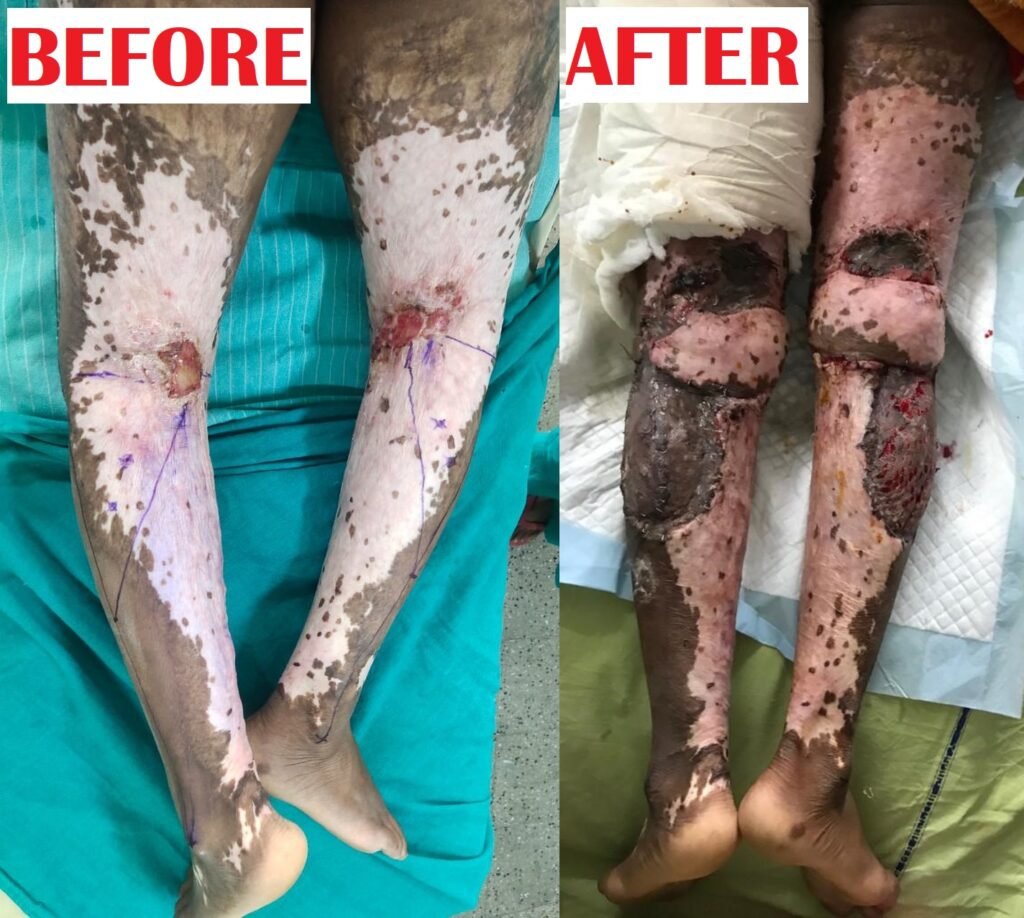
Prof. (Dr.) Souvik Adhikari has academic experience in plastic and reconstructive surgery, including published work relating to burn reconstruction and post-burn contracture management. His research includes the use of perforator flap techniques for reconstruction of post-burn flexion contractures of the knee joint.
This academic experience complements his broader practice in reconstructive surgery, including scar contracture release, skin grafting and tissue reconstruction.
Read more: Research & Publications
Gallery
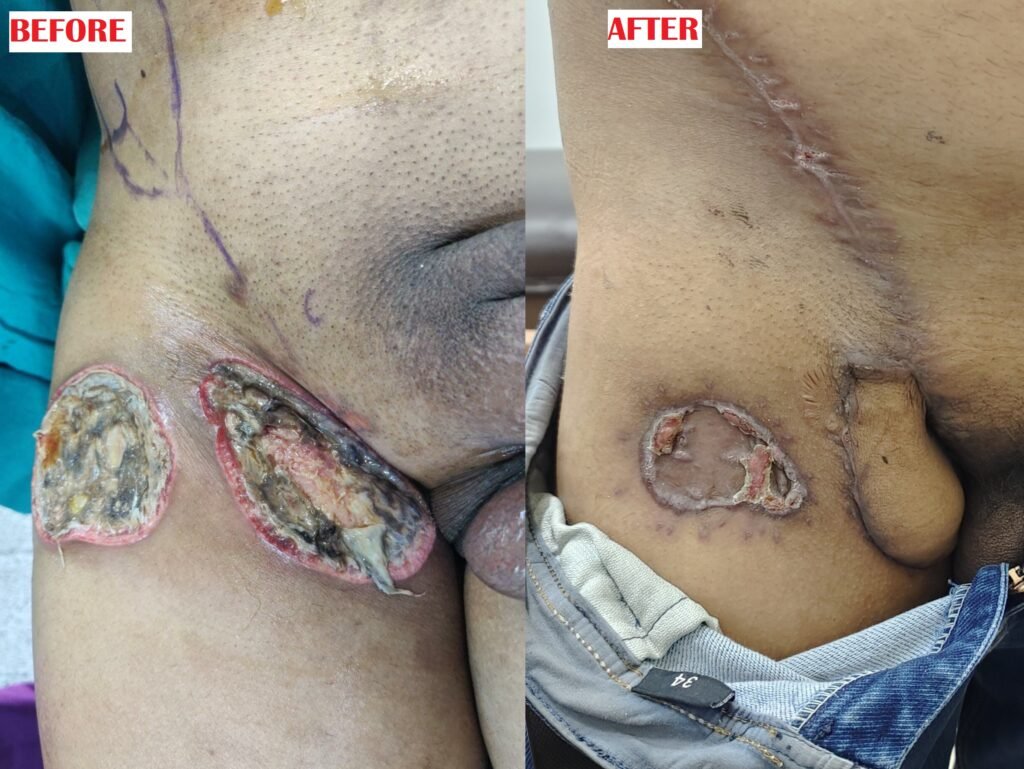
Consented before-and-after photographs for burn reconstruction are reviewed privately during consultation, in line with medical advertising guidelines.
Frequently Asked Questions About Burn Reconstruction in Kolkata
1. What is burn reconstruction surgery?
Burn reconstruction is a group of surgical procedures used to restore function, movement, skin coverage and appearance after a burn injury. Depending on the nature of the injury, reconstruction may involve scar release, skin grafting, flap reconstruction, scar revision or other procedures. Treatment is individualized according to the location, depth and extent of the burn and the problems caused by the resulting scars.
2. When is burn reconstruction needed?
Burn reconstruction may be considered when healed burn scars cause restricted movement, tightness, functional problems, significant contour deformity or concerns about appearance. Reconstruction may also be required when a wound has failed to heal adequately or when damaged tissue needs to be replaced with healthy tissue.
3. Can burn scar contractures be treated with surgery?
Yes. Burn scar contractures can sometimes restrict movement across joints or distort nearby structures. Surgical scar release can loosen the contracted tissue and may be followed by skin grafting or flap reconstruction to provide adequate coverage and reduce the risk of recurrent tightening.
4. Can burn reconstruction improve movement?
One of the important objectives of reconstructive surgery is to restore or improve function. When a tight burn scar restricts movement of the neck, hand, arm, leg or another body part, releasing the contracture and providing appropriate tissue coverage may improve mobility. Physiotherapy and rehabilitation are often an important part of the overall recovery.
5. What types of burn reconstruction procedures are available?
Depending on the injury, reconstruction may involve scar release, split-thickness or full-thickness skin grafting, local or regional flap reconstruction, revision of problematic scars, and other reconstructive techniques. More complex injuries may require staged procedures rather than a single operation.
6. When is a skin graft required after a burn?
Skin grafting may be required when a burn is too deep to heal adequately on its own or when scar tissue needs to be released and sufficient healthy skin is not available for direct closure. The choice between different types of grafts depends on the size, location and functional requirements of the reconstructed area.
7. What is the difference between a skin graft and a flap in burn reconstruction?
A skin graft consists of skin transferred from a donor site to cover a prepared wound, while a flap transfers tissue with its own blood supply. Flaps may be particularly useful when deeper structures need coverage or when a durable, well-vascularized tissue replacement is required. The choice depends on the depth and location of the defect and the reconstructive objective.
8. Can burn reconstruction be performed on the face?
Yes. Facial burn reconstruction may address scar contractures, distorted facial contours, restricted movement and other post-burn changes. Reconstruction of the face requires particular attention to facial proportions, skin quality, function and aesthetic appearance.
9. Can burn reconstruction treat neck contractures?
Yes. Severe burn scars around the neck can restrict neck movement and may produce significant functional and cosmetic deformity. Contracture release followed by appropriate skin or tissue reconstruction may help restore neck movement and improve the contour of the affected area.
10. Can burn reconstruction improve hand function?
Burn scars involving the hand or fingers can restrict movement and interfere with important daily activities. Reconstruction may involve contracture release, skin grafting or flap coverage, depending on the structures involved. Rehabilitation and hand therapy are important components of functional recovery.
11. Can burn reconstruction be performed after many years?
Yes. Burn reconstruction does not necessarily have to be performed immediately after the original injury. Patients may seek reconstructive treatment months or even years later for persistent scar contractures, restricted movement, contour deformities or other long-term effects of burns.
12. How long should I wait before having burn reconstruction?
There is no single waiting period that applies to every patient. The appropriate timing depends on whether the burn is still healing, the condition and maturity of the scar, the presence of functional restriction, the patient’s general health and the reconstructive problem being addressed. Some problems require earlier intervention, while other scar revisions are planned after the tissues have stabilized.
13. Can burn reconstruction require more than one surgery?
Yes. Extensive burn injuries may require staged reconstruction. Different problems may need to be addressed separately, and additional procedures may sometimes be necessary to improve function, coverage or contour. Burn reconstruction is therefore often planned as a treatment pathway rather than as a single operation.
14. Will burn reconstruction completely remove the scar?
No. Reconstructive surgery can improve the quality, position, tightness or appearance of burn scars, but it cannot guarantee complete removal of a scar. The aim is often to make the scar less restrictive, improve function and create a more favorable contour while recognizing that some visible scarring may remain.
15. Can burn reconstruction improve the appearance of old burn scars?
In selected patients, reconstructive surgery can improve the contour, tightness and appearance of established burn scars. Depending on the scar, treatment may involve surgical scar revision, contracture release, grafting, flap reconstruction or other scar-management approaches. Some patients may also benefit from nonsurgical scar treatments as part of a broader treatment plan.
16. What are the risks of burn reconstruction surgery?
Potential risks include bleeding, infection, wound-healing problems, graft loss, flap-related complications, recurrent contracture, unfavorable scarring, altered sensation and the possibility of requiring additional surgery. The risks vary considerably according to the location and complexity of the reconstruction and the condition of the scarred tissues.
17. How long does recovery take after burn reconstruction?
Recovery depends on the type and extent of reconstruction. Healing after a relatively limited scar revision may be different from recovery following extensive contracture release, skin grafting or flap reconstruction. Wound care, activity modification and rehabilitation may continue for several weeks or longer, depending on the individual case.
18. Is physiotherapy necessary after burn reconstruction?
Physiotherapy or occupational therapy may be an important part of recovery, particularly when reconstruction involves a joint, hand, neck or another area where movement has been restricted by burn scarring. Rehabilitation helps maintain the movement gained through reconstruction and supports return to normal activities.
19. Can burn reconstruction be performed after a skin graft?
Yes. Previous skin grafting does not necessarily prevent further reconstructive surgery. Persistent contractures, contour problems or other functional concerns may sometimes require additional scar release, graft revision or flap reconstruction. The condition of the graft and surrounding tissues is assessed before deciding on further treatment.
20. How much does burn reconstruction cost in Kolkata?
The cost varies considerably depending on the location and extent of the burn-related deformity, the type of reconstruction required, whether a skin graft or flap is necessary, the complexity of surgery, anaesthesia, facility charges and postoperative care. An individualized estimate can be provided after clinical assessment and discussion of the reconstructive plan.
21. Can burn reconstruction improve both function and appearance?
Yes. Functional restoration is often an important priority, particularly when burn scars restrict movement or interfere with normal activities. At the same time, reconstruction can address contour, scar position and other visible deformities. The balance between functional and aesthetic goals is individualized for each patient.
22. When should I consult a plastic surgeon for burn reconstruction in Kolkata?
A consultation may be appropriate when a healed burn has resulted in restricted movement, scar contracture, persistent wound problems, significant contour deformity or concerns about appearance. Early assessment can help identify whether reconstructive surgery, scar management, rehabilitation or a combination of approaches would be appropriate.
Honest assessment, written estimate, no pressure to book.