Trauma reconstruction in Kolkata is a specialised branch of plastic and reconstructive surgery focused on restoring function, structure and appearance after serious injuries. Accidents, road traffic injuries, falls, workplace injuries, burns and other forms of trauma can cause extensive damage to the skin, soft tissues, muscles, nerves and underlying structures. Reconstructive surgery can help repair these defects and support recovery while aiming for the most natural and functional result possible.
Trauma Reconstruction Surgery in Kolkata
Trauma reconstruction surgery in Kolkata is individually planned according to the nature and extent of the injury. Depending on the defect, reconstruction may involve wound debridement, skin grafting, local or regional flap surgery, soft-tissue reconstruction and scar revision. Complex injuries may require staged reconstruction, particularly when there is significant tissue loss, infection or damage to important anatomical structures.
Facial Trauma Reconstruction in Kolkata
Facial trauma reconstruction requires particular precision because injuries to the face can affect both appearance and essential functions. Trauma involving the nose, eyelids, lips, cheeks, forehead or ears may result in tissue loss, scarring or distortion of normal facial structures. Reconstructive procedures can help restore facial contours while protecting important functions such as eyelid closure, nasal breathing and normal mouth movement.
Soft Tissue and Skin Loss After Trauma
Severe trauma can result in significant loss of skin and soft tissue, leaving exposed structures that require appropriate coverage. Depending on the location and size of the defect, reconstructive options may include skin grafting or flap surgery. A flap uses tissue with its blood supply to provide more substantial coverage when a simple skin graft is not adequate. The appropriate technique is selected according to the injury and surrounding tissue condition.
Hand and Limb Trauma Reconstruction
Injuries involving the hands, fingers, arms and legs can have a major impact on mobility and daily activities. Reconstructive surgery may be required when trauma results in significant tissue loss, exposed tendons, bones or joints, or functional deformity. The objective is to provide durable soft-tissue coverage and, where possible, preserve or restore useful function. Rehabilitation and physiotherapy may form an important part of recovery.
Scar Revision and Post-Trauma Reconstruction
Once an injury has healed, some patients may be left with prominent scars, contractures, contour deformities or restricted movement. Post-traumatic scar revision can improve the appearance and, in selected cases, the function of the affected area. Depending on the scar and deformity, treatment may involve surgical scar revision, contracture release, tissue rearrangement or grafting.
Personalised Trauma Reconstruction in Kolkata
Every traumatic injury is different, and reconstruction must take into account the location, depth and extent of tissue damage, previous operations, infection, scarring and functional requirements. Some injuries can be reconstructed in a single stage, while more complex defects may require multiple procedures. A detailed assessment allows the reconstructive plan to be tailored to the patient’s individual circumstances and recovery goals.
Trauma Reconstruction by Prof. (Dr.) Souvik Adhikari
Prof. (Dr.) Souvik Adhikari is a Professor and Consultant Plastic Surgeon with 17+ years of independent surgical experience. His background includes an MCh in Plastic & Reconstructive Surgery, academic teaching experience and an AOCMF Fellowship at Johns Hopkins University.
His experience in reconstructive surgery includes the management of complex soft-tissue injuries, hand trauma, tissue defects and reconstructive problems requiring careful restoration of both function and form.
Recovery After Trauma Reconstruction
Recovery following trauma reconstruction surgery in Kolkata depends on the severity of the original injury and the type of reconstruction performed. Patients may require wound care, physiotherapy, splinting, scar management or staged procedures depending on the affected area. Regular follow-up is important to monitor healing, functional recovery and the development of scars or other complications.
If you are searching for trauma reconstruction in Kolkata following an accident, injury or significant tissue loss, a specialist reconstructive consultation can help determine the most appropriate treatment pathway. The goal is to restore damaged tissue, protect important structures, improve function and reconstruct a natural-looking contour while supporting long-term recovery.
Trauma Reconstruction After Road Traffic and Complex Injuries
Road traffic accidents, industrial injuries, falls and other high-energy trauma can cause complex damage involving the skin, soft tissues, tendons, nerves, bones and joints. Some injuries result in tissue loss or expose important structures that cannot be safely covered with simple wound closure alone.
Trauma reconstruction may therefore require techniques such as wound debridement, skin grafting, local or regional flap reconstruction and other forms of soft-tissue coverage. In more complex injuries, reconstruction may need to be staged according to tissue viability, contamination, infection, associated injuries and the overall condition of the patient.
The reconstructive objective is not simply to close a wound. Appropriate treatment aims to provide durable tissue coverage, protect important underlying structures and, where possible, preserve or restore useful function.
Hand Trauma and Blast Injury Reconstruction
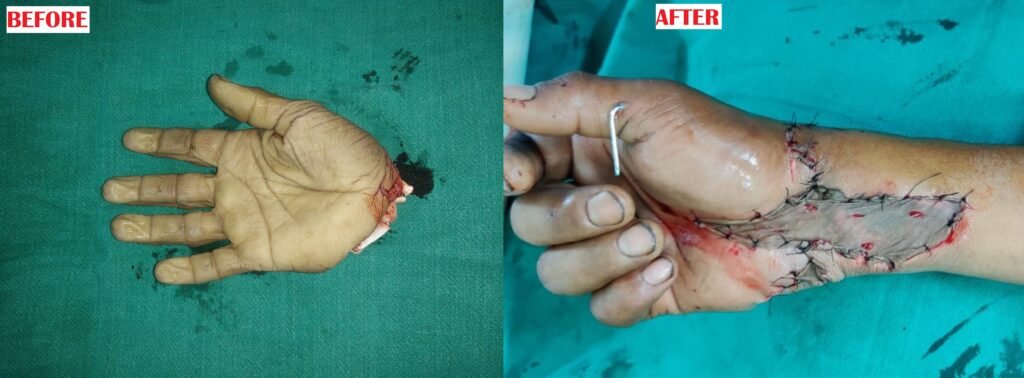
Hand injuries can result from road traffic accidents, machinery injuries, industrial trauma, burns and blast-related injuries. Depending on the mechanism and severity of injury, damage may involve the skin, soft tissues, tendons, nerves, blood vessels, bones and joints.
Complex hand trauma may require a staged reconstructive approach aimed at preserving viable tissue, providing appropriate soft-tissue coverage and, where possible, restoring useful movement and function. Treatment may include wound debridement, repair of injured structures, skin grafting, local or regional flap reconstruction and subsequent scar or contracture correction.
Blast injuries can produce particularly complex patterns of tissue damage because of the combined effects of the explosive force, penetrating material, contamination and tissue destruction. Careful assessment of the extent of injury is important when planning reconstruction, and treatment may require more than one stage depending on tissue viability and functional requirements.
Rehabilitation, splinting and physiotherapy can be essential components of recovery following complex hand trauma. The reconstructive objective is not simply wound closure, but the restoration of durable tissue coverage and the maximum achievable useful hand function.
Prof. (Dr.) Souvik Adhikari has published peer-reviewed research on Blast Injuries to the Hand: Pathomechanics, Patterns and Treatment, reflecting academic involvement in the understanding and management of complex hand trauma.
Reconstruction of Lower Leg Soft-Tissue Defects
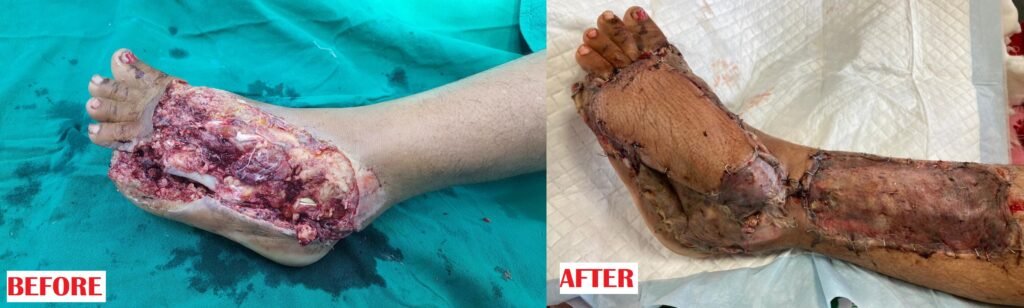
Trauma involving the lower leg can result in soft-tissue loss with exposure of underlying structures such as bone or tendons. Reconstruction can be particularly challenging in the lower third of the leg because the available local soft-tissue coverage may be limited.
Depending on the size, location and depth of the defect, reconstruction may involve skin grafting, local or regional flap techniques or other reconstructive approaches. The choice of procedure depends on the condition of the wound, surrounding tissues, blood supply, exposed structures and the patient’s overall clinical circumstances.
Prof. (Dr.) Souvik Adhikari has also contributed to published academic work examining different surgical options in the management of lower-third leg defects, a topic directly relevant to complex lower-limb soft-tissue reconstruction.
Individualised Planning for Trauma Reconstruction
Trauma reconstruction is planned according to the nature of the original injury, the tissues involved, the extent of tissue loss and the functional requirements of the affected area. Unlike many elective procedures, traumatic injuries can vary greatly in severity and may involve skin, subcutaneous tissue, muscle, tendons, nerves, blood vessels, bones or joints.
The reconstructive plan takes into account wound condition, tissue viability, blood supply, contamination or infection, previous operations, scarring and the need to protect important anatomical structures. Some injuries can be treated with a single reconstructive procedure, while complex defects may require staged treatment.
Who May Need Trauma Reconstruction?
Trauma reconstruction may be considered for patients with:
- Significant skin or soft-tissue loss following an accident or injury
- Complex wounds that cannot be closed safely with simple wound repair
- Exposed bone, tendon, joint or other important structures
- Facial injuries associated with tissue loss, scarring or deformity
- Hand or limb injuries affecting soft-tissue coverage or function
- Post-traumatic scars or contractures causing restricted movement
- Persistent contour deformities following healing of an injury
- Lower-limb or other extremity defects requiring specialised soft-tissue coverage
The appropriate treatment depends on the individual injury and the patient’s current clinical condition.
Reconstructive Options After Trauma
Trauma reconstruction may involve one or more techniques depending on the defect. These can include:
- Wound debridement and preparation
- Skin grafting
- Local tissue rearrangement
- Local or regional flap reconstruction
- Soft-tissue reconstruction
- Scar revision
- Contracture release
- Staged reconstruction
- Rehabilitation and scar management as part of longer-term recovery
Not every technique is appropriate for every injury. The reconstructive approach is selected according to the tissue defect and functional requirements.
Skin Grafting After Trauma
Skin grafting may be used to cover appropriately prepared wounds where the wound bed has sufficient blood supply and the underlying structures are suitable for graft coverage.
A skin graft may not provide adequate reconstruction when bone, tendon or other poorly vascularised structures are exposed. In such situations, more substantial soft-tissue coverage may be required.
Flap Reconstruction for Complex Tissue Defects
A flap transfers living tissue with its own blood supply to cover or reconstruct a defect. Flap reconstruction may be considered when important structures require durable coverage or when the defect cannot be adequately managed with a skin graft.
Depending on the location and requirements of the defect, local or regional flap techniques may be considered. Complex reconstruction is planned individually according to the anatomy, available tissues and reconstructive requirements.
Hand and Limb Trauma Reconstruction
Trauma affecting the hands and limbs can involve multiple tissue layers and may have major functional consequences. Reconstruction may be required to provide soft-tissue coverage, protect exposed structures and support the restoration of useful movement and function.
Prof. (Dr.) Souvik Adhikari has published research on blast injuries to the hand and has academic experience relevant to the assessment and treatment of complex hand trauma. Rehabilitation and physiotherapy may be important components of recovery depending on the injury.
Post-Traumatic Scars and Contractures
Even after the original injury has healed, patients may develop prominent scars, tissue distortion, contour deformities or contractures that restrict movement.
Depending on the problem, reconstruction may involve scar revision, contracture release, tissue rearrangement, skin grafting or other techniques. The objective is to improve function and tissue quality where possible while achieving the best practical improvement in appearance.
Anaesthesia
The type of anaesthesia depends on the location, complexity and duration of reconstruction and the patient’s overall medical condition. Minor procedures may be performed using local or regional anaesthesia, while more extensive reconstruction may require general anaesthesia.
The anaesthetic plan is determined after appropriate surgical and pre-anaesthetic assessment.
Duration of Trauma Reconstruction Surgery
The duration varies considerably according to the type of injury and reconstructive technique. A relatively limited procedure may require less operating time, whereas complex soft-tissue reconstruction or staged procedures can take substantially longer.
The expected duration is discussed once an individual reconstructive plan has been established.
Recovery After Trauma Reconstruction
Recovery depends on the severity of the original injury, the area reconstructed and the technique used. Some patients may require wound care and relatively short-term follow-up, while others may require splinting, physiotherapy, rehabilitation, scar management or staged procedures.
Functional recovery may continue beyond the initial wound-healing period, particularly following injuries involving the hands, limbs or other functionally important areas.
Risks and Possible Complications
The risks of trauma reconstruction depend on the original injury and the procedure performed. Possible complications may include:
- Bleeding or haematoma
- Infection
- Delayed wound healing
- Partial or complete loss of a skin graft or flap
- Persistent swelling
- Changes in sensation
- Scar-related problems
- Contour irregularity or asymmetry
- Recurrent contracture
- Functional limitation
- Need for additional or staged procedures
- Anaesthetic and other medical complications
Individual risks are discussed according to the specific injury and proposed reconstruction.
Results and Realistic Expectations
The outcome of trauma reconstruction depends not only on the reconstructive procedure but also on the severity of the original injury, tissue loss, associated damage and the healing process.
The aim is to restore durable tissue coverage, protect important structures and improve function and appearance where possible. Complete restoration to the pre-injury state cannot always be achieved, particularly after severe trauma, and some patients may require staged procedures or ongoing rehabilitation.
Scars and reconstructed tissues continue to mature over time, and the final functional and aesthetic outcome may take months to become fully apparent.
Consultation for Trauma Reconstruction in Kolkata
A reconstructive consultation includes assessment of the original injury, previous treatment, current wound or scar condition, tissue loss, functional problems and available reconstructive options.
Previous operation records, imaging and photographs of the original injury can be useful where available. Depending on the clinical situation, treatment may involve immediate reconstruction, delayed reconstruction or staged management.
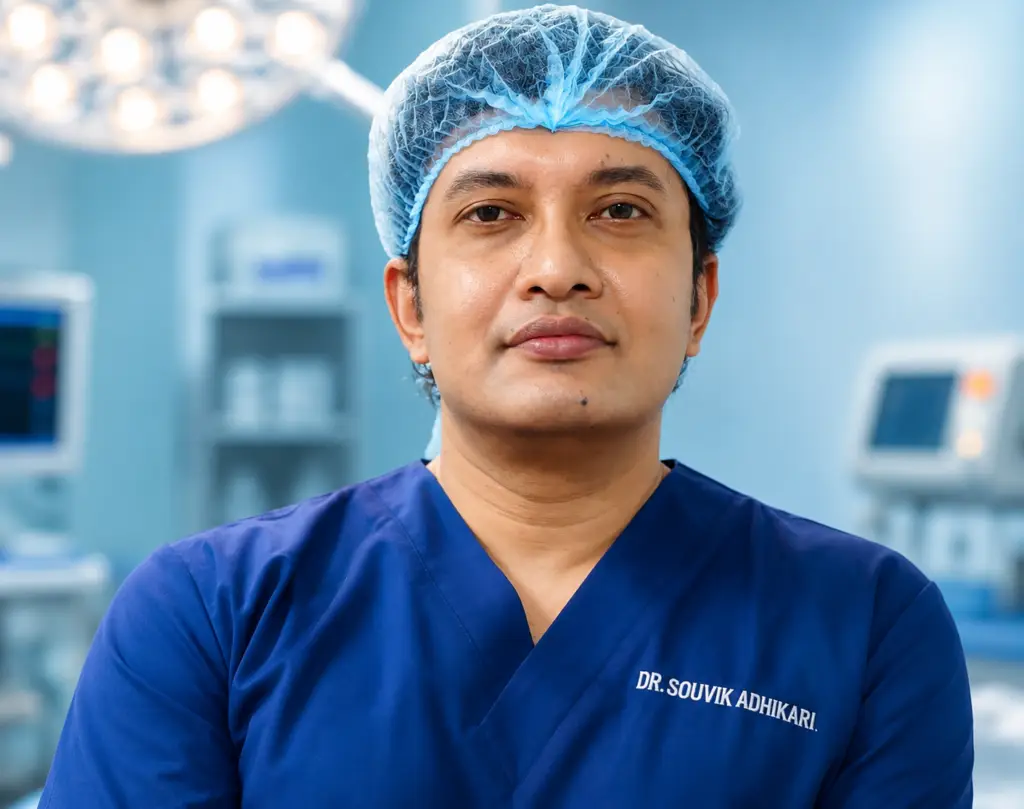
Prof. (Dr.) Souvik Adhikari
MS, MCh (Plastic Surgery)
17+ years experience
Gallery
Consented before-and-after photographs for trauma reconstruction are reviewed privately during consultation, in line with medical advertising guidelines.
Academic Experience in Trauma and Reconstructive Surgery
Prof. (Dr.) Souvik Adhikari’s clinical and academic work includes published research relevant to trauma and complex reconstructive surgery.
His peer-reviewed publication “Blast Injuries to the Hand: Pathomechanics, Patterns and Treatment” examined the patterns and management considerations associated with blast-related hand injuries. His academic work also includes publication on surgical options for lower-third leg defects, a challenging area of soft-tissue reconstruction.
This experience complements his broader work in plastic and reconstructive surgery, including flap-based reconstruction, burn reconstruction, scar management and restoration of form and function following complex tissue injury.
Read more about Prof. (Dr.) Souvik Adhikari’s Research & Publications →
Frequently Asked Questions
What is trauma reconstruction surgery?
Trauma reconstruction is reconstructive plastic surgery performed to restore the form and function of tissues damaged by accidents, burns, falls, industrial injuries, road traffic accidents or other traumatic events. Depending on the injury, reconstruction may involve wound management, skin grafting, flap surgery, tendon or nerve repair, scar revision or correction of post-traumatic deformities.
Who may need trauma reconstruction in Kolkata?
Patients with significant soft-tissue, skin, muscle, tendon, nerve or structural injuries following accidents or other trauma may require reconstructive surgery. The appropriate treatment depends on the location, severity and type of injury and whether functional or aesthetic problems remain after the initial injury.
Can plastic surgery help after an accident?
Yes. Reconstructive plastic surgery can help restore damaged tissues and improve function and appearance following an accident. Treatment may range from relatively simple wound closure or skin grafting to more complex flap-based reconstruction, depending on the injury.
What types of traumatic injuries can be treated with reconstructive surgery?
Trauma reconstruction may be considered for a wide range of injuries, including: Facial and scalp injuries, Hand and finger injuries, Soft-tissue defects, Tendon and nerve injuries, Exposed bone, tendon or joints, Extensive wounds, Burn-related deformities, Post-traumatic scars and contractures, Tissue loss following road traffic or industrial accidents, Selected post-traumatic deformities The reconstructive approach is individualised according to the injured tissues and functional requirements.
What is facial trauma reconstruction?
Facial trauma reconstruction aims to restore damaged facial skin, soft tissues and underlying structures following accidents or other injuries. Depending on the defect, reconstruction may involve meticulous wound repair, skin grafting, local or regional flaps, scar revision or other reconstructive techniques. Because the face is functionally and aesthetically important, reconstruction aims to restore both tissue coverage and appropriate facial contour.
Can trauma reconstruction restore function as well as appearance?
Yes. One of the major objectives of reconstructive plastic surgery is functional restoration, not simply cosmetic improvement. Depending on the injury, reconstruction may aim to improve movement, wound coverage, hand function, facial movement, sensation or other affected functions.
What is the difference between reconstructive and cosmetic plastic surgery?
Reconstructive plastic surgery focuses primarily on restoring tissue form and function affected by trauma, disease, congenital conditions or previous surgery. Cosmetic surgery primarily aims to modify or enhance otherwise normal structures according to a patient's aesthetic goals. Some reconstructive procedures can also provide substantial aesthetic improvement.
Are skin grafts used in trauma reconstruction?
Yes. Skin grafting is an important technique for covering selected traumatic wounds and soft-tissue defects. A thin layer of skin is taken from a suitable donor site and transferred to the injured area. Skin grafts are not appropriate for every wound. The wound bed, depth, location, blood supply and surrounding tissues must be assessed before selecting the reconstructive technique.
When is flap surgery required after an accident?
A flap may be considered when a traumatic defect requires tissue with its own blood supply or when important structures such as bone, tendon, joints or nerves are exposed. Depending on the defect, reconstruction may use local, regional or free flaps. The choice depends on the location and size of the defect, the tissues involved and the patient's overall condition.
Can old accident scars be treated with reconstructive plastic surgery?
Yes. Selected post-traumatic scars can be improved through scar revision surgery or other treatments, particularly when scars are raised, contracted, distorted or associated with functional problems. Scar revision cannot completely erase a scar, but appropriate treatment may improve its appearance, flexibility and relationship with surrounding tissues.
Can trauma reconstruction correct a contracture?
In selected cases, yes. Post-traumatic or burn contractures can restrict movement and may require reconstructive surgery to release the contracted tissue and restore mobility. Depending on the location and severity, treatment may involve scar release, skin grafting, local tissue rearrangement or flap reconstruction.
Can hand injuries be treated with reconstructive plastic surgery?
Complex hand injuries may require specialised reconstructive techniques to restore soft-tissue coverage and, when appropriate, function. Depending on the injury, treatment may involve repair or reconstruction of skin, tendons, nerves and other soft tissues. Early assessment can be particularly important because some injuries become more difficult to reconstruct after significant scarring or tissue loss.
Can nerve or tendon injuries be reconstructed after trauma?
Selected traumatic nerve and tendon injuries can be repaired or reconstructed depending on the nature, location and timing of the injury. Early specialist assessment is important because the treatment options and expected recovery depend on the specific structures involved.
Is trauma reconstruction performed immediately after an accident?
Not always. The timing depends on the patient's overall medical condition, the nature of the injury, contamination or infection, tissue viability and whether urgent wound stabilisation is required. Some injuries require immediate reconstruction, while others are better managed initially with wound care and subsequent definitive reconstruction after the tissues have stabilised.
Can reconstruction be performed after the initial wound has already healed?
Yes. Patients may seek reconstructive surgery months or even years after an injury because of scarring, tissue loss, contracture, deformity or functional limitation. The appropriate treatment depends on the current anatomy and the underlying problem.
Can trauma reconstruction improve facial scars after an accident?
Selected facial scars can be improved with reconstructive techniques such as surgical scar revision, Z-plasty, local tissue rearrangement or other scar-management approaches, depending on the scar's size, direction, thickness, location and effect on facial movement. The goal is improvement rather than complete removal of the scar.
How is the appropriate reconstruction technique selected?
The reconstructive plan is based on several factors, including: Location and size of the defect, Depth of tissue loss, Structures exposed or damaged, Blood supply, Skin and soft-tissue quality, Functional requirements, Existing scars, Previous operations, Overall health and healing factors The objective is to select the simplest reliable reconstructive option that can adequately restore the affected tissue and function.
Will trauma reconstruction leave scars?
Reconstructive surgery necessarily involves incisions or manipulation of tissues and therefore scarring cannot always be avoided. However, incisions and reconstructive techniques are planned to achieve appropriate tissue coverage and, where possible, minimise the visibility and functional effect of scars. Scars continue to mature and change for many months after surgery.
How long does recovery take after trauma reconstruction?
Recovery varies considerably because trauma reconstruction encompasses many different procedures. A relatively small wound reconstruction may have a shorter recovery, while complex flap, hand or multi-tissue reconstruction may require substantially longer healing and rehabilitation. The expected recovery period depends on the specific procedure, the extent of the injury and individual healing.
Is trauma reconstruction in Kolkata suitable for patients from outside West Bengal?
Yes. Patients travelling to Kolkata for reconstructive surgery can discuss their injury, previous treatment and available medical records during an initial consultation. The feasibility of travelling for surgery depends on the complexity of the reconstruction, the patient's medical condition and the postoperative follow-up required.
Can trauma reconstruction be combined with scar revision?
In selected patients, yes. When the primary reconstructive problem has been addressed and the tissues are suitable, scar revision may be incorporated into the reconstructive plan or performed as a later stage. The timing depends on tissue healing and the specific nature of the injury.
What should I bring to a trauma reconstruction consultation?
Previous operation notes, imaging reports, discharge summaries, photographs of the injury during its earlier stages and details of previous procedures can be useful. The surgeon will assess the current wound, scar, tissue loss or deformity and determine what reconstructive options may be appropriate.
Honest assessment, written estimate, no pressure to book.