Revision rhinoplasty in Kolkata is a specialised form of nose surgery performed to address persistent cosmetic concerns, structural problems or functional difficulties following previous rhinoplasty. Also known as secondary rhinoplasty, it requires careful assessment because the normal nasal anatomy may have been altered by earlier surgery, with scar tissue, reduced cartilage support or changes in the nasal framework. The objective is to improve the nose while maintaining or restoring appropriate structure and breathing function wherever possible.
Revision Rhinoplasty Surgery for Cosmetic and Functional Problems
Revision rhinoplasty surgery in Kolkata is often more complex than primary rhinoplasty because the surgeon must work with previously operated nasal tissues. Depending on the individual problem, treatment may involve correction of nasal asymmetry, irregularities of the bridge or tip, loss of structural support, excessive tissue removal or nasal obstruction. In selected cases, cartilage grafts from the septum, ear or other appropriate donor sites may be required to reconstruct and strengthen the nose.
Why Revision Rhinoplasty (Secondary Rhinoplasty) Is Different
Revision rhinoplasty is different from primary rhinoplasty because the nose has already undergone surgery and its original anatomy may have been altered. Scar tissue, changes in the nasal cartilage and bone, reduced structural support and previous tissue removal can make further correction more technically demanding.
Scar Tissue After Previous Rhinoplasty
Scar tissue can alter the normal tissue planes and make surgical dissection more difficult. It may also influence the final contour as the nose heals. The extent of scarring varies between patients and depends on the previous operation and individual healing response.
Reduced or Altered Cartilage Support
Previous rhinoplasty may have removed, repositioned or weakened nasal cartilage. When structural support is inadequate, further reduction may not be appropriate. In selected cases, cartilage grafting may instead be required to restore support and improve the shape or function of the nose.
Structural Reconstruction Rather Than Further Reduction
A revision procedure is not always about making the nose smaller or removing more tissue. In some patients, the priority is to rebuild or strengthen the nasal framework, improve tip support, correct asymmetry or restore the nasal airway.
Individualised Planning Is Essential
The appropriate revision rhinoplasty technique depends on the previous surgery, the remaining nasal framework, scar tissue, skin characteristics, breathing function and the specific concerns that need correction. A detailed examination is therefore essential before deciding whether revision surgery is appropriate.
Who May Need Revision Rhinoplasty?
Patients may consider revision rhinoplasty in Kolkata when they remain dissatisfied with the appearance of their nose after previous surgery or experience functional problems such as persistent nasal blockage. Common concerns include an uneven nasal bridge, pinched or irregular nasal tip, residual hump, over-resection, nasal deviation or insufficient structural support. A detailed examination is essential because the underlying cause must be identified before planning corrective surgery.
Functional and Cosmetic Revision Rhinoplasty
Revision rhinoplasty may address both aesthetic and functional concerns. Previous surgery can sometimes alter the nasal framework in a way that affects airflow, making structural reconstruction an important part of treatment. When appropriate, revision surgery can combine nasal reshaping with functional correction, with the specific approach determined by the patient’s anatomy and symptoms.
Natural-Looking Revision Nose Surgery
The goal of revision nose surgery in Kolkata is not simply to make further changes to the nose. In many cases, restoring structural support and improving proportion are more important than removing additional tissue. Careful planning is required to create a stable nasal framework and a natural-looking appearance. Patients should understand that revision surgery can be technically demanding and that complete correction may not always be possible.
Revision Rhinoplasty by Prof. (Dr.) Souvik Adhikari
Prof. (Dr.) Souvik Adhikari brings 17+ years of surgical experience in cosmetic, plastic and reconstructive surgery, with additional AOCMF Fellowship training at Johns Hopkins University, USA. His approach to revision rhinoplasty in Kolkata focuses on detailed assessment of the previously operated nose, structural planning, meticulous surgical technique and realistic expectations regarding both aesthetic and functional improvement.
Revision Rhinoplasty Recovery and Consultation
Recovery following revision rhinoplasty surgery varies depending on the complexity of reconstruction and whether cartilage grafting or other structural procedures are required. Swelling may persist for longer than after primary rhinoplasty, and the final nasal contour develops gradually as the tissues heal. During consultation, previous operative details, current nasal structure, breathing concerns and aesthetic goals are carefully assessed. The proposed surgical approach, limitations, potential risks and recovery process are discussed in detail.
If you are considering revision rhinoplasty in Kolkata after an unsatisfactory previous nose surgery, a specialist assessment can help identify the underlying structural or cosmetic concerns and determine what improvement may realistically be achieved. The goal is to create a stable, functional and naturally proportioned nose while addressing the specific problems resulting from previous surgery.
Individualised Planning for Revision Rhinoplasty
Revision rhinoplasty requires careful assessment of the nose after previous surgery. The surgical plan is based on the remaining nasal cartilage and bone, scar tissue, skin characteristics, nasal airway, previous operative changes and the specific concerns that need correction. Previous operative notes and photographs can be particularly useful during assessment.
Who May Benefit from Revision Rhinoplasty?
Revision rhinoplasty may be considered for patients who remain concerned about the appearance or function of the nose after previous rhinoplasty. Possible concerns include persistent or recurrent asymmetry, an irregular nasal bridge, tip deformity, excessive narrowing, residual or recurrent dorsal irregularity, inadequate structural support, nasal deviation or breathing difficulty.
Not every postoperative irregularity requires further surgery. In some cases, allowing adequate time for healing is important before deciding whether revision is appropriate.
Revision Rhinoplasty for Nasal Tip Problems
Previous rhinoplasty can sometimes result in a pinched, asymmetric, over-rotated, under-supported or otherwise irregular nasal tip. Depending on the underlying problem, revision surgery may involve repositioning existing cartilage or adding structural cartilage grafts to improve tip support and contour.
Revision Rhinoplasty for a Crooked or Asymmetrical Nose
A crooked or asymmetrical nose after previous surgery may result from residual structural deviation, altered cartilage support, scar tissue or changes during healing. Revision rhinoplasty can address selected structural causes of asymmetry, although complete symmetry cannot always be achieved because healing and tissue characteristics vary between individuals.
Revision Rhinoplasty After Excessive Tissue Removal
When too much cartilage or bone has been removed during an earlier rhinoplasty, further reduction may not be appropriate. In selected patients, reconstructive techniques and cartilage grafting may be used to restore structural support and improve contour.
Cartilage Grafting in Revision Rhinoplasty
Cartilage grafts may be required when the nose needs additional structural support or reconstruction. Depending on the amount and quality of cartilage remaining after previous surgery, graft material may be obtained from the nasal septum, ear or, in selected complex cases, another appropriate donor site such as the rib.
Cartilage grafting is not required in every revision rhinoplasty. The need for grafting can only be determined after examination of the nasal framework.
Revision Rhinoplasty for Breathing Problems
Revision rhinoplasty may have both cosmetic and functional objectives. Previous surgery can sometimes contribute to nasal obstruction by altering the septum, nasal valves or supporting cartilage. When appropriate, structural rhinoplasty may be combined with septal or other functional correction to improve nasal airflow.
Revision Rhinoplasty and Septoplasty
Patients with both external nasal deformity and a deviated nasal septum may sometimes benefit from combining revision rhinoplasty with septoplasty. The appropriate approach depends on the location of the septal deviation, nasal airway and overall nasal structure.
Open or Closed Revision Rhinoplasty
Revision rhinoplasty may be performed through an open or closed approach depending on the complexity of the problem. An open approach can provide greater exposure of the nasal framework and may be useful for complex structural reconstruction, while selected less extensive revisions may be possible through a closed approach.
The approach is chosen according to the patient’s anatomy and the correction required rather than following a routine formula.
Anaesthesia for Revision Rhinoplasty
Revision rhinoplasty is generally performed under anaesthesia appropriate to the planned procedure and the patient’s individual medical assessment. The anaesthetic plan is discussed during preoperative evaluation.
Duration of Revision Rhinoplasty
The duration varies considerably. A limited revision may require substantially less operating time than a complex reconstruction involving cartilage grafting, septal correction or correction of multiple structural problems. A more accurate estimate can be provided after examination and review of the previous surgery.
Recovery After Revision Rhinoplasty
Recovery depends on the extent of revision and whether structural reconstruction or cartilage grafting is required. Swelling, bruising, nasal congestion and tenderness are common during the early healing period.
Revision rhinoplasty may take longer to settle than an uncomplicated primary rhinoplasty. Although important changes may be visible relatively early, swelling and tissue remodelling can continue for many months before the nasal contour stabilises.
Scars After Revision Rhinoplasty
When an open approach is used, a small incision is placed across the columella and normally heals as a fine scar. Closed rhinoplasty uses incisions inside the nose. The appearance of any scar depends on the surgical approach, individual healing and postoperative care.
Risks and Possible Complications
Revision rhinoplasty carries risks including bleeding, infection, persistent swelling, altered sensation, scarring, contour irregularity, asymmetry, breathing difficulty, unsatisfactory aesthetic outcome and the possibility of further surgery.
Because the nose has previously undergone surgery, scar tissue, altered anatomy and reduced cartilage support can make revision procedures more complex. The risks relevant to an individual case are discussed during consultation and informed consent.
Expected Results After Revision Rhinoplasty
The aim of revision rhinoplasty is meaningful improvement in nasal appearance, structure and, when appropriate, breathing function. The result depends on the condition of the tissues, the extent of previous surgery, the reconstructive requirements and individual healing.
Complete correction or perfect symmetry cannot always be guaranteed, particularly in complex revision cases. The objective is to achieve the best realistic improvement while maintaining appropriate nasal structure and function.
Consultation for Revision Rhinoplasty in Kolkata
A detailed consultation is particularly important before revision rhinoplasty. Previous operative notes, photographs from before and after the earlier surgery, relevant medical records and information about any breathing problems can help in assessing the current condition of the nose.
The nasal framework, skin and scar tissue, airway and specific aesthetic concerns are evaluated before discussing whether revision surgery is appropriate and what degree of improvement may realistically be achieved.
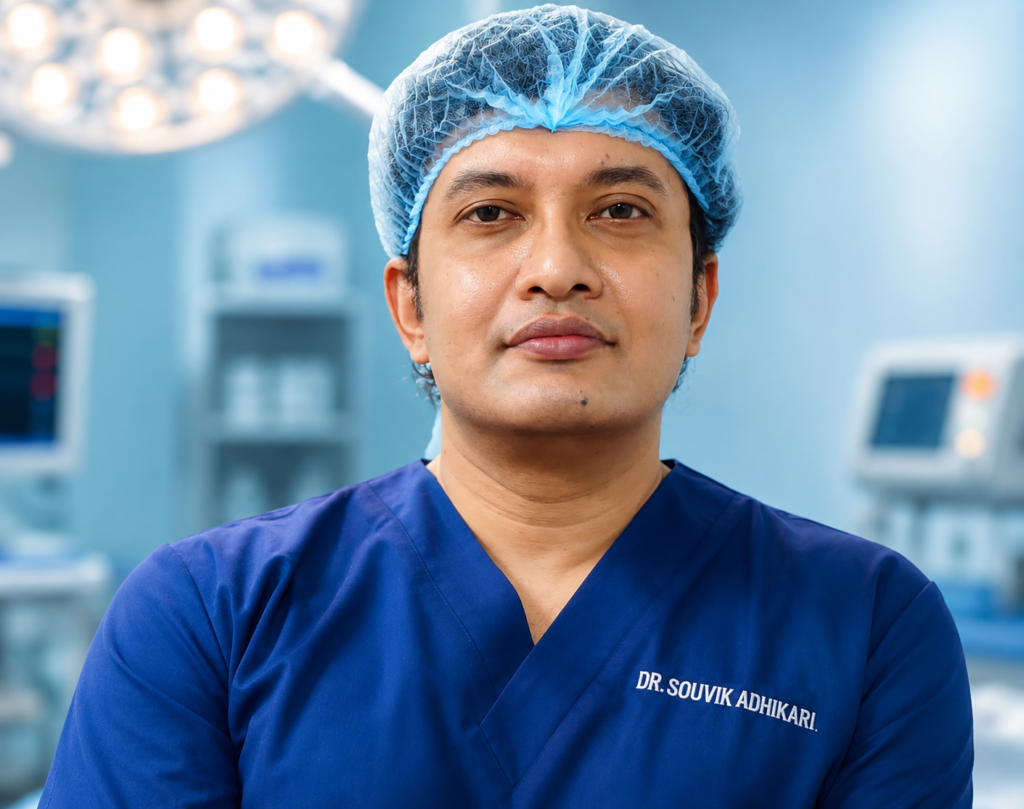
Prof. (Dr.) Souvik Adhikari
MS, MCh (Plastic Surgery)
17+ years experience
Reconstructive Approach to Complex Nasal Problems
Revision rhinoplasty often requires a reconstructive approach when previous surgery has altered the nasal framework or reduced structural support. Careful analysis of cartilage, bone, scar tissue and nasal airway is therefore an important part of planning complex secondary nasal surgery.
Prof. (Dr.) Souvik Adhikari’s practice in plastic and reconstructive surgery includes management of complex structural problems where restoration of form and function are closely interconnected. This reconstructive perspective is particularly relevant when revision rhinoplasty requires structural support, cartilage grafting or correction of functional nasal problems.
For patients with complex nasal deformities, the aim is not simply to perform another cosmetic procedure, but to understand the underlying structural problem and determine what can realistically be improved.
Frequently Asked Questions About Revision Rhinoplasty in Kolkata
1. What is revision rhinoplasty?
Revision rhinoplasty, also called secondary rhinoplasty, is surgery performed to correct or improve problems that persist or develop after a previous rhinoplasty. The concerns may be cosmetic, functional, or both and can include nasal asymmetry, contour irregularities, inadequate tip support, breathing difficulty or changes that have developed during healing. Revision surgery is often more complex than primary rhinoplasty because the normal nasal anatomy may already have been altered.
2. Who may need revision rhinoplasty?
Revision rhinoplasty may be considered when a patient remains dissatisfied with the appearance or function of the nose after previous surgery. Common concerns include persistent asymmetry, an irregular nasal bridge, an under- or over-corrected nasal tip, residual dorsal hump, excessive narrowing, nasal obstruction, scar-related deformity or changes that became apparent as swelling settled.
3. What problems can revision rhinoplasty correct?
Depending on the underlying anatomy, revision rhinoplasty may address nasal asymmetry, residual or recurrent dorsal irregularities, tip deformity, inadequate or excessive tip projection, columellar or nostril irregularities, structural weakness, scar-related contour problems and breathing difficulties. The exact problems that can be corrected depend on the tissues remaining after previous surgery.
4. Can revision rhinoplasty improve breathing?
Yes, revision rhinoplasty can sometimes address functional problems such as nasal obstruction when these are caused by structural abnormalities. Previous surgery may affect the nasal septum, internal or external nasal valves or supporting cartilage. Functional correction may therefore be combined with aesthetic revision when appropriate.
5. How long should I wait before having revision rhinoplasty?
Revision rhinoplasty is generally not performed immediately after primary rhinoplasty because swelling, scar formation and tissue healing can continue for many months. The appropriate interval depends on the original operation, the problem being considered and the extent of healing. In many cases, surgeons wait at least 6–12 months before undertaking definitive revision, although earlier assessment may be appropriate for selected functional or structural problems. The Association of Plastic Surgeons of India advises waiting at least six months to one year for revision after rhinoplasty because swelling and tissue changes may continue during this period.
6. Is revision rhinoplasty more difficult than primary rhinoplasty?
Usually, yes. Previous rhinoplasty can alter the normal cartilage and bone framework and create scar tissue that makes dissection and reconstruction more challenging. There may also be less available cartilage for structural support. For these reasons, revision rhinoplasty requires careful assessment and a surgical plan tailored to the altered anatomy.
7. Will I need cartilage grafts during revision rhinoplasty?
Not every patient requires a cartilage graft, but grafting is commonly considered when additional structural support or reconstruction is needed. Septal cartilage may be available in some patients; when insufficient, cartilage from the ear or rib may sometimes be considered depending on the extent of reconstruction required. The need for grafting can only be determined after examination of the existing nasal framework.
8. Can revision rhinoplasty correct a collapsed or weak nasal tip?
In selected patients, revision rhinoplasty can restore structural support to a weakened or distorted nasal tip. Depending on the cause, treatment may involve repositioning existing cartilage or using structural cartilage grafts. The aim is to improve tip shape and support while maintaining appropriate nasal function.
9. Can revision rhinoplasty correct a crooked or asymmetrical nose?
Revision rhinoplasty can improve structural asymmetry in selected patients. However, perfect symmetry cannot always be achieved because nasal anatomy, skin thickness, scar tissue and healing responses vary between individuals. A realistic goal is meaningful improvement in balance and contour rather than absolute symmetry.
10. Can revision rhinoplasty correct an over-operated or “operated” appearance?
Revision rhinoplasty may improve an unnatural appearance caused by excessive tissue removal, over-narrowing, tip deformity, irregular cartilage contours or loss of structural support. In some cases, reconstruction rather than further reduction is required. The objective is to restore structural balance and create a nose that is harmonious with the rest of the face while preserving function.
11. Can revision rhinoplasty correct problems caused by too much cartilage or bone removal?
In selected cases, structural reconstruction can restore support lost during previous surgery. Cartilage grafts or other reconstructive techniques may be used when additional framework is required. The appropriate method depends on how much native cartilage and bone remain and on the specific deformity.
12. Can revision rhinoplasty correct breathing problems caused by previous surgery?
Yes, when nasal obstruction is related to structural changes caused or left unresolved by previous surgery, revision or functional rhinoplasty may improve airflow. Possible causes include septal deviation, narrowing of the internal nasal valve, external valve collapse or weakened nasal cartilage. A careful examination of both the external and internal nose is necessary before treatment.
13. Can revision rhinoplasty be combined with septoplasty?
Yes. When both external nasal deformity and internal septal deviation contribute to the patient’s concerns, revision rhinoplasty may be combined with septoplasty. The procedures address different aspects of nasal structure, and combining them may be appropriate when both appearance and breathing require correction.
14. Is revision rhinoplasty performed through an open or closed approach?
Revision rhinoplasty can be performed using an open or closed approach depending on the complexity of the problem and the surgeon’s assessment. An open approach provides wider exposure of the nasal framework and may be useful for complex structural reconstruction, while selected less extensive revisions may be possible through a closed approach. The approach is chosen according to the anatomy rather than as a routine rule.
15. How long does revision rhinoplasty take?
The duration varies considerably according to the complexity of the revision. A relatively limited correction may require less operative time than a major structural reconstruction involving cartilage grafting, septal correction or multiple nasal problems. An accurate estimate can be provided after assessing the previous surgery and the current nasal anatomy.
16. What is recovery like after revision rhinoplasty?
Recovery varies according to the extent of reconstruction. Swelling, nasal congestion, bruising and tenderness are common during the early period, while deeper swelling and tissue changes may continue for considerably longer. Revision cases can take longer to settle than uncomplicated primary rhinoplasty, and the final contour may continue to evolve for many months.
17. Are the results of revision rhinoplasty permanent?
Revision rhinoplasty is intended to create a long-lasting structural change, but the final appearance can be influenced by healing, scar formation, ageing and changes in the nasal tissues. Some patients may require additional revision surgery, particularly in complex cases. No surgeon can guarantee a specific cosmetic result.
18. What are the risks of revision rhinoplasty?
Potential risks include bleeding, infection, persistent swelling, altered sensation, scarring, breathing difficulty, asymmetry, contour irregularities, unsatisfactory appearance and the possibility of further surgery. Revision cases may have additional challenges because of previous surgery, scar tissue and altered cartilage support. These risks should be discussed individually during consultation.
19. How much does revision rhinoplasty cost in Kolkata?
The cost of revision rhinoplasty varies considerably according to the complexity of the deformity, the extent of reconstruction, whether cartilage grafting or septal correction is required, the type of anaesthesia and surgical-facility requirements. A personalised estimate is more appropriate than quoting a fixed price before assessing the nose and reviewing the previous surgical history.
20. What should I bring to a revision rhinoplasty consultation?
Previous operative notes, photographs taken before and after the earlier rhinoplasty, medical records, imaging or other relevant reports can be useful. It is also helpful to describe the specific changes you are dissatisfied with and any breathing problems or other symptoms that developed after the previous operation. A detailed examination of the external and internal nose is essential for planning revision surgery.
Honest assessment, written estimate, no pressure to book.